The Ground
Before the first off-lead run, it is worth saying something about the ground itself, because the choice of where to begin this work was not incidental. I own four acres of field and woodland in Mullion, on the Lizard peninsula in Cornwall, with a stream running through the lower edge of the wood. I bought the land with two intentions, both of them serious: to give Falkor a place to learn the shape of the work before he encounters the constraints of a real survey site, and to give the family ground to use for nothing in particular. The two purposes are not in tension. A puppy needs ordinary ground as much as it needs training ground, and the best working dogs are raised on land that is familiar to them long before it is worked. This is that land. Four acres is not vast, but it is enough to contain a meadow, a stretch of streamside, a stand of broadleaf woodland, and the transitions between them — enough variety to teach a young dog that the world is made of different textures, and that the handler is constant across all of them. It is, for the purpose of this journal, the first field.
The First Off-Lead Run
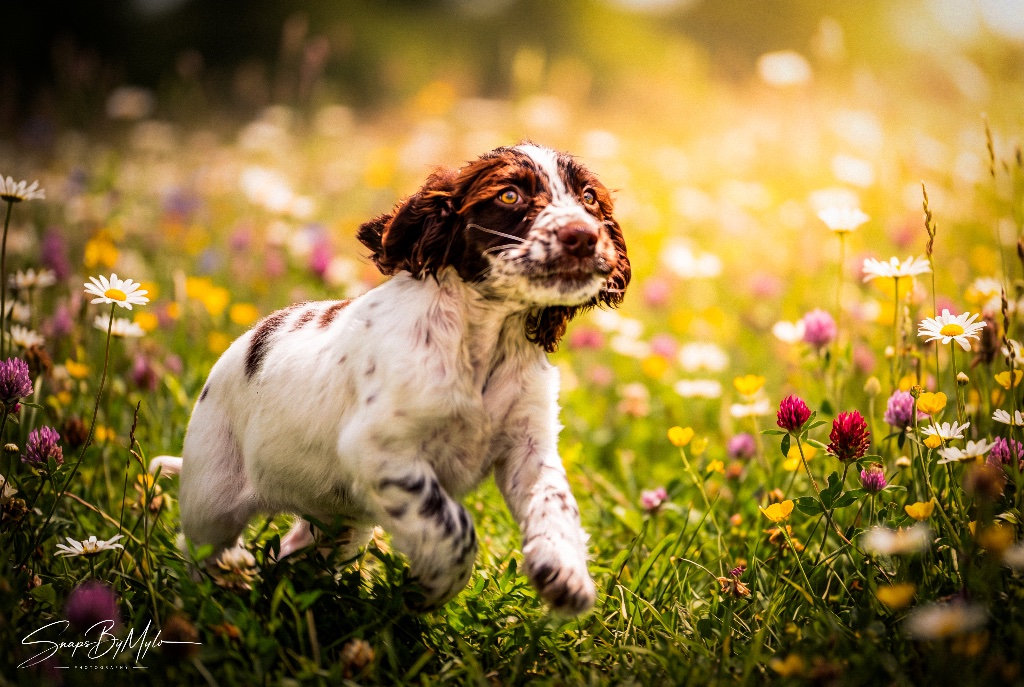
The first time Falkor ran off-lead on the meadow, he moved exactly as the breed standard predicts — low to the ground, ears back, paws striking the clover in the quartering rhythm that is the signature of a working spaniel. He covered the length of the field and turned back in a wide arc. I let him run for about thirty seconds, then called his name and gave the cue he already knew: come. He turned his head, registered the sound, and came back. Not instantly — there was a tussock he was reluctant to leave, and the arc of his return was wider than it needed to be — but he came, and he came because the cue already meant something to him. That is the point worth recording. By the time a puppy runs free for the first time, the recall should not be a new behaviour under test. It should be an established cue, conditioned in low-distraction contexts, now being asked to hold in a more demanding one. The first off-lead run is not where recall begins. It is where recall is first asked to generalise.
The Foundation Cues
It is worth being clear about what was already in place before that first run, because it is the part of the story that is most often skipped. Falkor, at the age we are talking about, already had three reliable cues: come, sit, and wait. None of them were polished. None of them would hold under every distraction. But they were conditioned, consistent, and functional in the contexts in which they had been taught — the house, the garden, the pavement on quiet walks. The work of the first off-lead sessions was not to teach these cues. It was to carry them, intact, into a more stimulating environment, and to begin the long process of making them reliable across the full range of conditions a working dog will eventually encounter.
This is the distinction that matters, and it is easy to misstate. A cue is not a behaviour that exists in the abstract. It is a behaviour conditioned in a context, and it generalises — or fails to — across contexts. A dog that sits reliably in the kitchen will not necessarily sit reliably in a meadow with a pheasant in it. The gap between those two contexts is not a failure of the dog. It is the work to be done. The meadow at Mullion is where that work begins for Falkor: a known cue, a new context, and a handler present to reinforce the cue's meaning when the context threatens to overwhelm it.
Conditioning the Check-In
Even with the foundation cues in place, the check-in still had to be built, and it is a different thing from the recall. Come is a cue I give. The check-in is a rhythm the dog develops on its own — the habit of lifting its head from the work and orientating back to the handler without being asked. A dog that only returns when called is a dog whose attention I have to summon. A dog that checks in on its own is a dog whose attention I already share. The second is the foundation of a working partnership, and it is built, not taught.
We started with constraints: a short line for the first session or two, high-value food reward, and the meadow with no livestock and minimal distraction. I let him range to the edge of comfortable contact — fifteen metres, then twenty — and the moment he lifted his head and orientated back toward me, I marked and rewarded. Then release to range again. The objective was not to suppress the range. It was to make the return the dog's idea, and to make it rewarding enough that it became part of the rhythm rather than an interruption of it.
Within a few sessions the geometry was there: a loose quartering pattern across the wind, with the check-in as the pivot at the end of each pass. It was not always clean. A butterfly undid twenty minutes of work in ten seconds once. But the pattern held and became his. The meadow was teaching him the shape of the work, and I was there to reinforce it.
The Emergency Recall as a Separate Behaviour
It is worth being precise about the difference between the everyday recall and the emergency recall, because both are needed and they are not the same cue. The everyday come is the cue Falkor already had — functional, reliable in familiar contexts, the one I use to bring him back from ordinary ranging. The emergency recall is a distinct cue, and it has to mean one thing without exception: stop whatever you are doing and return to me now, regardless of what you are leaving behind.
I taught it separately, with a cue he only ever hears paired with a high-value outcome. The rule from the first session was absolute: the cue is given, the dog returns, something extraordinary happens — a piece of chicken, a short game, the best thirty seconds of his day. There is no instance of the emergency cue that ends in anything but a strong reward. Because the day I genuinely need it — a road, livestock, something I cannot see but know is wrong — I will not have a second chance to condition it. It has to be established already, and it has to mean, in the dog's experience, that the handler has never once been wrong about this.
By the end of the first month of off-lead work, he had both: the everyday recall he had brought with him from the foundation work, now generalising to the field, and the emergency recall, sharp and distinct, always reinforced. Two different behaviours, two different cues, one shared foundation — the learned expectation that returning to the handler is never a bad outcome.
The Wood and the Stream
The meadow was the first context. The woodland and the stream were the next, and they taught a different set of lessons. The wood is denser, the light broken, the ground uneven underfoot. A dog that quarters confidently in open grass has to learn a different movement in cover — slower, more careful, the head lower, the body adjusted to the obstacles. The stream added water to the equation: the splash, the cold, the moving surface that refracts and confuses. Falkor went through all of it without hesitation, which was the answer I was looking for. The land was bought for exactly this — the controlled introduction of varied terrain, in a place where I know every foot of the ground, before the dog is asked to work it as a survey site rather than explore it as a puppy.
There is something to be said for owning the ground you train on. It removes a class of variable — the unknown dog around the corner, the livestock in the next field, the public footpath that demands a different kind of control — and lets you introduce those variables deliberately, on your own terms, when the dog is ready for them. The four acres in Mullion are not the only ground Falkor will learn on; he will work elsewhere, on rougher country and more sensitive sites, in time. But they are the ground where the foundation is being laid, and there is a real value in that which I did not fully appreciate until I watched him learn his way across it.
Letting the Drive Persist
The temptation with a capable puppy is to ask for too much too soon — to tighten the recall, add precision, begin shaping the control that will matter a year from now. But the meadow and the wood at this age are not formal training contexts. They are where the dog learns that the work is rewarding.
So I let him range. I let him discover that the ground beyond the handler is full of scent and interest, and that the handler is always there when he turns back. I let the drive persist, because the drive is the engine. A spaniel whose drive has been suppressed in the pursuit of early obedience is a spaniel that will not work. A spaniel whose drive has been honoured and woven into a working partnership is a spaniel that will work with full commitment.
The line I try to hold is this: never ask for obedience that costs the dog its engagement with the work. A recall built on punishment is not a recall; it is the gradual erosion of the thing that makes the dog worth training. A recall built on reward and relationship holds under pressure, because it holds for the right reasons. Falkor came when I called, on that first run, not because he had to but because returning to me was already, in his experience, a good outcome. That is the foundation, and it is sound.
The Shape of the Partnership
By the end of that first month of off-lead work, something had changed in how we moved together across the land. Not that he was obedient — he was still a puppy, still capable of ignoring me for a butterfly — but that there was a geometry to it. He would range, turn, check in, range again, and the whole pattern had a structure I had not imposed and could not have invented. It was ours. It was the beginning of a way of working that will carry us, eventually, into the real fieldwork — the surveys, the scent lines, the long days in difficult country. First steps into the field, on ground I chose for this purpose. The real work is only beginning, and the meadow in Mullion is the first of a thousand fields. But the geometry is there, the return is there, the trust is there. For now, that is the foundation, and it is sound.