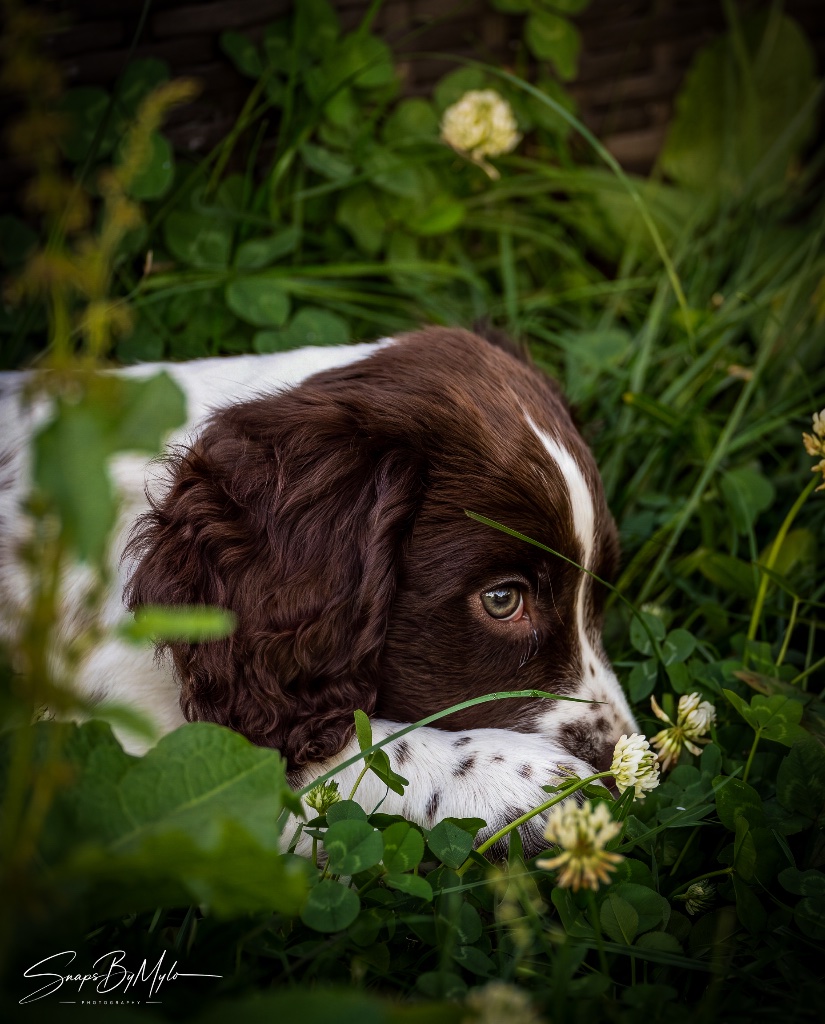
The Arrival
There is a moment, when a working dog first enters the household that will shape the next decade of its life, when the ordinary rhythm of the house simply stops. The kettle goes cold, the phone is set down, and every creature present seems to register that something has changed. This is the effect of a new puppy, and it is not a small thing. What arrived on an afternoon in mid-July was an eight-week-old Cocker Spaniel, liver and white, of working breeding and very little weight, and the first thing I wanted to assess was not how he looked but how he responded to novelty — the single most useful early indicator of whether a dog will hold up in the unpredictable environments conservation work demands.
Falkor belongs to Canis familiaris, the domestic dog, a species whose behavioural plasticity is the product of tens of thousands of years of co-evolution with humans and whose working utility depends almost entirely on that plasticity being preserved through competent early rearing. The first eight weeks with the breeder — the dam, the littermates, the handling, the exposure — are not a prelude to development; they are development itself. The socialisation window, the period between roughly three and fourteen weeks during which a puppy forms its lasting associations with the world, is already more than half spent by the time a working puppy comes home. What the breeder has done, or has not done, in that window is visible in the first hour.
What I saw was a puppy that investigated the kitchen methodically, recovered from a door slamming within seconds, and startled at his own reflection before moving on. None of this is remarkable for a well-socialised animal. Each of it is a useful baseline. A detection dog will spend its working life being asked to remain composed in environments it has never encountered, and the capacity to startle and recover quickly — rather than startle and shut down — is one of the more reliable early predictors of that capacity.
The Name
Falkor is named after the luck dragon from a children's story I was fond of as a boy, and I will not dress that up as anything more significant than it is. For a working dog, however, the name is also the first piece of functional conditioning: the one acoustic signal that means, regardless of context, attend to me. I introduced it from the first evening, consistently, never as a correction and never paired with anything aversive, so that it would acquire a single, unambiguous meaning. Within a week he was orienting to it reliably. A cue, like any conditioned stimulus, functions best when it is clean.
The First Night
The first night was unremarkable, which is itself worth noting. He slept in his crate and settled after a single brief whimper. I mention this not to suggest he is an unusually easy puppy but because it confirmed what I had hoped to see: that his early rearing had been competent. A puppy that has had consistent handling, appropriate exposure, and the steady presence of its dam and littermates during the socialisation period arrives already partly prepared. The work ahead is not to build an animal from nothing. It is to preserve what a good breeder has already established and to add, over time, the specific skills this work requires.
The First Week
The first week was governed by a single principle: let him learn the shape of his environment before anything was asked of it. The reasoning is straightforward. A puppy in the socialisation window is forming lasting associations with everything it encounters, and the quality of those associations will shape its later working behaviour. Novelty introduced at a rate the puppy can process, paired with safety and reward, produces confident adults. Novelty introduced too fast, or paired with fright, produces the kind of generalised anxiety that ends a working dog's career before it begins.
So the week was deliberately quiet. The house came first, then the garden on day three, then the stationary car on day five. Each new exposure was followed by rest and familiar contact. This is not glamorous. It is husbandry. But husbandry done well in the first weeks is the single highest-yield investment you can make in a working dog, because everything built on top of it — the scent work, the indications, the field surveys — depends on a fundamentally settled animal.
Baseline Observations
By the end of the first week I had begun keeping structured notes, the way I would for any field subject. The variables I am tracking in these early weeks are the ones that will determine the shape of his training: response to novelty, recovery from startle, food drive, toy drive, the onset and consistency of hunting behaviour, and the quality of his attention to me in the presence of distraction. Food drive is high and consistent, which makes early foundational training straightforward. Toy drive is present but still developing — he is interested in objects but not yet possessed by them, which is normal for the age and will change. The hunting behaviour appeared at nine weeks: the transition from casual sniffing to focused, nose-down tracking of a specific scent line across the lawn, the tail beating in a steady rhythm. For a Cocker bred from working lines, the early emergence of this behaviour is expected. The instinct is the raw material. Everything over the next eighteen months is about attaching that instinct to specific targets and a reliable indication.
The Programme Ahead
The plan, in broad outline, is the framework used by conservation detection dog programmes the world over, adapted to a single handler and a single dog. The first six months are foundation: recall, settle, environmental confidence, a reliable retrieve, and the beginnings of operant work. The second six months introduce target odours and the indication behaviour — the trained response that tells me, unambiguously, that the dog has located the scent source. After that comes the field phase: generalising the trained behaviour to real survey conditions, building stamina and focus across variable terrain and weather, and eventually deploying on live conservation surveys.
The targets will depend on the survey partners and the conservation need, but the likely applications are the ones this breed is suited to: locating the scat of protected or elusive mammals for population monitoring, detecting the nests of ground-nesting birds during breeding surveys, and assisting with invasive species detection. The dog is a tool — a remarkably effective one — for collecting presence/absence and distribution data that would be difficult or impossible to gather by human survey alone. Used well, he will generate data that feeds directly into conservation decision-making. That is the point of all of this. The puppy on the kitchen floor is, in a real sense, a field instrument, and the next two years are the process of calibrating him.
Why a Journal
I am keeping this journal for the same reason I keep field notes on any long-term project: because the work is incremental, the progress is not always visible day to day, and the discipline of recording it honestly is what keeps the work honest. There will be setbacks. There will be periods where progress plateaus and the temptation is to push harder, or to construct a narrative of steady improvement. Neither helps. What helps is the record. This is the first entry. Falkor is eight weeks old, asleep in a patch of afternoon sun, with a sound temperament, a competent early start, and a clear programme of work ahead of him. The rest is time, consistency, and the willingness to adjust the plan when the dog in front of me is not the dog I imagined. That, more or less, is how all fieldwork goes.