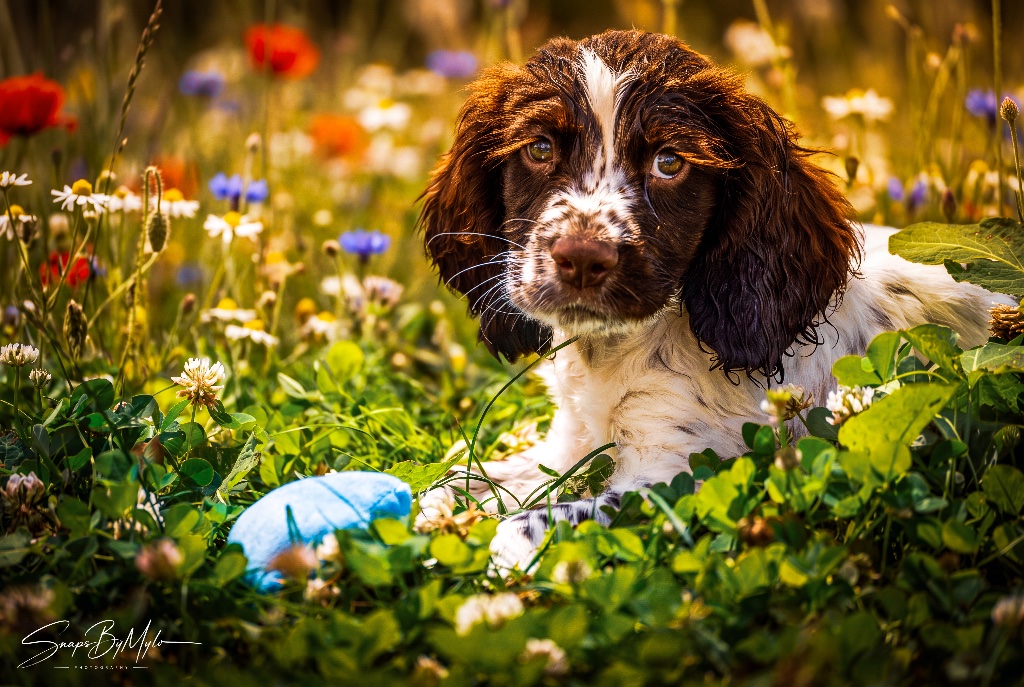
The Retrieve Toy
There is a blue toy in the grass. It is small, slightly squashed, and entirely ordinary. At eleven weeks, it is also one of the most functional training tools Falkor has. I did not buy it as a training aid. I bought it because a puppy needs something to carry around the house. But watching him seek it out in the meadow, pick it up, carry it back, and offer it with his tail going, I realised I was watching the first repetition of three behaviours at once, none of which I had planned to train that afternoon. This is how it works with working dogs. The lessons that matter most are rarely the ones you set out to deliver. They arrive as play. The blue toy is not a training exercise. It is a toy. And because it is a toy, it is the best training tool I have.
The Retrieve Begins With Motivation
A detection dog that will not hold, carry, and release an article on cue cannot work. The formal retrieve — sit, hold, carry, deliver to hand — comes later, built on precision and many repetitions in which the dog is asked to do something it does not, in the moment, particularly want to do. But the motivation to pick something up and bring it back starts here, in a field, with a toy, for no reason at all.
When Falkor finds the toy in the clover and carries it to me, he is not performing a retrieve. He is rehearsing the full cycle — search, find, hold, return, release — because the behaviour itself is reinforcing. That motivation is the foundation every formal exercise will be built on. The formal retrieve, when it comes, will not be a new behaviour imposed on a reluctant dog. It will be the shaping of a behaviour the dog already offers and already finds rewarding. This is the principle I keep returning to: condition the motivation first, and the form follows. A dog that wants to retrieve will tolerate the precision. A dog precision-trained into a retrieve it does not want will perform it under pressure and abandon it when the pressure is off. The toy is not teaching Falkor to retrieve. It is teaching him to want to retrieve. That is worth a hundred formal sessions.
Environmental Confidence Through Play
Look at the photograph again. The toy sits in the foreground, half-buried in clover. Falkor has walked through the wildflowers to reach it, crossed unfamiliar substrate, and settled in a field of moving light, scent, and the small disturbances of insects and wind. None of it inhibited him. He moved through it as though it were familiar ground, found the toy, picked it up, and returned. That is not accidental, and it is not nothing.
Every session that begins with a simple find-the-toy game in a new environment is a session that teaches a puppy the world is navigable — that new ground is interesting rather than threatening, that the handler standing at the edge of it is a secure base, and that ranging out and returning is both permitted and reinforced. Environmental confidence is not produced by exposure alone; a puppy flooded with overwhelming stimuli does not become confident, it becomes shut down. It is produced by the accumulation of many small, successful exposures, each met with the handler's steady presence and a familiar reward. The toy is the bridge — the known object in the unknown place, the item that signals that this too is safe.
Search as a Rehearsed Behaviour
There is a moment in every find-the-toy session I have come to watch for: the moment Falkor loses sight of the toy in the grass and has to locate it by scent. His head drops. The nose engages. The tail, which had been a question mark, becomes a metronome. He works the scent cone — casting left, casting right, narrowing — then locks on, and the body follows the nose into the clover. The toy is found. The tail accelerates.
He does not know he is learning to search. He thinks he is finding his toy. But the behaviour he is rehearsing — nose down, work the scent, persist to source — is the single most important behaviour a detection dog will perform. Every survey, every scent line, every indication on a target odour is built on this: the willingness to put the nose down and work a scent to its source, in cover, in wind, against distraction. Here he is, at eleven weeks, doing it for a toy, for free.
I have not introduced a target odour. I have not asked for an indication. I have not put a line on him or given a cue. I have thrown a toy into grass and let him find it. In doing so I have let him rehearse the most fundamental behaviour of his future working life, in its purest and most reinforcing form, before he has any idea it is work.
The Shared Find
Here is what is often missed about detection work: it is not, ultimately, about the nose. The nose is the instrument; the relationship is what makes the instrument usable. A dog that will work a scent line for an hour in difficult conditions — cold, wet, dense cover, past the scent of deer and rabbit and every other stimulus the world offers — is a dog that trusts the handler values what it is doing. That trust is not built on the training ground. It is built in the play that precedes it.
When Falkor brings the toy back and drops it at my feet and looks up, he is asking a question: was that good, are we doing this together, was the find ours? Every time I answer yes — with another throw, a word, a hand on his head, a game that restarts — I am establishing something he will carry into the real work: that the find is shared, that bringing it back is the correct outcome, that the handler is the destination of the behaviour, not a competitor for the prize. A detection dog that has learned in play that the find belongs to the team is a dog that will indicate honestly when the work is real — that will communicate what it has found rather than hoarding it or losing interest when the immediate reward is absent. The toy dropped at my feet is the first draft of an indication: I found it, it is yours, now we finish it together.
Release Before Retrieve
There is one small discipline I insist on even in the play: the toy is released, not taken by force. From the first session, the rule has been that the game restarts when the dog lets go, not when the handler pries the object free. If he wants the next throw, he has to give it up. I do not correct him for holding. I do not force his mouth open. I wait. I become uninteresting. The moment he releases — which, early on, he does because the next throw is more reinforcing than the current hold — the toy goes again. This is the seed of the formal release cue, and of something larger: the understanding that the handler is not a competitor for the article. A good many working dogs are compromised early by handlers who turn the retrieve into a contest — who teach, unintentionally, that the handler also wants the object and that releasing it means losing. A dog that has learned to guard the retrieve from the handler will guard the find from the handler, and a detection dog that guards the find cannot communicate it. The release, conditioned as a gateway to more reinforcement rather than a loss, is the correction. It teaches that handing the handler the thing is never the end of something good. It is always the start.
Why Play Comes First
I keep returning to the photograph, and to the small object at its centre. The blue toy will not last — it is already losing an ear, and the squeaker failed a week ago. It will be replaced by other toys, then dummies, then scent articles, then the real targets of the real work. But the lesson it carried will outlast all of them, because the lesson is not about the toy. It is about the relationship between dog, handler, finding, and returning: the full cycle of detection work — search, find, hold, return, release, reinforce — learned not as a chain of commands but as a game two animals play because both want to. Play is the first lesson, and it is the most important, not because it teaches any single behaviour but because it establishes the premise on which every future behaviour depends: that the work is cooperative, that the handler is worth returning to, that the find is the beginning of reinforcement rather than the end of it. Get that right in the meadow, with a toy, at eleven weeks, and the rest is technique. Get it wrong, and no volume of formal training will recover it. So I will keep throwing the toy, keep waiting for the release, keep reinforcing the return. The toy will go. The lesson will stay.