The Photograph
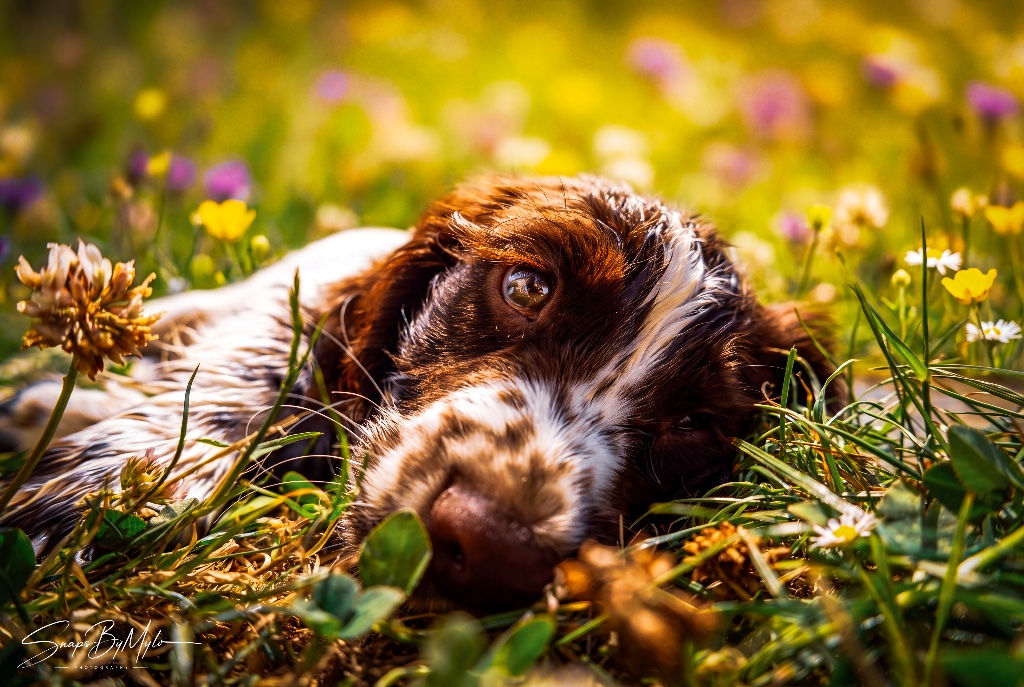
There is a photograph I keep returning to — Falkor at ten weeks, lying in a meadow of clover and daisies, chin on the grass, watching the last of the afternoon light. He is not doing anything. There is no behaviour to capture, no training in progress. He is simply settled. By the standards of the photographs I usually make, it is unremarkable. But I have looked at it more often than any image I have made of him since, because it records something I do not want to lose sight of in the work ahead: before the training, before the scent work, before any field deployment, there are the still periods. And the quality of a working dog's calm, built in these early unstructured weeks, is the substrate everything else is built on.
The Urge to Fill the Days
It is easy, in the first weeks of a puppy intended for work, to fill every day with plans — socialisation schedules keyed to the critical window, bite-inhibition drills, crate conditioning, the hundred small foundations a detection dog needs before formal training begins. I have made these schedules. I have colour-coded them. I have felt the familiar low-grade anxiety that if a developmental window closes unmet it will not reopen. That anxiety is not unfounded; the socialisation period is finite, and a puppy underexposed to the world by fourteen weeks will spend its life catching up.
I am not arguing against planning. I am arguing for what sits beneath the plan. What the quiet meadow sessions have reinforced is that the foundation of a conservation dog is not laid in the doing. It is laid in the periods of low-demand exposure in which a puppy learns, before anything is asked of it, that the world is a safe place to occupy.
Settling Is a Trained Variable
A detection dog's most valuable trait is not its nose — every dog has a nose, and most are extraordinary. It is the ability to hold a calm, alert state in a disordered environment: to lie at the edge of a survey site while the handler confers with a partner, to wait in a vehicle between transects, to hold position at the edge of a wood while the wind shifts and the correct scent cone takes time to arrive. The dog that cannot do this — that fidgets, vocalises, or breaks position because stillness is aversive — cannot work, however good its nose.
Settling is not a single behaviour you drill in a session. There is no cue that produces it reliably under pressure if the underlying emotional state is agitated. It is a conditioned capacity, built through repetition, in which the dog learns that stillness paired with the handler's presence is safe and occasionally rewarding. Five minutes sitting on the lawn before a walk, doing nothing. The pause at the door before going inside. The hand on his side while he falls asleep. None of it looks like training. All of it is.
The photograph records a puppy already learning that stillness is not a punishment but a resting state. That is not a trick to add later. It is the substrate on which every formal behaviour will be conditioned.
What the Data Shows
Among working dog handlers there is a recurring temptation to measure a puppy by how quickly it learns, how much drive it displays, how early the breed-specific instincts emerge. Those variables matter, eventually. But a puppy that is constantly stimulated in the first months — constantly worked, constantly asked to perform — is often the dog that struggles later, not from a lack of intelligence but because it never learned to regulate arousal. A dog that cannot come down from a high-arousal state cannot perform the sustained, focused searching that detection work requires.
Conservation detection is, in practice, long stretches of low-intensity searching punctuated by brief, high-intensity moments at the target. The dog that lives at high arousal burns out the focus before the useful work is done. The dog that can move between settled and searching — that can up-regulate for the search and down-regulate for the wait — is the dog that holds up across a full survey day. That capacity is built in the quiet early weeks, and it cannot be rushed.
Why This Matters in the Field
Months from now, Falkor will be asked to hold position at the edge of a woodland while I run a survey line through the undergrowth. He will need to ignore a pheasant breaking cover and attend to the scent cone drifting from a bramble bank. Eventually he will need to indicate on the scat of a target species — to freeze, hold, and communicate without disturbing — in a habitat where a misplaced step compromises the survey. None of that is achievable with a dog whose default state is movement. It requires a dog that learned, in these early meadow sessions, that being still with the handler is itself the job.
The stillness is not a skill to add at the end. It is the substrate. And it can only be established slowly, in the body, through repetition. It cannot be delivered in a training session. It has to be lived.
The Handler's Discipline
I should note that the quiet is not only for the dog. My working life has been spent largely in motion — covering ground, reading conditions, adjusting to the subject. The discipline of sitting still in a meadow with a puppy doing nothing has been a useful correction. A good deal of fieldwork, and a good deal of detection handling, is knowing when not to move. The data does not improve with haste. The dog does not work better for being pushed. The photograph, in the end, is a record of two animals learning the same lesson from the same afternoon: that the work begins long before the work, and that the quiet before the fieldwork is itself the fieldwork. We are already doing it.