The Question
Why a spaniel? I have been asked this, in one form or another, since I first mentioned bringing a working dog into my conservation practice, and I expect to keep being asked it for as long as Falkor and I work together. People who know dogs ask it because spaniels are not the breed that first comes to mind when most people picture a conservation detection dog. People who know conservation ask it because the field has been dominated, for understandable reasons, by other breeds — Labradors, German Shepherds, the various pointers — and they want to know whether the choice was reasoned or sentimental. It was reasoned, and this is the proper answer rather than the shorthand of a passing conversation.
The short version is this: there is no universally best breed for conservation detection work. There are dogs suited to particular kinds of detection, and dogs that are not, and the match depends on the handler, the environment, the target odour, and the conditions under which the work has to be done. I chose a Cocker Spaniel because the match between what this breed is and what I need this dog to do is, on the available evidence, close.
The Working Heritage
To understand why spaniels suit detection work, it helps to understand what they were bred for. The spaniel family is old, older than most of the breeds we recognise today, and it was shaped over centuries by a single selective pressure: locating game in dense cover and flushing it within range of the handler. That is, at its core, a detection task. The dog enters an environment where the target is hidden, uses scent to locate it, and communicates that location to the handler through a behaviour refined over generations. The original target was game rather than, say, the scat of a protected mammal. The underlying skill set — search, locate, indicate — is identical.
The Cocker Spaniel in particular was developed for work in the kind of dense, low cover that larger gundogs struggle to move through — bramble, rushes, hedgerow bottoms, reed beds. The work demands a dog of a particular size, with a particular kind of drive, and a willingness to push into thick vegetation without hesitation. It also demands a dog that works close to the handler, often within a few metres, because the cover is too dense and the ground too uneven for the wide-ranging patterns of the larger pointing breeds. Conservation detection work frequently requires exactly this — searching small, defined areas of dense cover for cryptic, well-hidden targets, where a methodical, close-working dog is more effective than a fast, wide-ranging one.
This heritage matters because it means the qualities I need are not things I have to build from nothing. They are things the breed already has, in abundance, the product of selection. A dog bred for a thousand years to put its nose into thick cover and work it methodically does not need to be convinced that doing so is worthwhile. It needs to be taught what to search for, how to signal when it has found it, and how to do all of that within the welfare and ethical constraints conservation work imposes. That is a substantial task, but it is a channelling task, not a creation task — and channelling an existing behaviour is generally more reliable than engineering one that is absent.
The Olfactory Instrument
The nose is the instrument at the centre of all of this, and it is worth being precise about why it is so effective. All dogs possess olfactory capability far beyond what we can readily imagine, given how comparatively poor our own sense of smell is. But there are differences between breeds, and they are not trivial. Spaniels belong to the group of dogs bred specifically to work scent on the ground, in cover, often in wet and difficult conditions, for sustained periods. Their nasal anatomy, the structure of the olfactory epithelium, the airflow dynamics of the sniff cycle, and the proportion of the brain devoted to olfactory processing are all optimised, through selection, for this kind of work.
In practice, this means a spaniel can detect scent at concentrations effectively invisible to us, distinguish between odours we would experience as identical, and follow a trail through environments that would defeat a less specialised nose — through running water, through rained-on vegetation, through cover where the source has been gone for hours or days. These are precisely the conditions under which much conservation detection work takes place. The scat of a protected mammal, deposited on a riverbank and subjected to a night of rain, is a challenging target. The cold nest of a ground-nesting bird, hidden in dense grass, is a challenging target. A spaniel's nose is built for exactly this class of problem.
Stamina is the other half of it. A working spaniel will search at intensity for far longer than most people who have only kept dogs as pets would believe possible. The work is physically demanding — constant motion, pushing through cover, uneven ground, continuous scent processing — and spaniels are built to sustain it. This matters for conservation because the value of a detection dog is, in large part, a function of how much ground it can cover effectively in a session. A dog that tires after twenty minutes covers a fraction of what a dog that can work for an hour at full intensity will cover, and the difference shows up directly in the survey data.
The Drive to Search
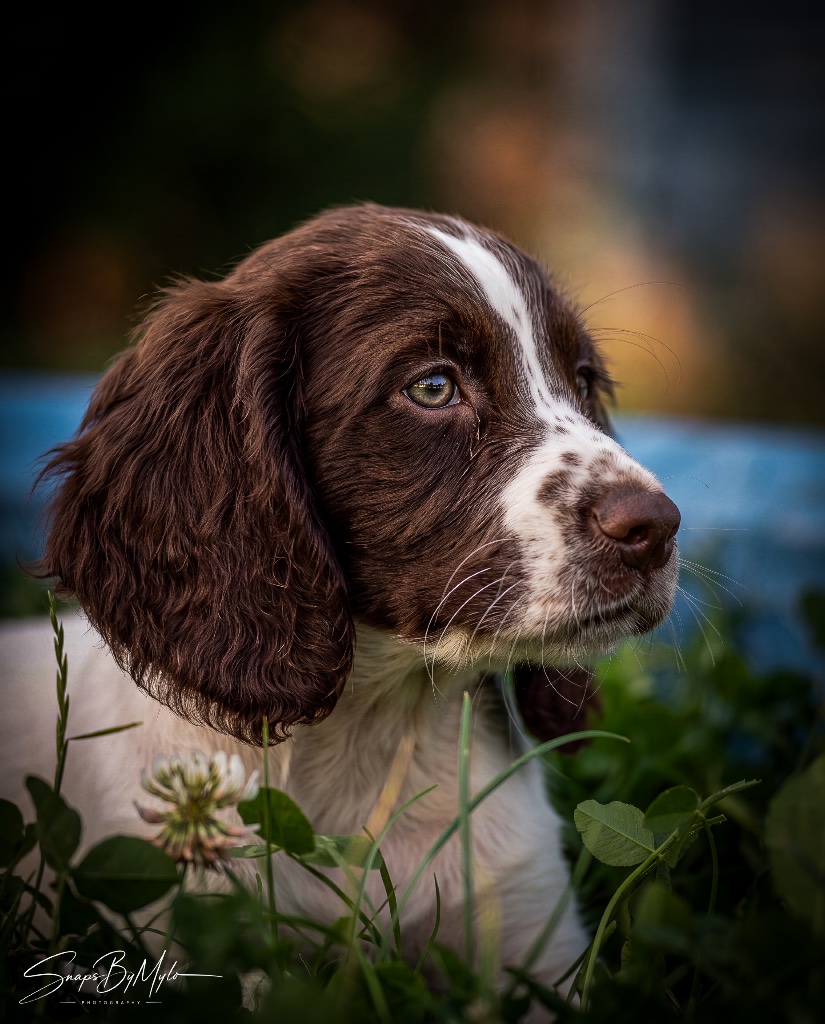
Having a good nose is one thing; wanting to use it is another, and this is where working temperament becomes decisive. A dog with an exceptional nose that does not want to use it is not a detection dog; it is a dog with a good nose. Spaniels, as a rule, want to use their noses. The drive to search — to put the nose down and work scent — is deeply embedded in the breed and visible from a young age. Falkor, at nine weeks, already spends a significant portion of his outdoor time nose to the ground, working the garden methodically, following trails invisible to me.
This drive is the foundation of detection training, and its presence or absence is one of the key variables that determines whether a given dog will make a working animal. A dog that has to be persuaded to search is a dog whose training will always involve a layer of motivation competing with the search itself. A dog that searches because it wants to is a dog whose training can focus entirely on directing and refining an already powerful impulse. The early behaviour suggests Falkor is in the second category, which is encouraging, though it is also exactly what I expected from a well-bred working Cocker.
It is worth being clear about what shaping means here, because it is often misunderstood. Shaping a drive does not mean suppressing it or redirecting it away from what the dog naturally wants to do. It means harnessing the natural behaviour and attaching it to a specific target and a specific indication, so the dog searches for what I have asked it to search for and tells me, in an agreed-upon way, when it has found it. The search itself remains the dog's own, driven by its own motivation. My role is to give that motivation a useful outlet and a clear language. Done well, this is deeply reinforcing for the dog — it gets to do what it most wants to do, in partnership with a person it trusts, with clear feedback and consistent reward.
Size, Agility, and Low Disturbance
Size matters in conservation detection work, and it matters in a direction that favours the spaniel. The environments where this work takes place are frequently fragile — sensitive habitats, protected sites, areas of dense ground cover that would be damaged by a large, heavy dog working through them. A Cocker Spaniel is small enough to work in these environments without causing the kind of disturbance that would undermine the purpose of the survey, and agile enough to navigate difficult terrain without injury. This is not a trivial consideration. A detection dog that damages the habitat it is surveying is, in a real sense, defeating its own purpose. The welfare of the dog and the welfare of the habitat are both served by an animal of the right scale.
Quietness matters too. Conservation detection work often takes place where disturbance must be kept to an absolute minimum — near ground-nesting birds during the breeding season, in the vicinity of sensitive mammals, in reserves where the presence of a working dog is itself a carefully managed exception. Spaniels, when trained to indication rather than to flush, can be quiet workers. The natural tendency of the breed when searching is to work close to the ground with intense focus, and the indication behaviour conservation work requires — a calm, settled alert at the target location rather than a frantic flush — is one the breed takes to readily when taught with consistency. This runs counter to the popular image of spaniels as excitable, but a spaniel on task is a focused animal, and the excitable behaviour people associate with the breed is, in most cases, underexercised pet dogs rather than trained working animals.
The Handler Fit
There is a final consideration that is less often discussed but, in my view, as important as any of the above: the fit between dog and handler. A detection dog team is exactly that — a team — and the effectiveness of the team depends on the handler's ability to read the dog, the dog's willingness to work for the handler, and the quality of communication between them. This is built over time, but it begins with a reasonable match. I work on foot, in varied terrain, often alone, and I need a dog that works at a range I can manage, that I can physically handle in difficult ground, and whose working pace matches the way I move through a survey site. A Cocker Spaniel fits that. A larger, wider-ranging breed might cover more ground in some conditions, but it would also be harder to manage in the dense, awkward cover where much of this work happens, and harder to transport and deploy across the range of sites I work on.
Conclusion
None of this means a Cocker Spaniel is the right choice for every conservation detection programme. Different targets, terrains, and handlers will point to different breeds, and the field is richer for the diversity of dogs working in it. But for the work I do — close-quarter searching in dense British habitats, for cryptic targets, in conditions where low disturbance is essential — the breed is, on the available evidence, the right tool. The question now is not whether the choice was sound but whether I can do justice to it. That is the work of the next two years, and I will record it here as it goes.