Photographing African Elephant
Introduction
African Elephant demand something from you before they give you anything worth keeping — they demand stillness. Not just physical stillness, but the kind that comes from slowing your mind down to match theirs. These animals operate on a frequency that most visitors move too quickly to tune into. Spend enough time with them, and you begin to read the landscape through their behaviour. A herd crossing open ground, a lone bull testing the air, a calf pressing itself against its mother's flank — each moment is preceded by signals, rhythms, and subtle shifts that, once you learn to read them, transform the way you see and ultimately the way you photograph.
Understand the Animal
African Elephant communicate constantly — most of it below what we can consciously hear. Before you raise a camera, spend time simply watching. The ear position alone tells you a great deal. Ears held loosely outward and flapping rhythmically signal a relaxed animal, often in the middle of feeding or moving at a comfortable pace. Ears pinned back flat against the neck mean something very different — threat, stress, or a mock charge building. Pay attention to the tail. A tail that swings loosely side to side in a relaxed pendulum motion is one thing; a tail held stiff and elevated is a tension signal you should not ignore. Trunk behaviour is one of the richest sources of anticipation. An elephant raising its trunk and curling the tip toward a scent source is actively reading its environment — this is a moment of alertness, and the animal may hold this posture briefly before deciding to move, vocalise, or settle. A trunk draped loosely over a tusk while feeding means the animal is fully relaxed, absorbed in the task of eating. When a bull repeatedly sweeps the ground with the tip of his trunk, he is tracking scent — potentially a female in oestrus or a rival. Something is about to happen. Feeding behaviour has its own rhythm. Elephants spend the majority of their day eating, and within feeding periods there are pulses of deep engagement and brief pauses where the animal lifts its head to scan its surroundings. Those pauses are moments. They are brief windows where the eye is visible, the posture is open, and the animal is neither obscured by brush nor facing directly away. Social dynamics within a herd offer some of the most layered photographic opportunities. Watch the matriarch — she is usually the largest female, and the herd takes its cues from her movement and direction. When she stops, ears fanned, reading something unseen, the herd freezes with her. When calves play, wrestling and chasing near water, the adults position themselves at the edges, always watching outward. These formations create natural framing and depth that cannot be constructed artificially. Bull elephants in musth — identified by temporal gland secretions running down the side of the face and a distinctive urine dribble — are unpredictable and must be respected as such. From a safe distance, they are photographically extraordinary. The tension in the body, the heightened alertness, the deliberate, heavy movement — everything about a bull in musth radiates controlled power. Anticipate slow, purposeful walking, head-shaking, and extended trunk-dragging along the ground.
Look Before You Shoot
Before the image, there is the read. The strongest photographs from the field are not taken quickly — they are arrived at slowly, through a process of observation that most people never commit to because it feels like waiting. It is not waiting. It is the work. When you find elephants, resist the immediate impulse to photograph. Spend the first several minutes simply watching the group. Identify who is relaxed, who is alert, who is feeding, and who is moving. Understand the direction of travel, the wind direction relative to your position, and the quality of light on the animals. Low, directional light — the kind found in the first ninety minutes after sunrise or the last hour before sunset — sculpts the texture of elephant skin in a way that flat midday light cannot. Wrinkles, folds, and the fine dust coating a dry-season elephant become three-dimensional. Background matters enormously. A cluttered background dissolves the power of even the strongest animal portrait. Look for open sky, water, or distant treeline behind the animal you are focusing on. Reposition your vehicle or your body slowly, always with awareness of the animal's sightlines and wind direction. Even a shift of a few metres can clean a background entirely. Light direction relative to the eye is critical in portraiture. An elephant's eye — small relative to the size of the face, set deep under the brow ridge — requires light that reaches it directly. A catchlight in the eye is the difference between a living portrait and a flat study. Watch the animal's head angle and identify moments when a turn brings direct light into that eye. Learn to read the stillness before movement. A feeding elephant that slowly lifts its head and holds — that is your cue. Be ready before it happens, not during it.
Composition Ideas
The Eye Alone
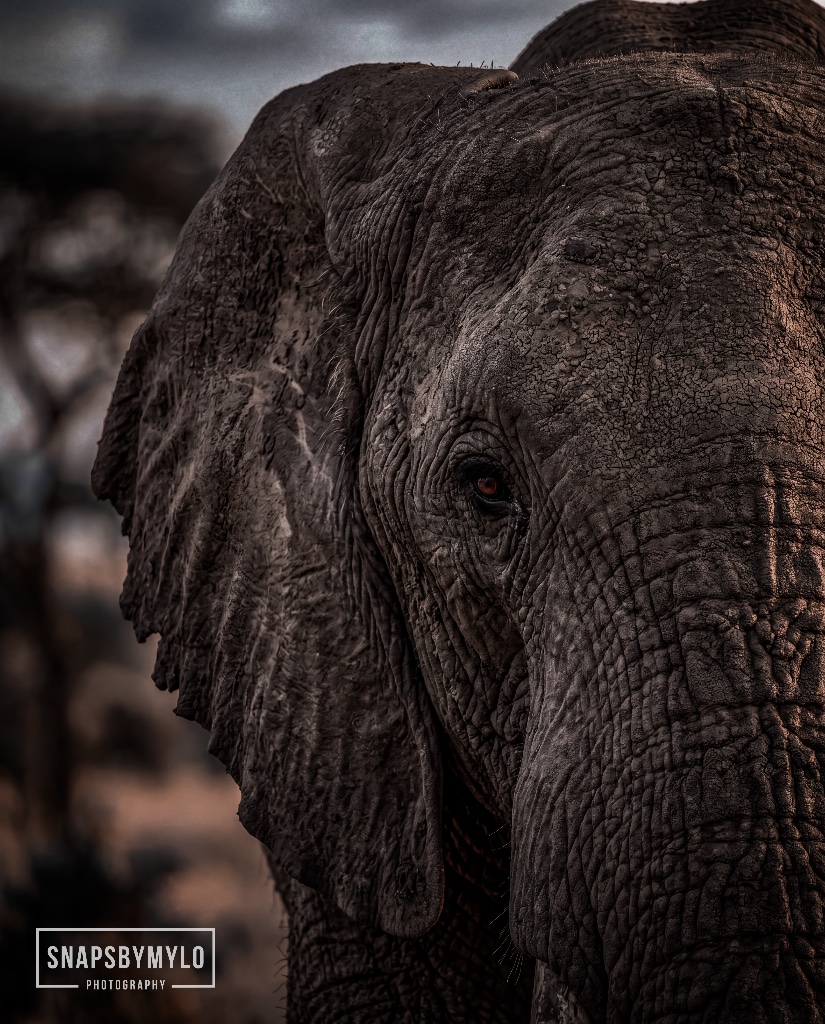
Look for: Position yourself at eye level with the elephant and wait for a moment where the head is turned enough to bring direct light into the eye. The reddish-brown iris and the extraordinary detail of the skin surrounding it become the entire story.
Why it works: Proximity and directness create intimacy. The eye of an African Elephant carries unmistakable depth and intelligence. When it fills the frame with surrounding texture, the viewer is drawn into a one-to-one encounter that no wide shot can replicate.
The Wrinkle Landscape
Look for: Seek out angular, directional light falling across the forehead, temple, or shoulder of a relaxed, stationary elephant. The folds and creases become a topography of their own.
Why it works: African Elephant skin is among the most texturally rich surfaces in nature. Strong sidelighting turns it into an abstract study — geological, ancient, layered. The animal becomes landscape.
Herd Depth
Look for: Find a position where multiple elephants are staggered at different distances moving in the same direction. Allow the lead animal to anchor the foreground with subsequent animals creating diminishing scale behind.
Why it works: Layered depth transforms a herd into a narrative. The viewer's eye travels into the frame, and the image carries a sense of scale and continuity that a single animal cannot.
The Trunk in Motion
Look for: Watch for the moment an elephant reaches up to pull foliage from a tree, or when a calf extends its trunk toward its mother. Anticipate the arc of the movement rather than reacting to it.
Why it works: The trunk is the most expressive part of an elephant's body. A trunk in purposeful motion implies story — it shows the animal doing something, not simply existing. Action creates investment in the viewer.
The Calf and the Giant
Look for: Wait for a moment where a calf is positioned directly alongside or beneath an adult — ideally the mother or a close female relative. The size contrast tells the entire story of family and protection.
Why it works: Scale contrast is one of photography's most reliable emotional levers. The vulnerability of the calf against the mass of the adult creates an immediate emotional response.
Silhouette at Last Light
Look for: Position yourself with a clear western horizon — ideally with elephants moving across open ground or standing at a waterhole against a fading sky. Wait for the moment a trunk lifts, ears fan, or the group clusters.
Why it works: Silhouette strips everything back to form. Against a burning sky, the unmistakable profile of an elephant — ears, tusks, trunk — needs no colour or detail. The shape carries everything.
Drinking and Reflection
Look for: At permanent water sources, wait for a moment when the elephant's trunk breaks the surface and the water reflection is still clear around it. Low angle amplifies the reflection.
Why it works: Water introduces symmetry, stillness, and a sense of place. The reflection doubles the visual weight of the animal and anchors it in a specific environment.
The Dust Bath
Look for: After drinking, elephants frequently throw dust or mud over themselves using the trunk. Position for backlight or sidelight to catch the particles suspended in the air around the animal.
Why it works: Airborne dust and mud create atmosphere and mood. The light catching the particles wraps the animal in a kind of haze that is both beautiful and behaviorally specific — it is an action you had to wait for.
The Lone Bull in Landscape
Look for: An older bull moving alone across open ground — small in the frame, surrounded by the scale of the savanna, lit from the side. Resist filling the frame. Let the space speak.
Why it works: Solitude reads powerfully in the frame. A single large animal given room within a vast landscape communicates something about the nature of these animals that a tight portrait cannot — age, distance, independence.
Eye-Level Earth
Look for: Drop your perspective as low as safely possible and wait for an elephant moving toward you or feeding close to ground level. The low angle brings the animal up against the sky and eliminates competing elements.
Why it works: A low angle fundamentally changes the relationship between viewer and subject — the elephant becomes elevated, dominant, and present in a way that a standing eye-level shot rarely achieves.
Moments Worth Waiting For
- —The moment a feeding elephant pauses, lifts its head, and holds — direct eye contact becoming possible for the first time in minutes.
- —A calf breaking into a run across open ground, trunk swinging loose and ears flapping — pure, unguarded movement.
- —An elephant raising its trunk fully skyward to test the wind, the trunk curled at the tip, the body still and alert.
- —The first slow step into a waterhole — the moment the feet disappear and the surface breaks around the animal's legs.
- —Two elephants greeting after separation, trunks entwined, rumbling low, temples touching — a private language made briefly visible.
- —A bull in musth walking alone through open ground, head held low, the ground-drag of his trunk marking his path.
- —The precise moment dust thrown from a trunk catches the light and hangs suspended in the air around the animal.
- —An old matriarch standing at the edge of the herd, ears spread wide, reading something distant and unseen.
- —A calf pressing into its mother's side and disappearing into shadow beneath her — safety made physical.
- —The long stillness of a lone elephant standing in last light at a waterhole, trunk draped over a tusk, unmoving, present.
Field Notes
What I noticed
The eye draws you in before the rest of the animal does. Working tight on the head of a relaxed bull, I kept returning to that eye — the reddish-brown iris, the depth behind it, the fold of skin above the brow casting a crescent of shadow. The skin told a story on its own: layered creases, dust settled into every fold, the texture catching the low sidelight like nothing else I had ever photographed up close.
What I waited for
The right head turn. For that eye to come fully into the light. An elephant at rest will shift its head in slow, subtle movements — testing scent, tracking sound. I watched for those micro-movements and anticipated where the head was likely to settle next. When the turn came and the light landed directly in the iris, I had already been in position for several minutes.
What I ignored
The wider scene entirely. There was brush to the left, a vehicle behind me, open sky to the right. None of it mattered. I had found the frame I wanted — skin, eye, light — and I committed to it. Chasing the wide environmental shot alongside a tight portrait in the same session often means you get neither. Choose, then wait.
What created the strongest image
The quality of light and the specificity of the eye contact. That reddish-brown iris looking outward — not alarmed, not aggressive, simply present — created something that felt like acknowledgement. The moody, directional light sculpted the wrinkles into something almost geological. It was not a photograph about elephants in general. It was about this one, in this light, in this moment.
Conservation Insight
The African Elephant is listed as Vulnerable, with forest elephant populations now classified as Critically Endangered. Ivory poaching and accelerating habitat fragmentation remain the primary threats, alongside deepening human-wildlife conflict as agricultural land expands into traditional elephant corridors. Elephants are ecosystem architects — they open dense bush, disperse seeds across vast distances, and create water access for hundreds of other species. Every photograph made with intention is also a record of something worth protecting. Pay attention to where your safari spend goes, and support operators who actively fund anti-poaching and community coexistence work.
Instagram Feed Cover
Photographs of African Elephant
Fine art prints available in limited and open editions.