Photographing Black Wolf
Introduction
The black wolf doesn't ask for your attention. It commands it. That contrast — ink-dark fur against snow, pine shadow, or leaf-covered forest floor — creates a visual tension that few animals can match. What makes black wolves rewarding to photograph isn't the colour alone. It's everything beneath it: the intelligence behind the eyes, the economy of movement, the deliberate way they occupy space. A black wolf lying still is still doing something. Learning to read that stillness, to anticipate the exhale before the rise, the glance before the move — that's where the real photographs live. This guide is about observation first, always.
Understand the Animal
Black wolves are not a separate species — they carry a melanistic coat variant found primarily in North American gray wolf populations, with particularly high concentrations in forested regions like Yellowstone and parts of Canada. That melanistic gene is believed to have originated from ancient domestic dog hybridisation, which makes these animals a living record of ecological history. But understanding what they look like matters far less than understanding how they behave. Wolves are deeply social, and black wolves within a pack are often — though not always — dominant individuals. Watch for postural language: a high tail carriage signals confidence or rank, while a lowered tail and tucked posture signals submission or unease. Ears are your fastest read. Forward-facing ears indicate alertness and focus — something has their attention. Flattened ears signal fear or aggression depending on context. Relaxed, sideward ears mean the animal is at ease. These are the frames you want. Before a wolf moves, it almost always signals. Watch the head. A slow, deliberate turn of the muzzle — particularly when the animal raises its nose slightly — means it's scenting. This precedes movement more often than not. If a resting wolf lifts its head, waits, and then shifts its weight onto its front legs, it is preparing to stand. That transition — the weight shift — gives you a two-to-three second window before the animal is upright and moving. Feeding behaviour is explosive and brief. Wolves at a kill are focused and low to the ground. The moments worth waiting for here are not the feeding itself — it's the pause between. The lift of the head. The blood-dark muzzle turned toward you or toward another pack member. The chest-deep stillness before returning to feed. In forested terrain, black wolves move along established trails and ridgelines. They are creatures of habit within familiar territory. If you observe one travel a path, return to that path. They often will too. Early mornings — particularly after overnight snowfall or rain — reveal fresh tracks and compress their movement into predictable corridors. Read the land. The wolf already has.
Look Before You Shoot
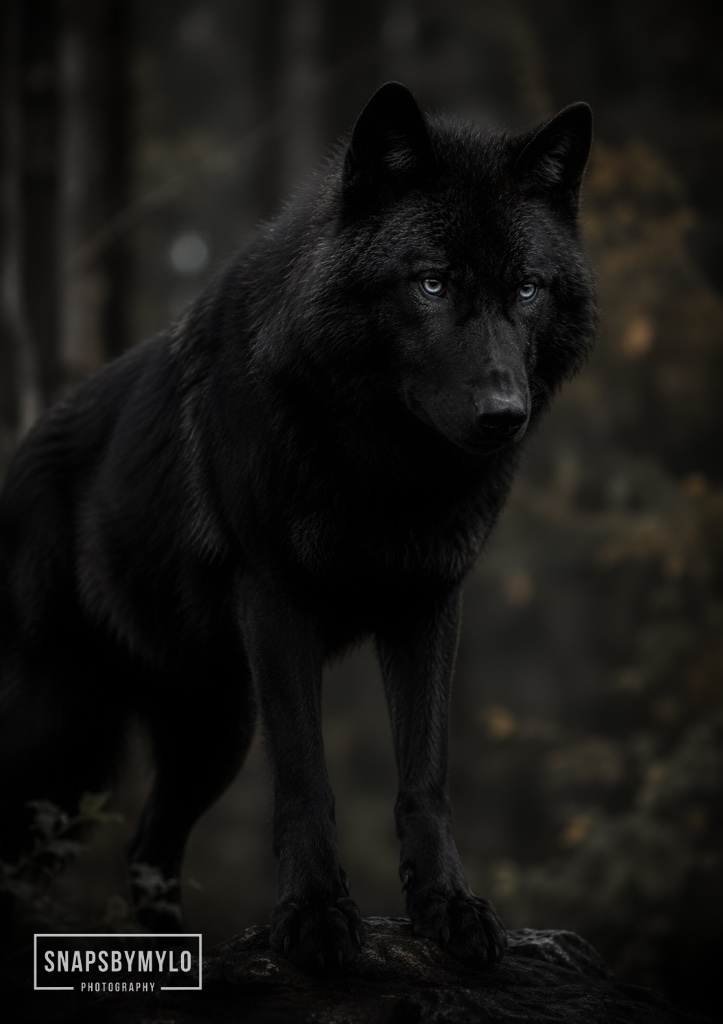
The first ten minutes in a wolf's presence should be spent watching, not shooting. This is not patience for patience's sake — it is data collection. You are reading the scene: where the light is falling, what the background looks like at ground level, how the animal is oriented, where it might move next. With black wolves specifically, background and light are everything. A black-coated animal photographed against a dark background becomes a silhouette of itself — you lose the form, the fur texture, the depth that makes the image three-dimensional. Conversely, position the wolf against a lighter background — snow, pale bark, open sky, filtered morning light — and suddenly the coat separates from the world and the eyes become the subject. Low-key forest light, like the scene that produced the image this guide was built from, is powerful precisely because it is controlled. When a shaft of ambient light catches the eye and leaves the body in partial shadow, the photograph tells a story that a fully lit image never could. Learn to notice where the light breaks through the canopy. Position yourself so that light source is behind you or to your side — not behind the wolf. Wait for the animal to orient toward you naturally. Forced proximity — moving too close too quickly — changes the animal's behaviour and compromises both your safety and the integrity of the photograph. The best eye-contact frames come when the wolf chooses to look at you, not when you've startled it into looking. There is a visible difference, and any experienced viewer will feel it. Read the background before the animal enters the frame. Know what's behind your subject before the moment arrives.
Composition Ideas
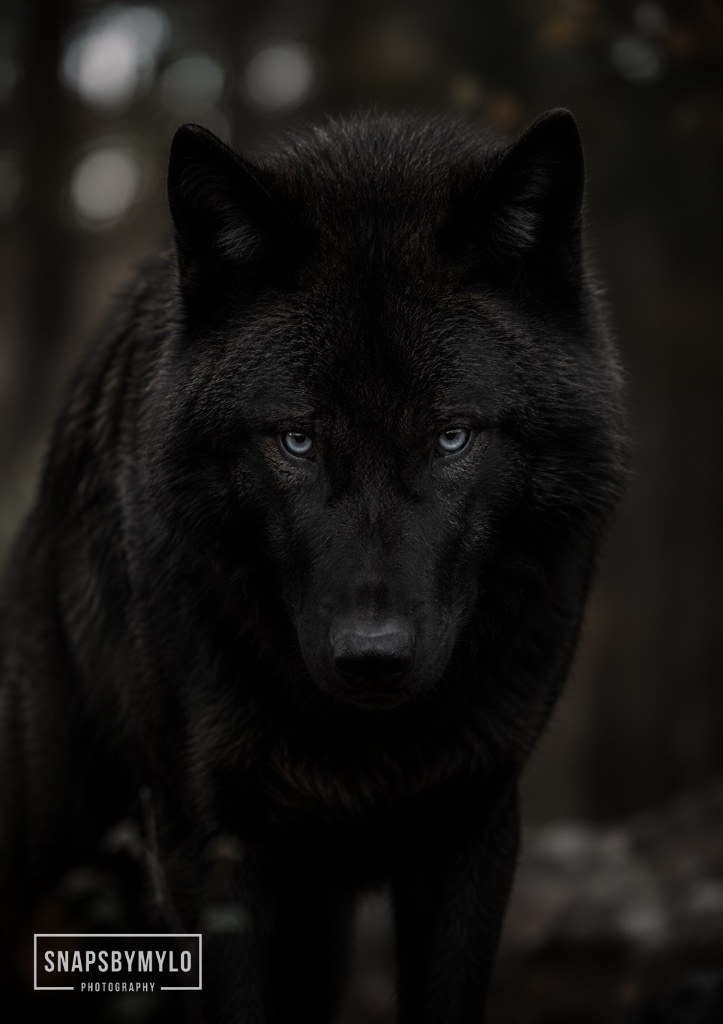
The Locked Gaze
Look for: Direct, sustained eye contact — ideally when the wolf is resting or still, head level or slightly raised. Icy blue or amber eyes catching available light while the dark body anchors the lower frame.
Why it works: Eye contact creates an immediate visual contract between subject and viewer. With a black wolf, the contrast between dark fur and pale, luminous eyes does the compositional work. The viewer has nowhere else to go.
Low and Level
Look for: Position yourself at or below the animal's eye level — particularly when the wolf is resting or lying flat on the ground. Forest floor texture, leaf litter, or snow should fill the foreground.
Why it works: Shooting at ground level removes the human dominance perspective. It places the viewer inside the animal's world rather than looking down into it. The intimacy this creates is immediate and irreplaceable.
The Emergence
Look for: A wolf moving between treeline and open ground — the moment when only part of the body is visible, the rest absorbed by shadow or foliage.
Why it works: Partial visibility invites the imagination. The mystery of what's concealed gives the visible elements — a shoulder, a flank, a single eye — heightened significance. A black wolf in dark timber nearly disappears, which is exactly the point.
Breath in Cold Air
Look for: Exhaled breath visible as a plume in cold morning air, ideally backlit or side-lit. Most visible at dawn in winter months or at high elevation.
Why it works: It is the simplest proof of life in a still photograph. A single breath renders the scene immediate — not a posed image, not a frozen moment, but something alive and present.
The Profile in Motion
Look for: A wolf in mid-trot or loping stride, captured in clean profile — ideally with open space ahead of the animal's direction of travel rather than behind it.
Why it works: Lead room gives movement somewhere to go within the frame. The profile of a black wolf in motion is architecturally beautiful — the slope of the back, the reach of the front legs, the low-carried tail all read as a single, coherent line.
Dark on Dark — Negative Space
Look for: A black wolf positioned in near-shadow, with only the outline of the body and the eyes discernible. This works especially in dense forest or at the edge of dusk.
Why it works: When pushed to its extreme, the black coat can become compositionally abstract — a shape and a pair of eyes. Images built on restraint and near-invisibility can be more arresting than fully exposed frames. Embrace what the light takes away.
Pack Geometry
Look for: Two or more wolves in frame — look for overlapping bodies, interacting muzzles, or a leader positioned slightly apart from the group. Distance and spatial relationship between animals tells a social story.
Why it works: A lone wolf reads as solitude. Two wolves read as relationship. The dynamic between pack members — dominance, affection, wariness — gives the image a narrative that a single subject cannot provide.
The Scent Raise
Look for: The moment a wolf raises its muzzle into the air to scent — neck extended, nostrils working. Often preceded by a stillness and a subtle shift in ear position.
Why it works: It is one of the most visually expressive behaviours wolves exhibit. The raised muzzle creates a diagonal line through the frame, and the obvious purpose — reading the world through smell — connects the viewer to the animal's reality rather than simply its appearance.
Snow as Negative Space
Look for: A black wolf against an open field of white snow — minimal background, maximum contrast. The animal centred or placed on a third, with unbroken white occupying the remaining frame.
Why it works: This is the composition that requires nothing to work except placement and patience. The contrast is total. The animal becomes pure graphic form — and a black wolf on snow is one of the clearest visual statements in wildlife photography.
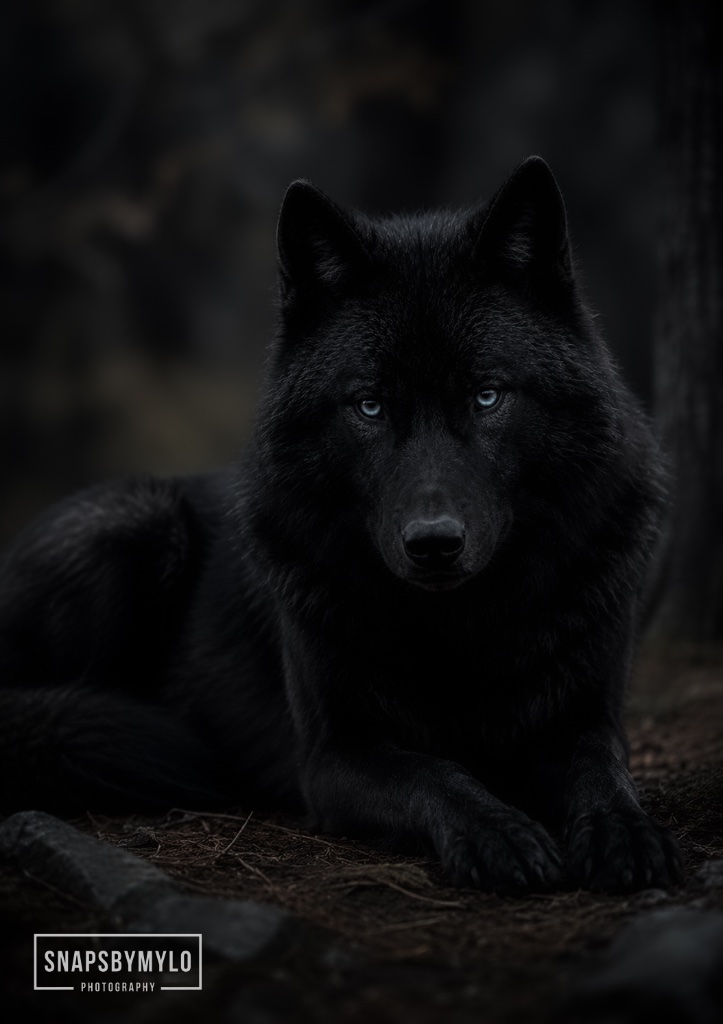
The Resting Watch
Look for: A wolf lying fully prone but alert — head up, eyes scanning, body relaxed but not sleeping. The juxtaposition of a resting body and an active, watchful gaze.
Why it works: This is the image that inspired this guide. Physical rest and mental vigilance existing simultaneously in one frame creates a tension that keeps the viewer's eye moving — between the stillness of the body and the aliveness of the eyes. It is a portrait of self-possession.
Moments Worth Waiting For
- —Sustained direct eye contact — the moment the wolf chooses to look at you and hold it
- —The weight shift before standing — front legs pressing down, back arching slightly before the rise
- —An exhaled breath caught in cold morning light
- —A full-body stretch after rising from rest — forelegs extended, spine long, head low
- —The muzzle raise — nose lifted, scenting the air, neck fully extended
- —Two wolves touching muzzles — greeting behaviour within the pack
- —A wolf howling — mouth open, head thrown back, the body's full energy channelled upward
- —The pause at the treeline — before entering open ground, a wolf will almost always stop and read the space
- —A wolf shaking off rain or snow — the entire coat moving at once in a split-second burst of energy
- —Pack movement in formation — the lead animal ahead, the group strung behind in the same tracks
- —A wolf lying with its chin on the ground, eyes still open and watching — the lowest, most vulnerable posture of rest
- —The moment after a howl — the wolf lowering its head slowly, returning to stillness
Field Notes
What I noticed
The eyes first — always. In low forest light, when the coat had already merged with the shadows around it, those eyes remained completely present. There was nothing passive about the way this wolf looked back. It was an assessment, the same kind I was making. I also noticed how little it moved. The stillness wasn't sleep — the ears kept shifting, the nostrils worked continuously. It was resting and working at the same time.
What I waited for
I waited for the head to lift into the light. The wolf was lying with its muzzle resting on its forepaws, and for several minutes the eyes were partially obscured. When it raised its head — slowly, no urgency — the ambient light caught the irises directly. That was the frame. I had maybe thirty seconds of it before the head dropped again.
What I ignored
I ignored the urge to move closer. The distance felt too far at first — I wanted more detail, more presence. But moving would have changed the wolf's behaviour and almost certainly ended the stillness. I also ignored the background, which was cluttered with fallen branches to the left. I adjusted my own position slightly instead — no more than a metre — and the branches fell out of the focal plane entirely.
What created the strongest image
The decision to stay low and let the darkness keep what it wanted. I didn't try to fight the low light or reveal everything. The coat disappearing into the forest floor, the face emerging from it — that relationship between concealment and presence made the image. And the eyes. Everything in that frame exists to lead you to those eyes.
Conservation Insight
Black wolves face the same existential pressures as all wolf populations: habitat loss, trophy hunting, predator control programs, and human-wildlife conflict at territorial boundaries. In parts of the United States, recent policy rollbacks have removed federal protections, leaving wolves vulnerable to state-level hunting quotas. The black coat variant — genetically distinct and ecologically significant — cannot be selectively preserved. When wolf populations decline, every variant is at risk. These animals are apex regulators. Their presence reshapes ecosystems from the top down. Photographing them with honesty and restraint is one small act of advocacy.
Instagram Feed Cover
Photographs of Black Wolf
Fine art prints available in limited and open editions.