Chimpanzee — A Close Encounter
Introduction
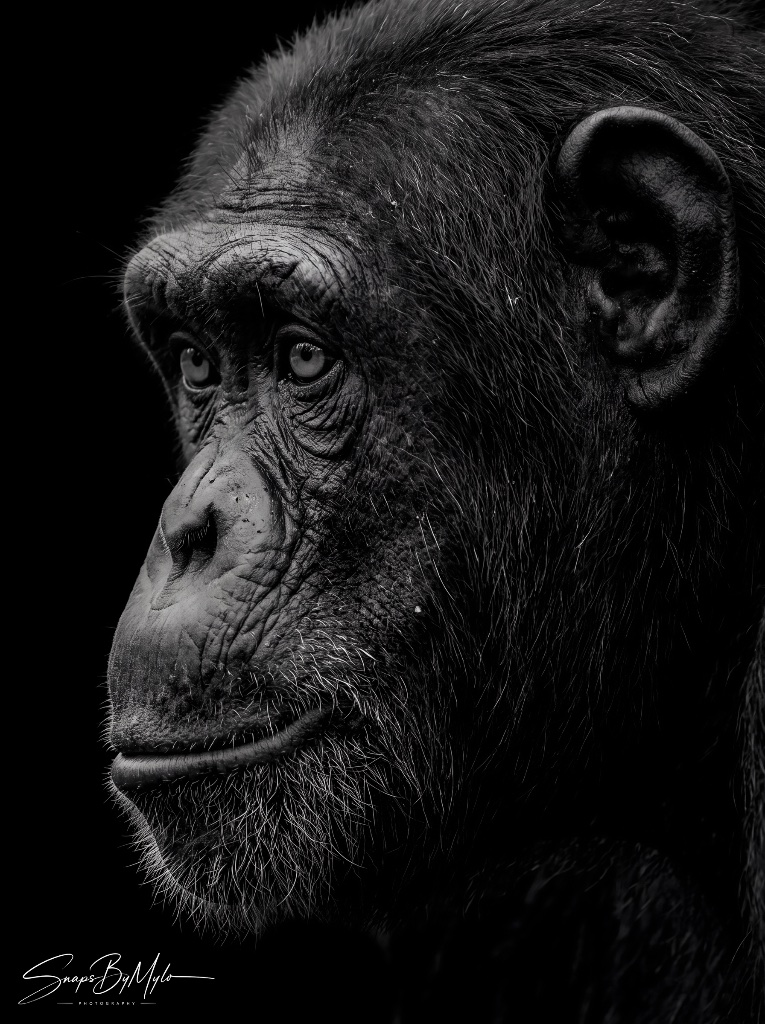
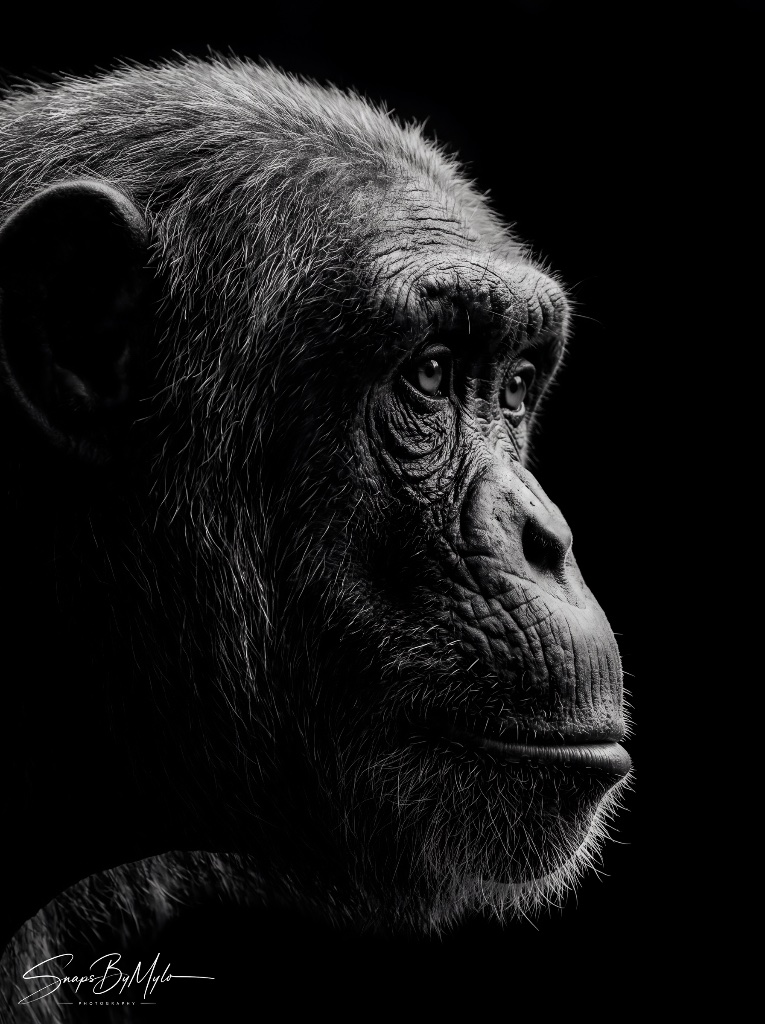
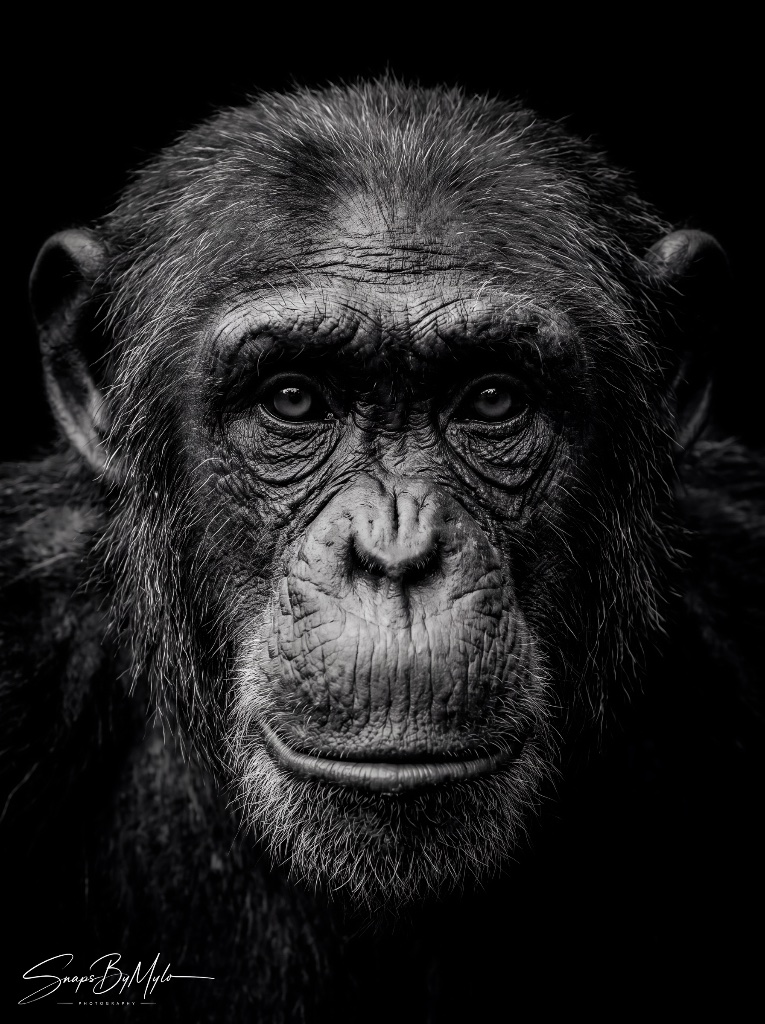
Chimpanzees are the most adaptable and widespread of the great apes, found across 21 countries in equatorial Africa. They are also one of the most rewarding subjects a wildlife photographer can work with — intelligent, expressive, and behaviourally complex. This guide draws on a close, sustained encounter with a single chimpanzee, photographed in three distinct orientations: left profile, forward, and right profile. The principles here apply to photographing chimpanzees in sanctuaries, rehabilitation centres, and the wild.
Understand the Animal
Chimpanzees share approximately 98.7% of their DNA with humans, and their faces reflect a range of emotions that will be immediately recognisable — curiosity, wariness, contemplation, boredom, and moments of sharp attention. Understanding that you are photographing a sentient, intelligent individual rather than simply an animal changes the way you compose. Chimpanzees are highly social and live in complex communities led by a dominant alpha male. They use tools, form alliances, and communicate through vocalisations, gestures, and facial expressions. In an encounter, a chimpanzee will almost certainly be aware of you — the question is whether it chooses to engage, ignore, or withdraw. Patience and stillness are everything. Sudden movements, direct sustained eye contact, or loud behaviour will cause a chimpanzee to disengage. Calm, quiet presence allows the animal to settle and return to its own behaviour, which is when the strongest images are made.
Look Before You Shoot
Before lifting the camera, spend time simply observing. Watch how the light falls on the chimpanzee's face — because chimpanzee facial features are deeply wrinkled and texturally rich, directional light creates extraordinary depth, while flat light flattens the face and removes the drama. A dark background is one of the most powerful tools you have: it separates the subject, emphasises form, and creates the high-contrast, almost painterly quality that defines the strongest great ape portraits. Notice the orientation of the chimpanzee's face relative to the light source and to your position. The three orientations captured in this encounter — left profile, forward, and right profile — each tell a different story. The profile emphasises the brow, the jaw, and the contour of the skull. The forward-facing portrait creates direct engagement and is the most emotionally powerful but also the most demanding, because the eyes must be sharp and the expression must hold. Watch for the moment the chimpanzee's gaze settles — the fraction of a second when the eyes lock and the expression resolves into something deliberate. That is your frame.
Composition Ideas
Profile Against Black
Look for: A side-on orientation where the chimpanzee's face is in profile against a dark or shadowed background. Look for directional light that rakes across the face, emphasising the brow ridge, the deep creases of the skin, and the texture of the fur.
Why it works: The profile isolates the sculptural quality of the chimpanzee's face — the brow, the jaw, the nose — as a graphic shape against negative space. A dark background eliminates distraction and creates the chiaroscuro effect that gives great ape portraits their gravitas. The left and right profile images from this encounter both use this approach.
Direct Forward Gaze
Look for: The chimpanzee looking directly at the lens. The eyes must be sharp. Look for a moment of stillness — not a glance, but a settled, deliberate look.
Why it works: A forward-facing portrait with eye contact is the most emotionally direct image you can make of a chimpanzee. Because the chimpanzee is choosing to look at you, the image carries a sense of mutual recognition that is almost uncomfortable in its intensity. The forward image from this encounter is the emotional centrepiece of the three.
Tight Facial Crop
Look for: Frame tightly on the face — brow to chin — excluding the body. This works best when the expression is still and the light is directional.
Why it works: A tight crop removes all context except the face itself, forcing the viewer to confront the individuality and intelligence of the subject. The texture of the skin, the depth of the wrinkles, and the expressiveness of the eyes become the entire image.
Moments Worth Waiting For
- —The moment the chimpanzee's gaze shifts from scanning to settling — that transition from movement to stillness is when the strongest portrait is made.
- —A brief pause between actions — after eating, after grooming, after looking away — when the chimpanzee is simply present and aware. These interstitial moments often produce the most contemplative expressions.
- —The instant the chimpanzee chooses to look directly at you. It may last only a second or two, but that direct engagement is the frame.
- —A subtle change in expression — a softening of the brow, a slight parting of the lips — that transforms a documentary record into a portrait with emotional depth.
Field Notes
What I noticed
I was in close proximity to this chimpanzee — close enough to see the individual wrinkles of the face, the texture of the skin around the eyes, and the fine detail of the fur. What struck me immediately was how recognisable the expressions were. This was not a generic animal face; it was a face with history, character, and mood. I noticed that the chimpanzee was aware of me but not threatened — it engaged briefly, then returned to its own rhythm, which is the ideal condition for portraiture. The light was directional and the background was dark, which gave me the high-contrast, studio-like quality I was looking for without any artificial setup.
What I waited for
I waited for stillness. The chimpanzee moved through a range of orientations — turning left, looking forward, turning right — and I did not chase every movement. Instead, I held position and waited for the face to settle into each orientation before releasing the shutter. For the forward-facing image, I specifically waited for the moment the gaze locked onto the lens, because a forward portrait without engaged eyes is just a face. That moment took patience — the chimpanzee had to choose to look.
What I ignored
I ignored the temptation to shoot continuously. Burst mode produces hundreds of frames of movement, but the strongest great ape portraits are made in the still moments between movements. I also ignored wider environmental framing — there was temptation to include more context, to show the setting, but the power of these three images comes from the tight focus on the face and the elimination of everything else. I chose depth over breadth, making three deliberate images — left, forward, right — rather than dozens of incidental ones.
What created the strongest image
The forward-facing portrait is the strongest of the three, and what created it was the combination of three things: direct eye contact, directional light, and a solid black background. The chimpanzee chose to look at me, the light sculpted the geometry of the face, and the black background eliminated all distraction. The result is an image that feels less like a photograph of an animal and more like an encounter with an individual. The left and right profiles frame that central image — they provide the sculptural, observational counterpoint to the direct emotional engagement of the forward gaze. Together, the three images read as a complete study of a single, unrepeatable encounter.
Conservation Insight
Chimpanzees are classified as Endangered, with populations having declined by more than 66% over the past 30 years. The Western chimpanzee is Critically Endangered. The principal threats — habitat loss, poaching for bushmeat, the illegal pet trade, and disease transmission from humans — are all intensifying. Being in close proximity to a chimpanzee is a reminder of how much we share: the face, the expressions, the intelligence, the capacity for something recognisable as emotion. It is also a reminder of responsibility. Chimpanzees are hunted for food and captured as infants for the pet trade, with the mother typically killed to obtain the infant. The forests they depend on are being cleared at an accelerating rate. Photographing a chimpanzee is not just a creative act — it is an act of advocacy. These images exist to make the viewer stop, recognise an individual, and understand what is at stake. Support the Jane Goodall Institute, the Wild Chimpanzee Foundation, and the Pan African Sanctuary Alliance. Choose sustainably sourced timber and conflict-free minerals. Never purchase primates or primate products.
Instagram Feed Cover
Photographs of Chimpanzee
Fine art prints available in limited and open editions.