Photographing Flamingo
Introduction
Flamingos reward patience in a way few subjects do. They exist in environments that most photographers underestimate — vast, flat, reflective wetlands where the light can shift from ordinary to extraordinary within minutes. What draws me back is not the colour alone, but the behaviour. A flamingo at rest is one thing. A flamingo feeding, sparring, preening, or turning its neck into an impossible curve against a mirror-flat surface is something else entirely. These birds hold still long enough to let you think carefully about composition, then surprise you with a gesture so precise and brief it demands everything from your attention. That tension — between stillness and movement — is where the best images live.
Understand the Animal
Before you raise your camera, spend time simply watching. Flamingos are deeply social birds and their behaviour follows recognisable rhythms once you understand what you're looking at. Feeding is one of the most active periods. Flamingos feed with their heads completely inverted, bill submerged, filtering water through specialised lamellae. Watch for the low, sweeping head motion and the shuffling of feet — they stir sediment deliberately to disturb algae and small crustaceans. This head-down position creates extraordinary shapes: the neck folds into dense curves, the body tilts forward, and the legs spread slightly for balance. It's an ungainly posture that somehow becomes beautiful at the right angle. Between feeding bursts, flamingos stand quietly and this is when the neck behaviour becomes most compelling. The S-curve of a resting flamingo's neck is not random — it is a postural reset, a comfort position. When a bird is alert, the neck extends tall and straight. When it's content, it collapses back into that signature curve. Learning to read the neck is learning to read the bird's emotional state. Social tension is visible too. Flamingos are not passive with each other. Watch for neck-stretching displays between neighbouring birds — one extending upward while another mirrors it. This is dominance communication. There will also be wing-spreading moments, brief and explosive, used both for threat and for balance after a stumble. One of the most overlooked behaviours is the pre-flight signal. Before any flamingo takes off, it will begin to walk. Not stand, not shift weight — walk. A moving flamingo in a stationary flock is almost always about to become airborne. Watch the feet. Watch for that purposeful stride separating from the group. That is your window to anticipate flight. Coloration also tells you something. The deepest coral and rose tones appear on birds in peak condition, often during breeding season. Paler birds are younger or stressed. If you see a particularly vivid bird in a group, it is worth investing time nearby — vibrant plumage means an active, healthy individual likely to engage in display behaviour.
Look Before You Shoot
The instinct at a flamingo wetland is to start immediately. Resist it entirely. When you first arrive at the water's edge, stop. Look at the whole scene before you isolate any individual bird. Where is the light falling? At golden hour, backlight turns wet plumage into something incandescent — the coral becomes almost luminous from behind, and the water around the bird glows. That same bird in flat midday light will look like a record shot. The scene is the same. The image is completely different. Light is not a setting. It is a decision about when to be there and where to stand. Next, read the background. Flamingo wetlands are often crowded environments — other birds, vegetation, distant structures. A strong image isolates the subject against something clean. Move your position left or right before you ever bring your eye to the viewfinder. Even a step or two can separate a bird from a cluttered background and pull it against open water or sky. At low angles, the water itself becomes the background, and a still-water reflection doubles the composition vertically. Consider the foreground too. Shallow water with surface texture — small ripples from a bird's leg or the tremor of a nearby wingbeat — adds depth and context without competing with the subject. Wait for separation within the group. Two birds overlapping each other produce a confused image. One bird with clear space around it, even briefly, is worth far more than ten birds tangled together. Flamingos shift constantly in a group, and separation happens naturally — the key is to be watching for it rather than reacting after the fact. Position yourself as low as conditions allow. Eye-level with the waterline transforms an ordinary wading bird into something intimate and powerful. The reflection locks in. The horizon disappears. The bird fills the world.
Composition Ideas
The S-Curve Portrait
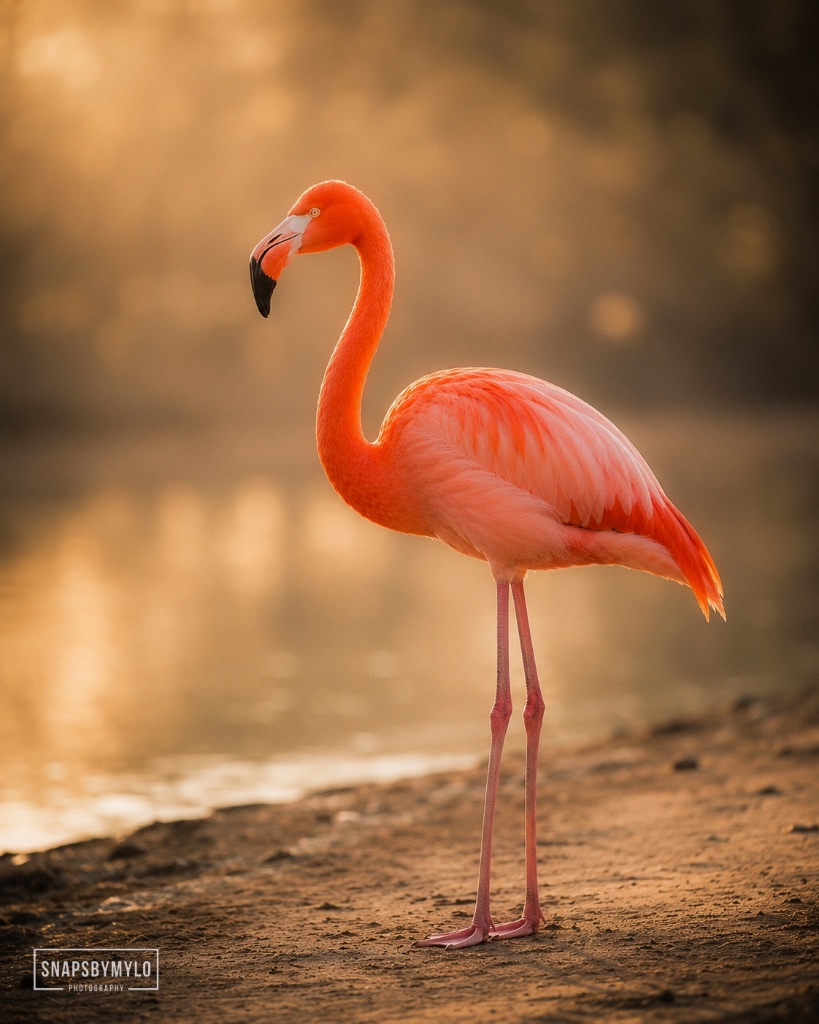
Look for: A resting flamingo with its neck folded back into a full S-shape, ideally with the head tucked or turned slightly. Look for one bird isolated from the group with clean water behind it.
Why it works: The S-curve of the neck is one of the most naturally elegant lines in all of wildlife photography. It draws the eye through the frame in a single flowing motion, creating movement within a still image. The contrast between the rigid vertical legs and the soft curve of the neck is inherently dynamic.
The Mirror Reflection
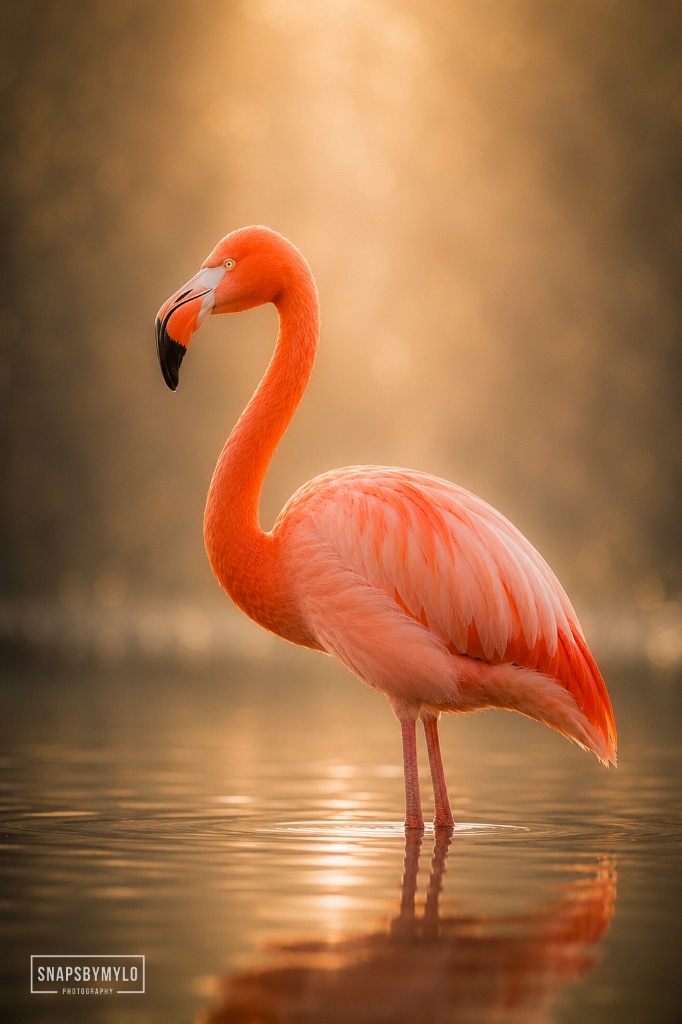
Look for: Absolute stillness in the water — usually early morning before wind picks up. Position low so the reflection appears as a near-perfect vertical twin of the bird below the waterline.
Why it works: The reflection creates a natural symmetry that doubles the visual weight of the subject. It transforms a single bird into a complete composition, and the boundary between bird and reflection becomes an invisible horizon that anchors the entire frame.
Backlit Plumage at Golden Hour
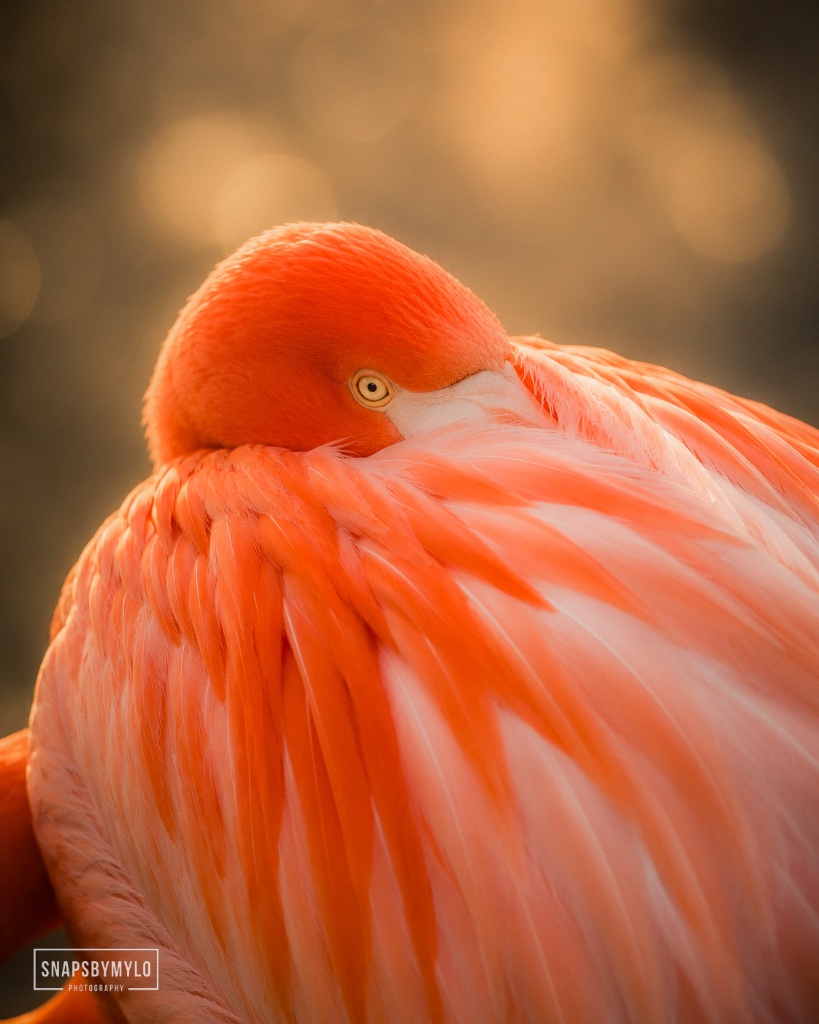
Look for: A bird standing between you and the low sun, with light passing directly through the feathers. The coral-orange plumage becomes translucent and almost glows. Look for fine feather detail illuminated from behind.
Why it works: Backlight removes flat colour and replaces it with luminosity. The rim-light effect separates the bird from its background, and the warm tonal quality of late sun intensifies the natural pigmentation of the plumage beyond what direct light can achieve.
The Feeding Silhouette
Look for: A flamingo with its head fully submerged, feeding. Shoot into the light so the body reads as a strong graphic shape — curved neck, flat body, legs spread. Water surface should be catching the light.
Why it works: The inverted feeding posture creates a shape unique to flamingos. As a silhouette, it becomes instantly recognisable and graphically powerful. The asymmetry of the inverted neck against the reflection below creates a closed loop — a near-circular composition built from one bird.
Flock Compression
Look for: A dense gathering of flamingos from a distance, compressed into a tight band of pink and coral across the frame. Look for tonal variation — some birds facing light, some in shadow — and a clean horizon line above or below.
Why it works: Compression removes individual identity and turns the flock into texture. The repeating forms, the variation in colour depth, and the collective movement rhythm create an abstract quality. It tells the story of scale and colony life in a single frame.
Negative Space and the Single Bird
Look for: One bird standing apart from the flock, surrounded by open water or sky. Particularly powerful if the water behind it is a single tone — silver, gold, or deep blue depending on the time of day.
Why it works: Isolation emphasises the subject's form. The empty space around it is not wasted — it is pressure. The bird becomes a focal point the eye cannot avoid. The loneliness of the single bird against open water also carries emotional weight.
The Wing Stretch
Look for: A bird extending one or both wings, revealing the deep crimson and black flight feathers hidden when the wings are folded. This moment is brief — usually two to four seconds — and happens most during preening sequences.
Why it works: The wing extension reveals the hidden geometry of the bird — the stark black-tipped feathers against the coral body is a colour contrast most people have never seen outside of photographs. The spread wing also dramatically changes the silhouette from delicate to powerful.
Eye-Level Water Perspective
Look for: Position yourself at or near water level and look for a bird whose eye falls on the natural horizon line of the frame. The water surface should bisect the lower third of the image.
Why it works: Eye-level perspective creates intimacy and removes the observer's visual advantage over the subject. The bird is no longer something you're looking down at — it exists in its own world and you have entered it. The flattened water surface at this angle becomes a stage.
The Social Gesture
Look for: Two birds engaged in a neck-display or minor territorial exchange — one extending tall, the other responding. Look for directional tension between the two birds, where the energy between them is visible.
Why it works: Two-bird compositions introduce narrative. The viewer immediately wants to know what is happening and who will yield. Tension between subjects creates a story within the frame, transforming a nature photograph into something closer to portraiture.
Moments Worth Waiting For
- —The full wing stretch revealing deep crimson and black flight feathers — it lasts seconds and transforms the entire silhouette of the bird
- —A bird lifting its head from feeding with water streaming from its inverted bill — backlit, this becomes a shower of golden droplets
- —The moment a feeding bird raises its head and makes direct, still eye contact with you before deciding whether to move
- —Pre-flight walking behaviour — one bird breaking from the stationary flock with purposeful strides, wings beginning to open as it builds speed
- —A neck-stretching dominance display between two neighbouring birds, both reaching maximum height simultaneously
- —The collapse from full alert posture back into the resting S-curve — a slow fold that takes three to four seconds and captures the transition between tension and ease
- —A still-water reflection at first light, before any wind, when the bird and its twin image form a perfect closed shape below the waterline
- —A group roosting on one leg simultaneously — the odd visual rhythm of dozens of birds balanced identically, shifting weight in near-unison
- —Courtship marching behaviour during breeding season — large groups walking in synchronised formation with necks fully extended, a spectacle of collective movement
- —A single flamingo landing at speed into shallow water, legs forward, wings back, water spraying outward in a wide arc
Field Notes
What I noticed
The light at the waterline during the last forty minutes before sunset turned everything amber-pink — the kind of colour that the eye adjusts to and the camera does not. I noticed the bird I was watching had been in the same position for nearly twelve minutes, neck folded back, completely still. The water around its legs had settled. The reflection had locked in. Everything in the frame had stopped moving except for a faint ripple crossing from the left — probably another bird twenty metres away. I noticed the curve of the neck had tightened slightly, which I recognised as the prelude to a head lift.
What I waited for
I waited for the head to come up. I knew it would — the neck had begun to unspool slowly, the way it does before a bird transitions from rest to alert. I wanted the head fully raised, neck at full S-extension, with the bill caught in the backlight. I also waited for that single ripple to pass through the reflection beneath the bird so the water would settle again before the moment arrived. It took about four more minutes. The bird lifted its head, turned it slightly toward the low sun, and held that position for perhaps three seconds.
What I ignored
I ignored the larger group of flamingos behind me and to the left. There was more activity there — birds moving, some beginning to feed. Another photographer had positioned themselves with that group. I ignored it because the single bird I had chosen had everything I needed already in the frame. More birds would have added noise, not story. I also ignored the slight haze on the horizon that was softening the background. It turned out to be an advantage — it compressed the tonal range behind the bird and made the coral plumage read more intensely.
What created the strongest image
The combination of the S-curve neck, the warm backlight catching the edge of the plumage, and the undisturbed reflection below. None of those three elements alone would have been enough. But at the moment the bird raised its head and the neck reached that intermediate extension — not fully alert, not fully folded — the curve was at its most expressive. The reflection mirrored it precisely. The backlight turned the wet feathers along the neck into something almost translucent. That was the image. It existed for about two seconds.
Conservation Insight
Several flamingo species face genuine pressure from habitat loss, water diversion, and human disturbance at breeding colonies. The Andean and Puna flamingos are classified as vulnerable; the James's flamingo as near-threatened. Breeding is critically sensitive to water levels — colonies will abandon nesting sites entirely if lake conditions shift during the season. Salt flat tourism, mining activity near high-altitude lakes, and climate-driven changes to wetland hydrology are the primary threats. When you photograph flamingos, distance is respect. A flushed colony is a failed nest. The image is never worth the disturbance.
Instagram Feed Cover
Photographs of Flamingo
Fine art prints available in limited and open editions.