Photographing Gibbon
Introduction
Gibbons do not give themselves to you easily. They move through the canopy like water — fluid, fast, and gone before you've processed what you saw. But when they stop, when they settle into a branch or descend to a sandy bank in the early morning stillness, something extraordinary happens. The light finds them. The forest exhales. If you've invested the time to understand them, you'll be ready for that moment. This guide is not about capturing gibbons — it's about earning the image. It's about sitting with them long enough that your presence becomes unremarkable, and their behaviour becomes readable. That's when the photographs stop being records and start becoming something else entirely.
Understand the Animal
Gibbons are creatures of routine, and that routine is your greatest asset as a photographer. They are largely territorial, and family groups — typically a bonded pair and their offspring — will travel the same arc through their home range each day. Learn that arc. Spend mornings tracing which trees they favour for feeding, where they descend to drink or rest, and which elevated perches they use to survey their territory before calling. That pre-dawn song — the haunting, resonant duet that carries across entire valleys — is not just spectacle. It is declaration. It tells you exactly where they are and signals that they are active, vocal, and about to move. Watch the body language before the movement. A gibbon preparing to brachiate — to swing — will shift its weight subtly, lowering its centre of gravity and angling its body toward the next branch. The arms extend slightly ahead of the decision. You will see the intention before the action if you are watching closely enough. This pre-movement tell is your cue to anticipate, not react. Feeding behaviour is slower and more predictable. When a gibbon locates ripe fruit — figs are a particular draw — it will work the same cluster methodically, often returning to the same tree over consecutive days. Watch for the way they use their hands: deliberate, almost contemplative. There's a stillness to feeding that rewards patience. Social behaviour between a bonded pair is where the most emotionally resonant imagery lives. Gibbons are one of the few primates that form long-term pair bonds, and their physical proximity — grooming, sitting shoulder to shoulder, one watching while the other rests — carries a weight that photographs understand immediately. When one gibbon is alert, the other is often calm. That contrast, the watchful and the resting, creates natural visual tension. Juveniles are unpredictable but instructive. They play aggressively, chase each other through the mid-canopy, and will occasionally descend lower than the adults — sometimes to open ground or sandy riverbanks. Adult behaviour changes when juveniles are active nearby: the parents become more watchful, scanning outward more frequently. This shift in posture is a signal worth reading — it often precedes a descent or a repositioning that opens up a cleaner line of sight for you. Temperature and time of day matter enormously. Gibbons are most active in the first two hours after dawn and again in the late afternoon. During the midday heat, they rest in the upper canopy, often out of sight and largely motionless. Plan your time in the field accordingly.
Look Before You Shoot
Before you raise anything, sit down. Literally. Lower your profile, reduce your visual footprint, and spend the first fifteen to twenty minutes simply watching. This is not wasted time — this is the most productive thing you can do. Read the light before you read the animal. Morning mist in gibbon habitat does something remarkable: it layers the forest into distinct planes of depth, softening backgrounds into cool, diffused greens and blues while the foreground warms in the early angled light. A gibbon caught in that transition — golden fur lit from behind by a low, hazy sun — against a blurred wall of jungle creates an image that no amount of technical correction can manufacture. You have to be positioned for it before the moment arrives. Background is composition. In dense forest, the difference between a cluttered, distracting frame and a clean, powerful one can be a matter of two or three steps to the left. Identify natural breaks in the canopy — gaps of open sky, patches of mist, pools of reflected light on water — and position yourself so that these elements fall behind your subject. Let the forest work with you. Do not move toward the gibbons when they look at you. Hold still. Sustained eye contact from a primate reads as challenge. Break your gaze gently, move slowly and laterally rather than directly, and allow them to re-settle. A gibbon that has habituated to your presence will return to natural behaviour within a few minutes of your last perceived threat. A gibbon that feels cornered or pursued will move higher and faster, and you will spend the rest of the morning staring at the canopy floor. Wait for the animal to position itself. The best images are rarely the first ones — they come after the initial startle has passed, after the animal has moved into the light you identified, and after it has relaxed enough to behave naturally. Patience here is not passive. It is the most active decision you make in the field.
Composition Ideas
The Brachiating Arc
Look for: A gibbon mid-swing between two anchor points, arms fully extended, body forming a perfect pendulum curve against open sky or mist.
Why it works: The extended arc of a swinging gibbon is one of the most dynamic shapes in nature photography. Framing this against negative space — sky, mist, or backlit fog — strips away all distraction and lets the motion read as pure form. Position yourself below and slightly to the side so the swing crosses your frame horizontally rather than toward or away from you.
The Bonded Pair
Look for: Two gibbons in close physical proximity — one alert, one at rest, or both oriented in the same direction. Look for the geometry of their bodies echoing or contrasting each other.
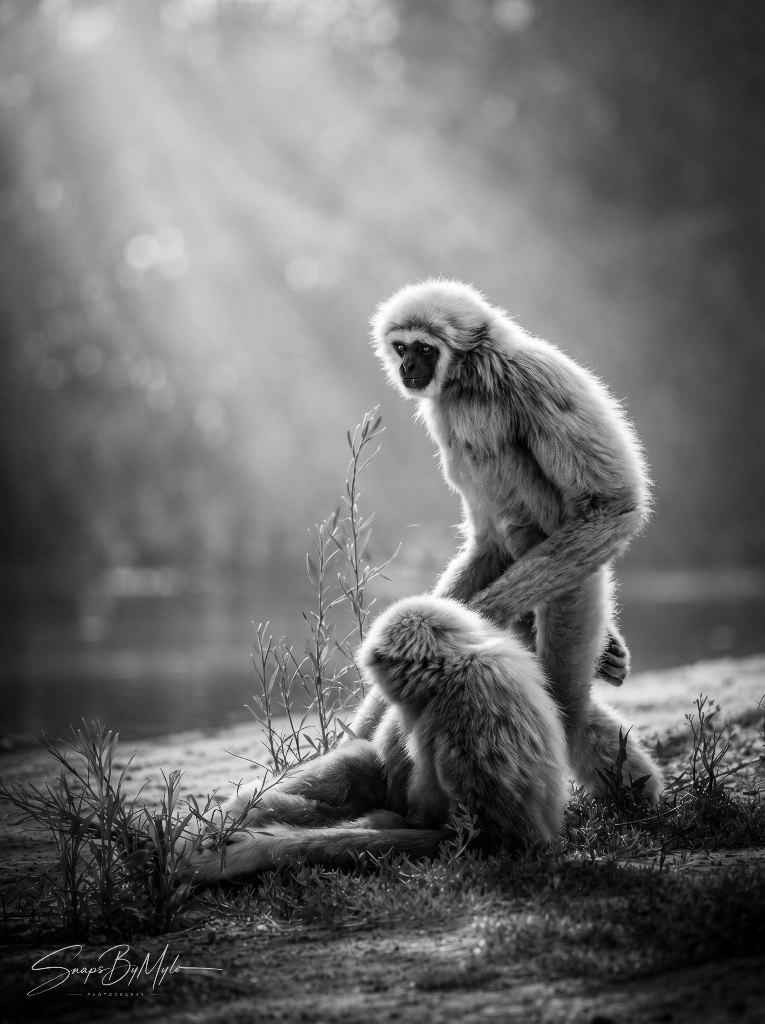
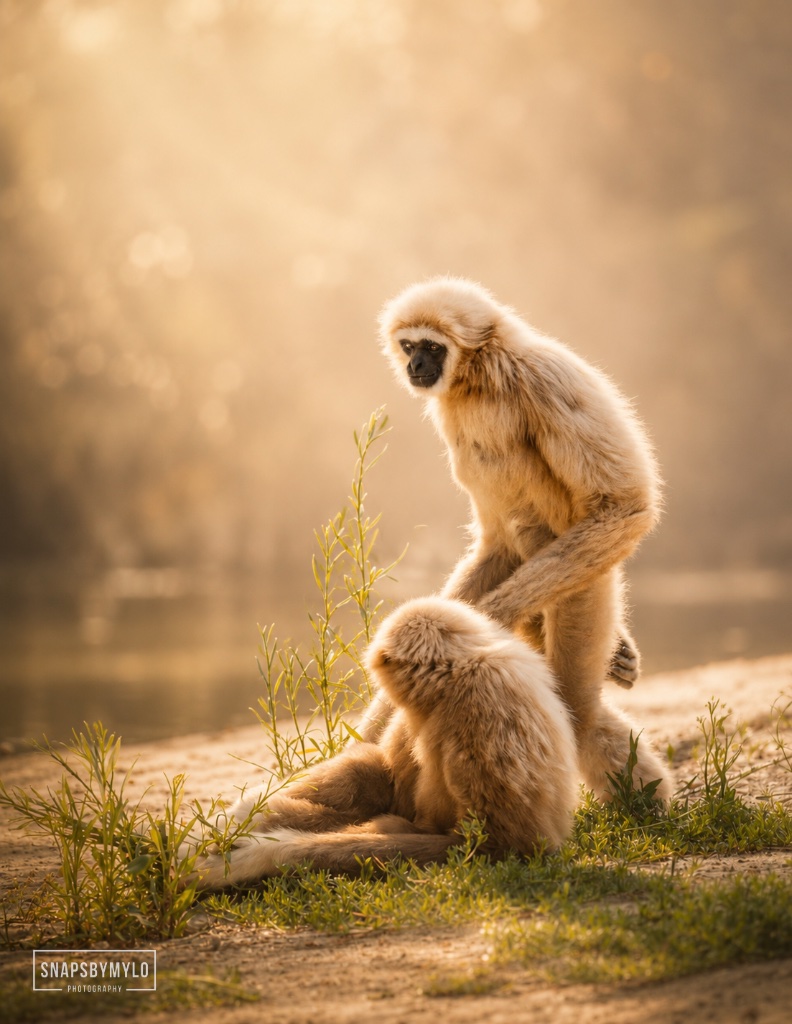
Why it works: This is the image that holds. The pair bond in gibbons is visually legible — there is a tenderness to the way they occupy shared space that communicates without explanation. A seated pair on a sandy bank, one watching outward while the other leans or looks back, creates both emotional resonance and compositional balance.
Backlit Golden Fur
Look for: Early morning or late afternoon light positioned behind or beside the gibbon, igniting the rim of their golden or cream fur into a luminous halo.
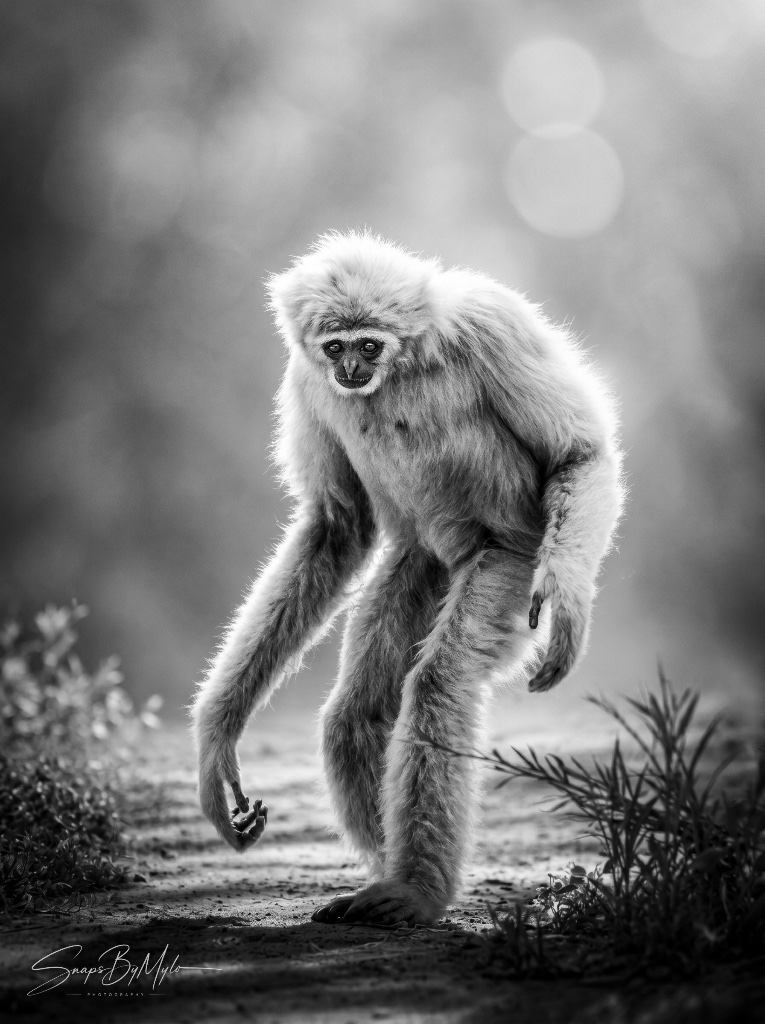
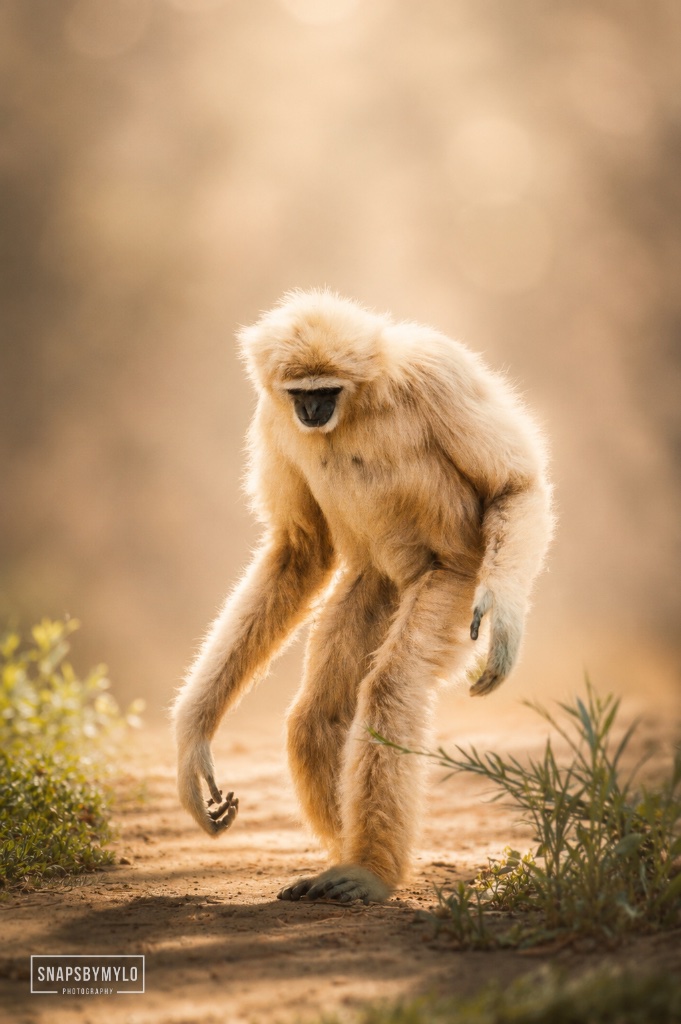
Why it works: Gibbons' fur — particularly in paler or golden morphs — responds to backlight with an almost translucent warmth. This rim lighting separates the subject cleanly from a darker jungle background and adds an immediate sense of atmosphere. Mist amplifies this effect dramatically.
The Descending Moment
Look for: A gibbon moving from canopy level down to lower vegetation or ground — the transition point where the animal is framed between forest and open space.
Why it works: Descent is unusual and therefore visually significant. It signals comfort, curiosity, or a specific behavioural purpose. The image of a gibbon mid-descent — caught in the layered transition between canopy and ground — tells a richer story than a portrait shot in isolation.
Hands and Grip
Look for: A close composition that isolates the gibbon's remarkably long fingers curled around a branch, or reaching for fruit, with the face softly visible in the background.
Why it works: Gibbon hands are extraordinary — evolved for suspension rather than manipulation, they curve around branches with the confidence of something built for exactly this purpose. Emphasising the grip anchors the animal to its environment and tells a behavioural story in a single frame.
The Calling Posture
Look for: A gibbon mid-vocalisation — throat extended, head angled upward, body held vertically on a exposed perch with open canopy or sky behind.
Why it works: The territorial call of a gibbon is one of the great sounds of the Asian forest, and the posture that produces it is visually arresting. An open throat, upward tilt, and the obvious effort of full vocalisation creates an image of raw expressiveness. It reads as sound made visible.
Juvenile Chaos
Look for: A young gibbon in mid-play — tumbling, dangling from one hand, or in the act of launching itself toward a sibling or parent. Look for the moment just after the decision to move.
Why it works: Juveniles have not yet refined their movement to the flowing efficiency of adults. Their play is genuinely chaotic and full of false starts, tumbles, and recoveries. This imperfection is charming and immediately relatable, creating images that feel spontaneous rather than posed.
Reflection and Water
Look for: A gibbon near a stream, pool, or wet sandy bank where a partial reflection or simply the context of water creates a lower anchor to the frame.
Why it works: Gibbons descending to water sources is uncommon enough to feel rare. Including the water — as reflection, foreground texture, or environmental context — places the animal in a specific ecological moment and adds a layer of depth and calm to what can otherwise be all-canopy compositions.
The Profile in Stillness
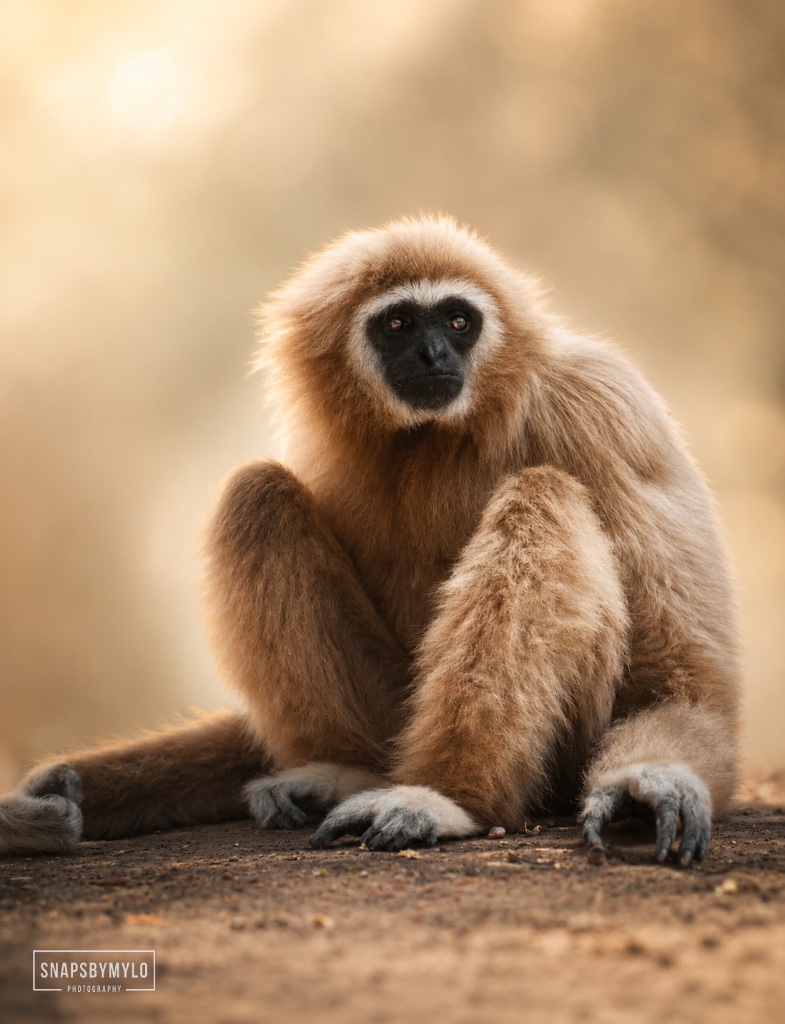
Look for: A seated gibbon in strict profile, facing away from you or sideways, set against a clean plane of soft light or mist with clear negative space around the body.
Why it works: Stillness in a highly mobile animal carries enormous visual weight. A profile composition strips the image to its most graphic elements — the distinctive silhouette of a gibbon, its posture, and its relationship to space. The deliberate emptiness around it creates room for the viewer to settle into the moment alongside the animal.
Eye Contact Through Foliage
Look for: A gibbon looking directly at you or your direction, partially framed by leaves, branches, or dappled light — awareness without full exposure.
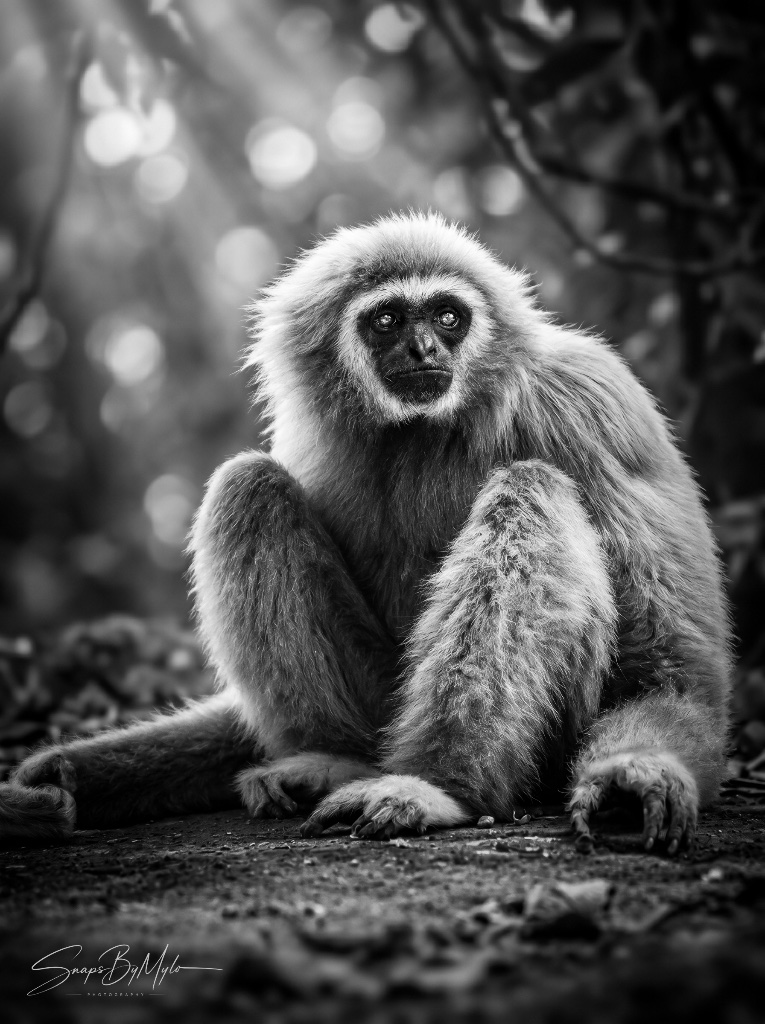
Why it works: When a gibbon decides to look at you, it does so with complete focus. Catching that gaze through a partial frame of natural foliage creates a sense of encounter rather than observation — the feeling that you are being assessed as much as you are assessing. It is humbling and visually powerful.
Moments Worth Waiting For
- —The full territorial duet between a bonded pair — both animals calling simultaneously from the same exposed perch, faces lifted, the forest silent around them
- —Direct, sustained eye contact from a settled adult who has decided you are not a threat — unhurried, curious, and deeply present
- —A grooming session between the pair, where one works methodically through the other's fur while the recipient sits with eyes half-closed in apparent contentment
- —A juvenile's first hesitant descent to ground level, all uncertainty and bravado at once, while a parent watches from just above
- —The full extension of a brachiation swing across an open gap in the canopy, arms stretched to their full two-metre span against morning mist
- —A gibbon pausing mid-feed to look outward — fruit in hand, weight settled, expression unguarded — before returning to the food
- —Two animals seated side by side in the low morning light, oriented in the same direction, close enough to be touching but each lost in their own stillness
- —The moment a gibbon notices its own reflection in still water — rare, but when it happens, it produces a visible pause that is unlike any other behaviour
- —A full body stretch after rest — arms extended overhead around a vertical branch, the entire posture open and unguarded
- —Rain beginning while gibbons are active in the canopy — the behavioural shift as they move to shelter, the light flattening, the atmosphere changing around them
Field Notes
What I noticed
The pair had been on that sandy bank for longer than I expected — gibbons almost never come to ground willingly, and I'd been watching them in the upper canopy for over an hour before they descended. What brought them down was the warmth of the morning sun hitting that particular stretch of open bank. The golden one settled first, weight completely distributed, like it had decided this was safe. The other came down thirty seconds later and didn't sit — just stood close, watching outward. That asymmetry between them, one fully at rest and one still alert, was what made the frame.
What I waited for
I waited for the standing one to shift its gaze back toward the seated one. For about four minutes, it was scanning the tree line, which was behaviourally interesting but compositionally incomplete — both animals were facing away from each other's energy. When it finally turned and looked back, there was a brief moment of connection between them, and that was the image. Two seconds, maybe three. Everything in the frame aligned.
What I ignored
I ignored the juveniles in the canopy behind me. They were louder and more active and would have been easier to photograph in purely practical terms. But the pair on the bank had a quality of stillness that felt earned — like they'd been together long enough to not need to perform anything for each other. That's harder to find and worth far more.
What created the strongest image
The mist. Without question. It was burning off by 8am and by 8:20 it was gone entirely. The window where that backlit haze was sitting just behind the bank — turning the jungle behind them into a soft wall of warm green — was maybe twenty-five minutes. The golden fur and the mist were in conversation with each other. I've photographed gibbons in hard midday light and the images are technically fine and completely lifeless. The atmosphere was the difference between a photograph and a picture.
Conservation Insight
Most gibbon species are classified as Endangered or Critically Endangered. Habitat loss — driven by palm oil expansion, logging, and agricultural conversion — has reduced forest connectivity to a point where isolated groups can no longer find mates or sustain genetic diversity. The illegal pet trade remains a significant pressure, with infants taken from mothers who are killed to obtain them. Gibbons are slow to reproduce — a single offspring every two to three years — which means populations recover at a fraction of the speed they collapse. Photographing them ethically and sharing their world honestly is a form of advocacy that reaches people that scientific literature never will.
Instagram Feed Cover
Photographs of Gibbon
Fine art prints available in limited and open editions.