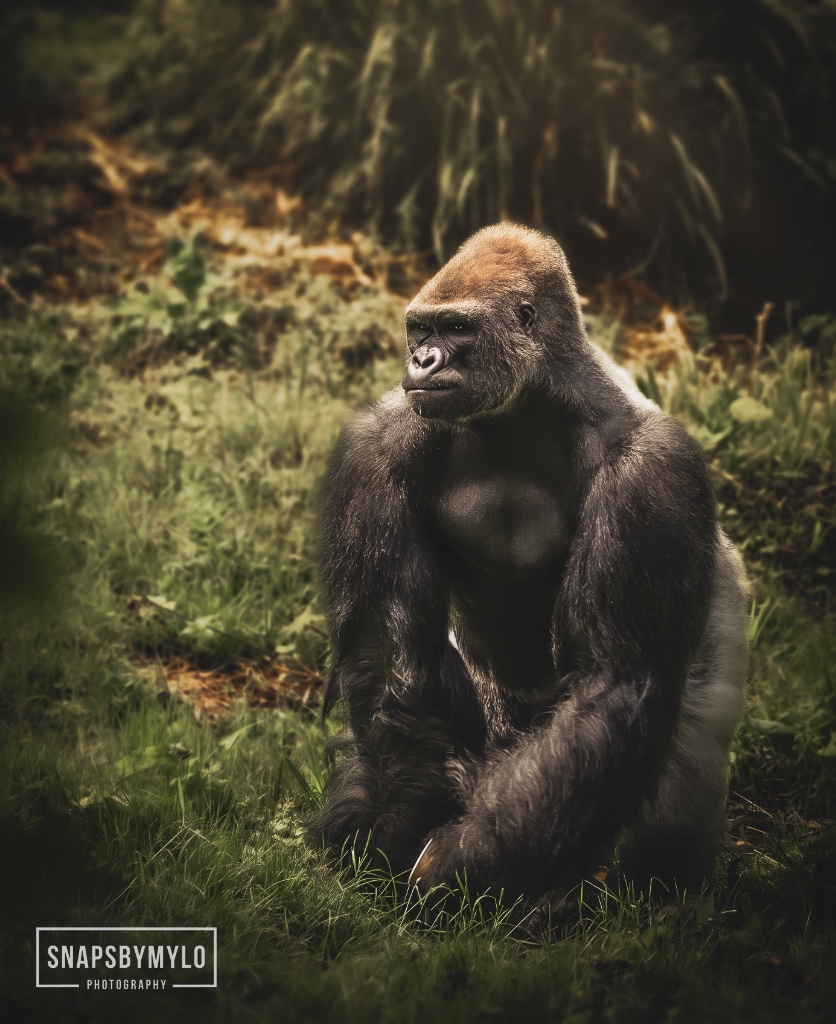
Photographing Gorilla
Introduction
Gorillas are not subjects you photograph — they are presences you earn the right to sit near. After years in the field, what strikes me most is not their physical scale but their psychological weight. A silverback at rest carries more gravity in a single glance than most animals carry in a lifetime of motion. What makes them extraordinary to photograph is precisely what makes them difficult: they are unhurried, deeply aware, and entirely indifferent to your agenda. That indifference, once you learn to work within it rather than against it, produces images that feel less like wildlife photography and more like portraiture. The reward is intimate, earned, and unforgettable.
Understand the Animal
Before you raise anything to your eye, spend time simply watching. Gorillas operate on a rhythm that has nothing to do with urgency. A group will move, feed, rest, and interact in cycles that — once you recognise them — become entirely predictable. That predictability is your greatest compositional tool. The silverback is the gravitational centre of everything. Watch him first. His posture tells you the emotional temperature of the entire group. When he sits square, arms loose, gaze drifting — the group is settled. When his brow lowers and his shoulders square forward, something has shifted his attention. It may be another male at the periphery, a sound from the forest edge, or simply your presence being re-evaluated. Do not move in these moments. Stillness is your permission to stay. Feeding behaviour is where you find texture and story. Gorillas feed methodically — pulling stems, stripping bark, selecting specific leaves with a precision that looks almost deliberate. Watch the hands. The hands are remarkable. They handle food with a gentleness that reads as consideration, and in strong light, the detail in those fingers against vegetation produces some of the most quietly powerful frames I have ever made. Juveniles are unpredictable and constantly in motion. They will tumble into frame, chase each other through undergrowth, and occasionally make brief, curious approaches toward observers. Do not anticipate drama from juveniles — anticipate surprise. The best juvenile frames tend to arrive when you have stopped trying to track them and simply held your position. Grooming between adults is slow, focused, and tender. It creates natural two-subject compositions where proximity and direction of gaze do all the compositional work. Watch for the moment one animal pauses mid-groom to look outward — that interruption in focus often produces the most emotionally resonant frames. Body language signals to learn: a relaxed, half-lidded gaze means comfort. Prolonged direct eye contact from a silverback is not aggression but assessment — hold your ground quietly. Yawning, though it looks aggressive, is often a displacement behaviour in settled animals. Chest beats are rarely preceded by stillness — watch for a slight forward lean and a rise in the shoulders before it happens. If you read it early, you are positioned. If you wait for the sound, the moment is already gone.
Look Before You Shoot
The single most valuable thing you can do when you arrive near a gorilla group is nothing. Sit. Settle. Let the scene breathe around you before you engage with it compositionally. Start by reading the light. In montane forest and dense jungle, light is not consistent — it moves, breaks, disappears, and reappears in ways that have everything to do with canopy cover and time of day. Identify where the warmest, most directional light is falling and consider whether any animal is currently positioned within it, or likely to move into it. Patience here is not passive — it is active calculation. Background discipline is everything in gorilla photography. The forest is visually complex: branches fracture your subject, bright sky gaps compete for attention, and tangled undergrowth can flatten what should be three-dimensional. Lower your position to separate your subject from a cluttered midground. A slight shift of even half a metre can move a distracting branch from behind the head of a silverback to behind his shoulder, and the image transforms entirely. Positioning relative to the group should be gradual and deliberate. Do not move toward the most interesting animal directly. Move at oblique angles, settle, wait, then reassess. Often the best position is not the closest one — it is the one that gives you a clean sight line with the right light falling across the face. Wait for the animal to give you something. A silverback seated in grass with his gaze turned slightly away from you is already a powerful composition — but if you wait, there will be a moment when he turns, when the light catches his brow, when his expression shifts from neutral to something that reads as depth. That moment, and only that moment, is the frame worth making. Everything before it is rehearsal.
Composition Ideas
The Silverback Gaze
Look for: A moment of direct but relaxed eye contact from a silverback — preferably with his body angled slightly away while his head turns toward you, creating tension between departure and presence.
Why it works: The asymmetry between body direction and gaze creates psychological pull. The viewer is drawn into a relationship with the subject rather than simply observing it. Combined with strong ambient light on the face, it reads as portraiture rather than documentation.
Hands in Context
Look for: Close framing on the hands during feeding — fingers wrapped around a stem, knuckles pressed into soil, or a single hand pulling vegetation against a softly lit background.
Why it works: Gorilla hands are one of the most humanising visual elements in nature photography. Tight framing isolates this connection and invites reflection without requiring the full animal to be in frame. The detail is the story.
Embedded in the Forest
Look for: A wider frame where the gorilla occupies roughly one third of the composition, surrounded and partially obscured by forest vegetation — grasses at the base, canopy above, dappled light filtering through.
Why it works: Context is everything. Showing the animal within its environment rather than extracted from it communicates belonging. The forest is not background — it is the subject's world, and including it honestly changes the emotional register of the image.
The Profile in Repose
Look for: A silverback or large female seated in true profile — chin slightly lowered, gaze forward, body mass settled. Ideally with a clean tonal separation between subject and background.
Why it works: Profile compositions convey dignity and stillness. The full form of the animal reads clearly, and when the light wraps around the face from the front, the profile becomes sculptural. It is one of the most timeless framings in wildlife photography.
Juvenile Motion Against Stillness
Look for: A juvenile moving through frame — climbing, tumbling, running — while an adult remains completely still in the same composition. The contrast in energy creates narrative.
Why it works: Two subjects behaving entirely differently within one frame tells a story about the group dynamic without a single word. The stillness of the adult anchors the chaos of youth, and the eye travels between them with genuine interest.
Grooming Geometry
Look for: Two animals engaged in grooming — pay attention to the angles their bodies create, the direction of their gazes, and the negative space between them.
Why it works: Grooming is one of the most intimate behaviours in any primate group. Photographically, it creates natural two-subject compositions where closeness, touch, and focused attention do the emotional work. The geometry of two bodies leaning toward each other is inherently compelling.
Rim Light and Dark Tones
Look for: A gorilla backlit or side-lit by directional forest light, creating a luminous edge along the crown of the head and the breadth of the shoulders against a darker background.
Why it works: The deep pigmentation of gorilla fur absorbs light beautifully, and a rim or edge light separates that darkness from the shadow of the forest behind. The result is a sense of weight and dimension that flat frontal light cannot produce.
The Contemplative Frame
Look for: A silverback seated and still, gaze directed to the middle distance — not at you, not at the group, but at nothing in particular. The expression registers as thought, even though that projection is ours to make.
Why it works: This is the frame that stopped me the first time I made it. When a large, powerful animal is completely still and apparently absorbed in something interior, the viewer leans in. The image asks a question it does not answer — and that tension is what makes people stay with a photograph.
Scale in the Landscape
Look for: A gorilla moving through tall grasses or dense undergrowth where the vegetation gives a genuine sense of scale — ideally framed so that the animal is partially obscured and clearly navigating rather than posing.
Why it works: Showing an animal in genuine relationship with its environment — moving through it, not simply sitting in it — communicates presence and vitality. The partial obscuring by vegetation reads as authenticity and rewards the viewer's eye as it searches through the frame.
Moments Worth Waiting For
- —A silverback turning his gaze directly toward you with a fully relaxed face — assessment without aggression, presence without threat.
- —The chest beat — specifically the brief moment of forward lean and shoulder rise that precedes the sound. The anticipation carries more tension than the act itself.
- —A juvenile making a cautious, curious approach before retreating — that moment of suspended decision is rarely longer than two seconds.
- —Feeding hands in warm directional light — especially when the grip is gentle and the fingers are clearly articulated against contrasting vegetation.
- —A group settling after movement — the transition from travel to rest, when bodies drop, breathing visibly slows, and the forest goes quiet around them.
- —Two animals holding sustained eye contact with each other — whether between a mother and infant or two adults in a moment of social negotiation.
- —A gorilla emerging from dense vegetation into open light — the brief transition between shadow and exposure before they adjust their movement.
- —A silverback yawning in profile — not as aggression, but as a displaced tension release that creates an unexpectedly intimate expression.
- —An infant riding on a mother's back through tall grass — the rhythm of movement and the infant's wide-eyed alertness above the grass line.
- —A moment of absolute stillness from a silverback seated at the forest edge — where the ambient light falls warm across half a face and the background falls to shadow.
Field Notes
What I noticed
The first thing that strikes you, sitting near a habituated group in the Virungas, is how ordinary it all feels — and how extraordinary that ordinariness is. These animals are not performing. They are living. The silverback I spent most time with had a habit of sitting slightly apart from the group in the late morning, in a small clearing where the light came through at an angle that felt almost deliberate. He would sit with one arm resting on a bent knee, gaze drifting, completely absorbed in whatever interior life he was running. I noticed the quality of his stillness — it was not the stillness of an animal that had stopped moving. It was the stillness of an animal that had decided to be still. There is a difference, and the camera reads it.
What I waited for
I waited for him to turn his head into the light. He had been seated facing roughly away from me for nearly twenty minutes, and I had not moved. When he turned — slowly, without any apparent reason — the light caught the ridge of his brow, the flatness of his nose, the depth of his eyes. I had perhaps four seconds before he shifted again. I made two frames. The second one was the image. Everything before that moment was waiting. I do not use the word patience, because patience implies endurance. This was attention. Sustained, quiet, expensive attention.
What I ignored
I ignored the juveniles for most of the morning. They were active, entertaining, and constantly moving — everything that seems like opportunity. But the energy of that movement kept pulling me away from the stillness I was building toward. I made a deliberate decision to let them go and hold my position relative to the silverback. The temptation to follow the obvious action is real and consistent in the field. Resisting it is a discipline that takes years to develop, and I still get it wrong sometimes.
What created the strongest image
The combination of physical stillness in the subject and directional warm light that separated his face from the background without flattening it. But more than that — it was the expression. There was something present behind his eyes that I cannot name and will not try to. The image works because it asks a question. What is he thinking? I do not know. Neither does anyone else. That uncertainty is the entire point, and it is the reason people stop when they see it. Not because of how it was made, but because of what it holds.
Conservation Insight
Both mountain and eastern lowland gorillas remain critically endangered. Habitat loss to agriculture and charcoal production, political instability across key ranges in the DRC, Uganda, and Rwanda, and the ongoing threat of snare poaching continue to reduce viable populations. There are fewer than 1,100 mountain gorillas left. Ethical tourism and international conservation funding have proven genuinely effective in stabilising numbers — but the margin is narrow. Every image made with care and intention is an act of advocacy. Photograph with that weight in mind.
Instagram Feed Cover