Photographing Leopard
Introduction
Leopards demand nothing from you. That is precisely what makes them so difficult — and so rewarding — to photograph. They operate entirely on their own terms: resting when they choose, moving when they decide, vanishing before you've even registered what you saw. Time in the field with a leopard is rarely about action. It's about presence. Stillness inside chaos. A leopard draped across a dark branch, amber eyes cutting straight through you, the coat doing something impossible with available light — those frames don't happen because you were fast. They happen because you were paying attention long before you ever raised your camera.
Understand the Animal
Leopards are solitary, largely crepuscular, and extraordinarily adapted to concealment. Before you can compose a frame worth keeping, you need to understand what they are doing and — more importantly — what they are about to do. Start with the tail. A leopard's tail is a live telegraph wire. When it hangs relaxed and curved at the tip, the animal is settled. When it begins to flick — short, sharp movements at the very end — attention has shifted. Something has registered. Watch where the ears go next. Ears forward, body low, tail still: a leopard watching prey. Ears flattened and rotated sideways: discomfort, possible aggression, or awareness of another predator nearby. At rest — which is where you will spend the majority of your time with a leopard — the animal cycles through distinct phases. Deep sleep, where the head drops fully and the body softens into the branch or rock. Light rest, where the eyes open periodically to scan, often only halfway. And alert rest, where the body remains still but the eyes are fully open, tracking something you likely cannot see yet. That third phase is the one to prepare for. The animal is computing. Feeding behaviour offers extraordinary compositional opportunity, but requires patience in approach. A leopard with a kill in a tree will feed in concentrated bursts, then rest, then feed again. It repositions constantly — turning the carcass, adjusting its grip, stepping around it. Anticipate the moment it lifts its head between pulls. That is when the blood-stained face, the intent expression, and the environmental context combine into something raw and true. Social encounters between leopards are rare and brief. A female with older cubs will tolerate them near a kill for weeks, but the interactions themselves — a cub attempting to take a piece, the mother's warning look, the submission that follows — happen in seconds. You will not get a second chance. Movement cues to anticipate: when a resting leopard begins to groom its paws, it often does so before settling for a longer rest — you may have minutes. When it yawns and stretches a foreleg, a position shift or descent is frequently coming. When it lifts its nose slightly and turns its head without moving its body, it has scented something. Stay with it.
Look Before You Shoot
Before you even consider framing, spend time simply reading the scene around the leopard. This discipline separates the images that feel discovered from those that merely document. First, assess the background. Leopards choose their resting spots with an instinct for concealment, which means they are almost always surrounded by visual complexity — branching trunks, dappled shadow, layered canopy. That complexity is your greatest compositional asset if you control it, and your worst enemy if you don't. Move your position — even by half a metre — until the background either separates from the animal or deepens into something intentional. A cluttered background at eye level becomes a rich frame of weathered wood when you drop lower. Light on a leopard behaves unlike light on almost any other subject. The rosette pattern absorbs and scatters simultaneously. In hard sidelight, the coat reveals extraordinary three-dimensional texture — the dark spots becoming shadow pools, the tawny ground colour warming toward amber. In softer, diffused light, the coat flattens slightly but the eyes ignite. Understand which quality of light you are working in before you position. Patience here is not passive. It is active reading. Watch the animal's breathing. Watch the light shifting across the scene. Watch what is entering the background — a bird moving through, a second vehicle approaching, the wind pulling at nearby grass. None of these are irrelevant. Position yourself at or below the animal's eye level whenever possible. A leopard resting on a branch, photographed from below at a slight upward angle, becomes architectural — the branch becomes a stage, the framing tightens, and the relationship between predator and environment becomes something you feel rather than simply see. Resist the urgency to shoot immediately. Settle. Read. Then let the frame come to you.
Composition Ideas
The Branch as a Stage
Look for: A leopard resting or moving along a horizontal branch with clear separation between the animal's body and the background — ideally with negative space below or beside the frame.
Why it works: The branch becomes a compositional line that guides the eye directly to the subject. The elevation creates a natural sense of dominance without forcing it, and the empty space around the animal adds tension and presence.
The Eye Contact Lock
Look for: The precise moment a resting or alert leopard turns its gaze directly toward you. Amber eyes, forward-facing, fully lit — even a fraction of a second of true eye contact.
Why it works: Eye contact collapses distance. It transforms a photograph of an animal into an encounter. The viewer is no longer a spectator — they are inside the frame. With a leopard, that feeling carries real weight.
Emerging from Shadow
Look for: The animal moving from deep shade into a band of direct light — the moment the coat transitions from dark and flat to fully revealed, with rosettes catching the light edge-on.
Why it works: The visual contrast between concealment and revelation is what a leopard's existence is built on. Capturing that threshold — not fully hidden, not fully exposed — creates an image with genuine narrative tension.
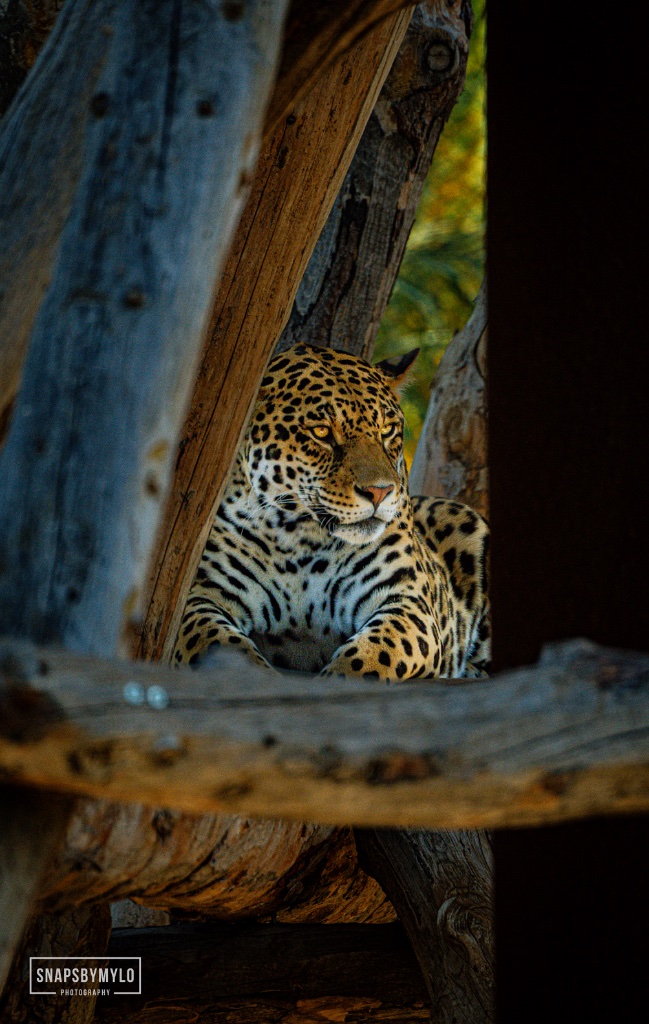
Framed by Trunks
Look for: Two or more vertical tree trunks or branches creating a natural frame around the leopard's body or face, particularly when the subject is in sharper focus than the framing elements.
Why it works: The trunks act as a visual doorway — drawing the eye inward toward the animal while embedding it within its environment. The photograph feels like something glimpsed rather than posed, which is exactly right for this animal.
The Stretch and Reach
Look for: The full body extension that occurs when a leopard stretches after rest — front paws extended, back arched, tail lifted. Often preceded by a yawn.
Why it works: Full-body stretches reveal the leopard's extraordinary physicality in a single frame. The elongated form, the muscle tension visible beneath the coat, and the casual power of the gesture are impossible to manufacture — you have to wait for it.
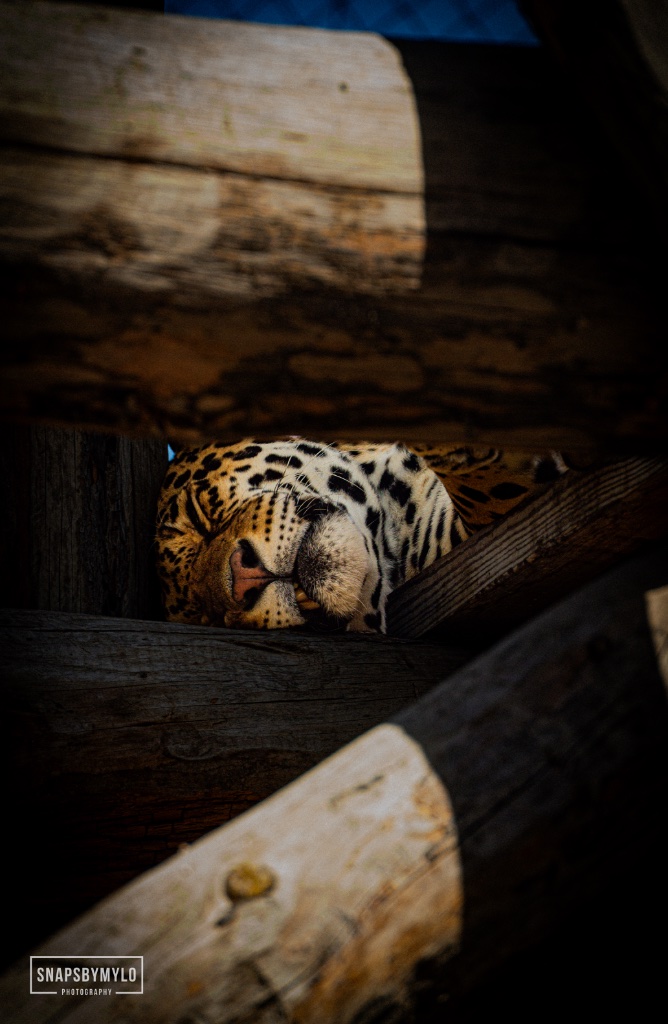
Head Below the Branch
Look for: A leopard hanging its head downward over the edge of a branch — either watching something below or simply resting in that characteristic dropped-head posture.
Why it works: This posture is uniquely, iconically leopard. No other large cat rests this way with such regularity. The geometry of the drooping head against the branch creates a composition that is immediately recognisable and visually surprising.
The Grooming Sequence
Look for: A leopard working through a grooming routine — licking paws, wiping the face, working along the flank. Look for the precise moment the tongue appears or the paw is raised to the face.
Why it works: Grooming drops the animal's guard visibly. The posture opens, the expression softens, and the behaviour reveals something intimate that pure predator shots rarely achieve. It humanises without diminishing.
Kill in the Tree
Look for: A leopard feeding or resting alongside a hoisted kill — look for the interplay between the carcass, the branch structure, and the animal's position. The moment the head lifts between feeding bites is the critical one.
Why it works: A kill in a tree is a leopard fully expressing what it is — powerful, resourceful, and entirely apart from the rules that govern every other predator. That context makes even a simple resting frame extraordinary.
Negative Space and Solitude
Look for: A lone leopard positioned toward one edge of the frame with open sky, canopy, or plain behind it — the surrounding emptiness intentional and significant.
Why it works: Leopards are profoundly solitary. Giving the frame space around the animal expresses that solitude visually. The empty portion of the image is not wasted — it is the point.
Light on the Coat
Look for: A shaft of hard directional light falling across the leopard's flank or shoulder, revealing the full rosette pattern in high contrast. Works especially well at low sun angles when light rakes across the fur at a shallow angle.
Why it works: The leopard's coat is one of the most visually complex surfaces in the animal world. Hard raking light turns it into something almost topographic — the rosettes become three-dimensional, the ground colour shifts in warmth, and the texture becomes the subject as much as the animal itself.
Moments Worth Waiting For
- —Direct amber eye contact held for more than two seconds — the full weight of the animal's attention on you
- —The yawn-and-stretch sequence immediately after waking from deep rest — full body extension, all four limbs, tail raised
- —A descent from the tree — the deliberate, almost slow-motion way a leopard backs down a trunk before dropping
- —The head-below-the-branch hang — dropped muzzle, half-closed eyes, tail trailing — the posture that belongs only to this animal
- —First light or last light hitting the coat at a low angle, the rosette pattern catching in three dimensions
- —A feeding pause — head lifted from the kill, blood on the face, eyes scanning — raw and completely unguarded
- —A cub interaction with the mother — a grooming moment, a rebuke, a shared resting position that shows both animals in the same frame
- —The moment a leopard scents something — the subtle nose-lift, the ear rotation, the body going completely still while the mind accelerates
- —Rain-wet coat — the rosette pattern deepens in colour and contrast, and the animal's discomfort makes its expressions more expressive
- —The precise instant of disappearance — the spotted flank sliding behind a trunk, the tail the last thing visible before the animal is gone
Field Notes
What I noticed
She had been on that branch for nearly three hours before I arrived, and she hadn't moved in any meaningful way for the last forty minutes of that. What I noticed first was the tail — barely moving, just the tip, in a slow half-curl that told me she was in light rest rather than truly asleep. The eyes opened every few minutes, scanned left, then closed again. The branch was dark, heavily textured, and the trunks around it created these natural vertical frames I hadn't seen from the vehicle until I repositioned slightly to the right. The light was dropping at an angle that was catching the far side of her shoulder — not the face yet, but moving.
What I waited for
I waited for the light to reach her eyes. It took another twenty-two minutes. In that window, I watched her shift position once — a minor adjustment of her front paws — and I watched the background empty of a vehicle that had been sitting at the wrong angle behind me. When the light finally hit her face, both eyes opened fully and she looked directly toward me. Not through me, not past me — at me. I had perhaps four or five seconds of that. I used all of them.
What I ignored
I ignored the impala herd moving through the midground behind her. They were creating movement and some noise, and twice the guide suggested she might descend to hunt. She didn't, and I was glad I hadn't chased that story. The real frame was always the stillness. I also ignored the urge to move closer when the light first changed — my position was working and I didn't want to risk breaking whatever stillness she had accepted us into.
What created the strongest image
The combination of those dark, weathered trunks framing her — almost symmetrically, without me planning it — and the quality of her attention when she finally looked at the lens. The coat was doing something extraordinary in that light: the rosettes on her shoulder were almost sculptural, and the amber of her eyes was the same tone as the warm light catching the branch below her. It wasn't a dramatic frame. There was no action, no kill, no movement. It was just her, in full presence, and the photograph knew it.
Conservation Insight
Leopards are listed as Vulnerable on the IUCN Red List, with populations declining across large portions of their historical range. Habitat fragmentation, retaliatory killing by livestock farmers, and illegal trade in skins and bones are the primary pressures. Outside protected areas, leopards are largely invisible to the communities that share land with them — which is both a survival advantage and a conservation liability. Photographs that convey the intelligence and presence of this animal matter. The closer people feel to what they might lose, the more likely they are to care about the policies and land-use decisions that will determine whether leopards survive the next fifty years.
Instagram Feed Cover
Photographs of Leopard
Fine art prints available in limited and open editions.