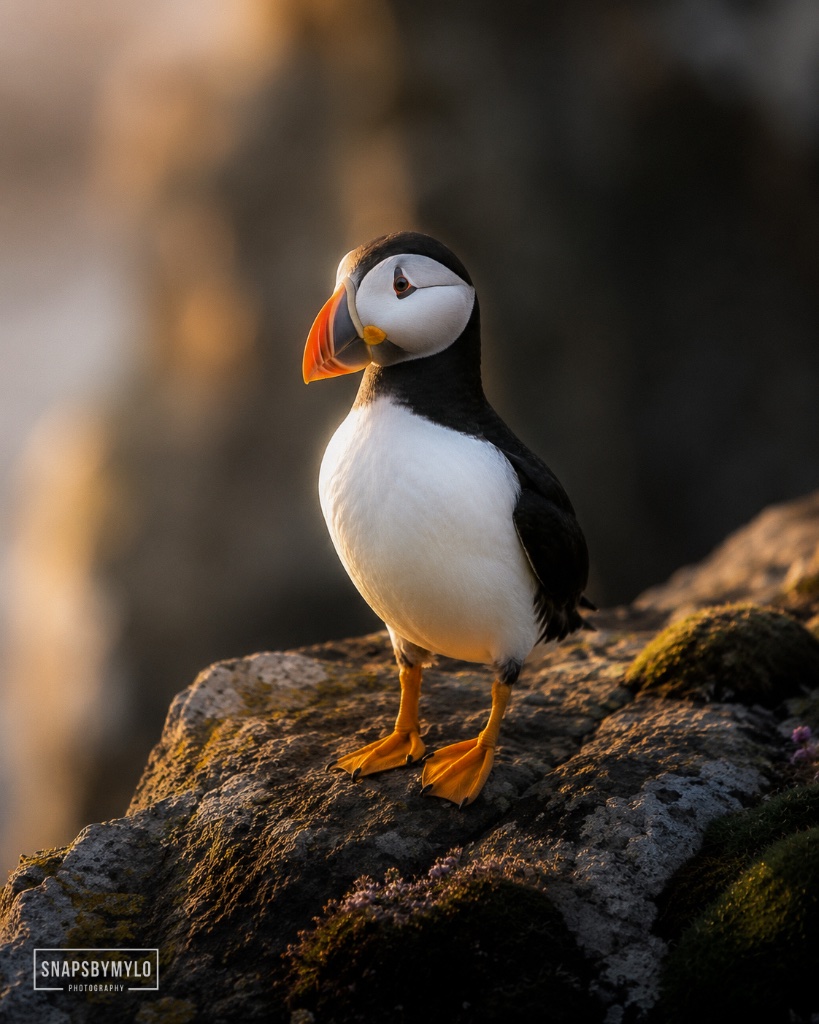
Photographing Atlantic Puffin
Introduction
Atlantic Puffin are deceptively easy to underestimate. They stand at the edge of a cliff, round and still, and first-time visitors assume the shot is obvious. It rarely is. What makes them genuinely rewarding is the sheer density of behaviour packed into a small body — the bill-loaded fish runs, the clumsy landings, the colony arguments, the stillness that suddenly breaks into something extraordinary. They reward patience and punish impatience in equal measure. Spend real time with them and you stop seeing a cartoon bird. You start reading their posture, anticipating their exits, feeling the rhythm of a colony. That rhythm is where the strongest photographs live.
Understand the Animal
Atlantic Puffin are colonial nesters, and that colony structure shapes almost everything they do during the breeding season — which is the window most photographers have access to them. They return to the same burrow year after year, and that territorial familiarity means they carry themselves with a certain confidence on land that can be mistaken for tameness. It is not. They are acutely aware of their surroundings and will flush if you push too close too fast. Learn to read posture before anything else. A puffin standing tall and rotating its head in slow, deliberate arcs is scanning — it is alert but settled. A puffin crouching low with its bill angled toward the ground is preparing to enter its burrow, and the moment is about to end. A puffin tilting its head skyward and holding that position is often about to vocalise — a low, purring growl that is easy to miss at distance but signals social engagement. Watch for this. It is one of the more intimate moments available to you. Bill displays are central to puffin social life. Two birds engaged in mutual billing — rapidly tapping their beaks together — are bonded pairs reinforcing their relationship. It happens quickly, lasts seconds, and is easily missed if you are not already reading the scene before it begins. When you see two birds perched close together, oriented toward each other rather than outward, stay ready. Something is about to happen. Fish arrivals are among the most kinetic moments the species offers. A returning bird carrying sand eels will approach the burrow with urgency, often banking hard in the wind before dropping onto the clifftop. The landing is rarely graceful — puffins hit the ground with more enthusiasm than precision. That scramble, the wings out, feet forward, bill full, is a photograph worth positioning for. Watch the flight lines. Puffins returning to their burrows tend to use consistent approach paths. Study where birds are coming from, not just where they are sitting. Juvenile or inexperienced birds show more hesitation around burrow entrances — hovering nearby, retreating when disturbed. Established adults move with purpose. Learning the difference between the two tells you how much time you likely have before the moment resolves.
Look Before You Shoot
Before you raise your frame to compose a single shot, spend time simply watching. Sit down. Let the colony forget you are there. This is not patience as a virtue — it is patience as a technical strategy. The birds closest to you after ten minutes of stillness are behaving more naturally than the birds you photographed in the first two minutes of arrival. That difference is visible in the image. Read the light before you read the birds. Atlantic Puffin colonies are often exposed headlands and cliff edges — places where the light changes dramatically with the angle of the sun and the movement of cloud. The golden-hour rim light that wraps around that black-and-white plumage and catches the orange of the bill exists in a window of perhaps twenty minutes. Know where that window falls before the birds arrive in it. Position accordingly. Background control is one of the most undervalued decisions in puffin photography. The dark basalt and mossy rock formations of colonies like Skomer, Staffa, or the Treshnish Isles give you an inherently strong canvas — textured, deep, and tonally contrasting against the white of the bird's face. But colony vegetation can also clutter a frame badly. Take time to find angles where the background separates cleanly from the subject. Move left or right before you commit to a position, not after. Pay attention to where burrow entrances are relative to the light and your line of sight. A bird perched at the entrance to its burrow with clean sky or dark rock behind it, in the last light of the evening, is the setup you are building toward. Identify that burrow early in the session and give it the space and time it needs. Crowding it will empty it. Watching it from a respectful distance will fill your frame when the bird is ready.
Composition Ideas
The Clifftop Silhouette
Look for: A single puffin or pair positioned at the very edge of the cliff against an open sky, particularly at dawn or dusk when the sky holds colour and depth.
Why it works: The compact, round body shape of Atlantic Puffin reads as a perfect silhouette. Even with no colour detail, the form is instantly recognisable. The open sky creates scale and context — you feel the exposure of their world.
Rim Light on the Plumage
Look for: Low-angle golden or warm light striking the bird from behind or the side, separating the black back from the background and illuminating the bill's orange and yellow tones.
Why it works: The contrast between the bird's crisp black-and-white plumage and the rim light creates a natural separation from dark rocky backgrounds. The bill becomes almost luminous. This is the light that reveals texture and dimension in what could otherwise be a flat subject.
The Loaded Bill
Look for: A returning bird perched with a full bill of sand eels, arranged in that characteristic horizontal fan — multiple fish heads visible on one side, tails on the other.
Why it works: The loaded bill tells a complete story in a single frame. It is a portrait and a narrative simultaneously. The colour of the fish against the orange bill creates an unexpected palette that draws the eye through the image.
Bill Touching — Bonded Pairs
Look for: Two birds facing each other, bills making contact or about to. Look for the slight forward lean that precedes the contact — bodies weight-shifted toward each other.
Why it works: Mutual billing is one of the most intimate behaviours in the colony. Two birds in contact creates a compositional V-shape that naturally draws the eye inward to the point of connection. The behaviour gives emotional weight to what would otherwise be a double portrait.
Environmental Framing — Burrow Entrance
Look for: A puffin framed within the natural arch or dark recess of its burrow entrance, surrounded by soil, grass roots, or rock.
Why it works: The burrow frames the bird organically. It creates depth, context, and a sense of place. You understand immediately that this is a nesting bird — the image is about the animal's relationship to its habitat, not just the animal.
Eye-Level Rock Portrait
Look for: Getting physically low — down to the bird's eye level — and composing against dark textured rock with the bird's eye sharp and the background falling soft.
Why it works: Eye-level contact removes the hierarchy of the observer above the subject. You are in the bird's world, not looking down at it. The dark mossy rock provides a background that anchors the colour of the bill without competing with it.
The Incoming Landing
Look for: Birds approaching the clifftop on final approach — wings spread, feet forward, often angled into wind. Study the regular flight lines returning birds use and pre-frame that space.
Why it works: A puffin in motion is a completely different subject to a perched one. The outstretched wings reveal the full span and the aerodynamic awkwardness that makes the species endearing. Motion creates tension and life in a frame.
Colony Context — Bird and Landscape
Look for: Stepping back from the tight portrait to include the habitat — clifftop grasses, the drop to the sea, other birds scattered across the scene. One sharp bird in a field of context.
Why it works: Not every puffin image needs to be a close portrait. A wider frame that places the bird within the landscape tells the fuller story of where and how these birds live. The scale of the cliff against the small bird shifts the viewer's emotional register.
The Stare — Direct Eye Contact
Look for: A moment when the bird's eye is oriented directly at your position — the full triangular face of the puffin looking squarely into the frame. Wait for this rather than triggering on a three-quarter view.
Why it works: Direct eye contact creates an immediate and undeniable connection between subject and viewer. The puffin's eye — dark, ringed with red and blue orbital detail during breeding season — is one of the most striking features of the bird at close distance. Full eye contact stops the viewer.
The Wing Stretch
Look for: A perched bird extending one or both wings in a stretch before or after preening. It is brief but telegraphed — watch for a rolling shrug of the shoulders before the full extension.
Why it works: The wing stretch breaks the compact, rounded silhouette entirely. It reveals the size and musculature of the bird in a way that perch portraits never do. The contrast between the familiar shape and this sudden opening is visually surprising.
Moments Worth Waiting For
- —A bird returning to its burrow carrying a full bill of sand eels — watching it land, gather itself, and disappear into the earth
- —Mutual billing between a bonded pair — the rapid bill-tapping that lasts only seconds but carries everything
- —Direct eye contact from a settled, unbothered bird — the moment it chooses to look at you rather than past you
- —A wing stretch from a perched bird — the body language rolls through the shoulders before the wings extend, giving you a half-second of warning
- —A bird vocalising — head tilted upward, throat working, the low growl audible only when the wind drops
- —The scrambled landing of a fish-carrying bird — feet forward, wings back, slightly chaotic and entirely alive
- —Two birds in a territorial dispute at a burrow entrance — posturing, lunging, bill-grappling that erupts and resolves fast
- —A bird preening in warm side-light — slow, methodical, completely absorbed and unguarded
- —The quiet moment just before a bird takes flight — the weight shift forward, the lean into wind, the three-second pause before departure
- —First light on the colony as birds emerge from burrows and begin their morning activity — the whole clifftop waking up at once
Field Notes
What I noticed
The birds on the outer edge of the colony — furthest from the main burrow clusters — were consistently more relaxed and willing to hold their position. The dense centre of the colony was constant movement and interruption. The peripheral birds gave me time. I also noticed how much the wind shaped the session. On high-wind days, landing birds hit the clifftop with more drama and less control, and the fish-carrying arrivals were more chaotic and more photogenic.
What I waited for
I spent the better part of an evening session committed to one specific burrow entrance on the south-facing edge of the colony, where the late light was striking at almost horizontal. I waited for a returning bird to land, settle, and turn toward the light. It happened twice in ninety minutes. Both times it was worth the wait. The second time, the bird held the position for nearly forty seconds — looking directly at the camera with a full bill of fish and the warm light wrapping around its back. That was the frame.
What I ignored
I ignored the birds in the middle of the colony where there was too much background activity and no clean separation between subjects. I also stopped trying to photograph the flight lines — the light was wrong for it and I was positioned badly for the approach angles. Some sessions teach you what not to do as much as what to do. Letting go of those shots and focusing on what was actually working in front of me was the right call.
What created the strongest image
The dark mossy rock. That background was everything. The contrast it created against the white of the face and the orange of the bill was clean and immediate, without any distracting colour or texture competing for attention. The rim light did its work because the background was dark enough to let it show. The bird's eye was sharp and forward-facing. It was not a technically complicated frame — it was a patient one.
Conservation Insight
Atlantic Puffin are listed as Vulnerable on the IUCN Red List, with populations in decline across much of their range. The pressures are interconnected — shifting sea temperatures moving sand eel populations away from traditional feeding grounds, increased predation pressure from expanding gull populations, and the long-term disruption of breeding cycles through climate-driven timing mismatches. They are long-lived birds that invest heavily in single offspring, which makes population recovery slow. Every breeding pair that successfully fledges a chick matters. Visiting colonies mindfully — keeping distance, staying on designated paths, never approaching burrows — is a form of active participation in their survival.
Instagram Feed Cover