Photographing Red Fox
Introduction
Red foxes reward patience in a way few animals do. They're neither predictable nor entirely wild — they exist in that uncomfortable overlap between human and natural worlds, which is exactly what makes them so compelling to photograph. A fox at rest carries more tension than most animals in motion. The ears never stop working. The eyes hold something unreadable. What draws me back, season after season, isn't the obvious shot — the running fox, the leaping fox — it's the quiet ones. A fox settled on a gravel path in golden hour light, fur burning rust and amber, completely still but completely awake. That's the image. Learning to read them gets you there.
Understand the Animal
Red foxes are crepuscular by nature — most active around dawn and dusk — but don't be fooled into thinking daylight hours are unproductive. Urban and semi-urban foxes in particular have adjusted their rhythms significantly. A fox seen mid-morning in a park or field margin isn't lost or sick; it's often simply comfortable. That comfort is something to read carefully. Watch the ears first. A fox's ears are its primary communication tool and its early warning system. Both ears forward and slightly cupped means the animal is locked onto something — a sound, a movement, a smell. One ear rotating independently while the body stays still means it's cataloguing its environment without committing to a response. Flattened ears signal stress or submission — if you see this, you've likely pushed too close. The tail, or brush, tells you almost as much. A fox carrying its brush low and relaxed is calm. Raised and slightly puffed, it's alert or excited. Tucked between the legs is a stress signal — back off and give space. Feeding behaviour is one of the most photogenic sequences to anticipate. Foxes hunt by scent and sound, not sight. When you see a fox stop mid-stride, lower its nose to the ground, and begin a slow, deliberate weave — it's tracking. The pause before the pounce is the frame. The weight shifts to the hindquarters, the brush lifts slightly, the spine curves. It happens fast, but the preparation is slow enough to read if you've been watching. Social behaviour between foxes — particularly in late autumn and winter during the mating season — produces some of the most dynamic interactions. Vixens will vocalise and chase, dog foxes will circle and display. Even outside of mating season, juvenile foxes playing at the den entrance in late spring offer moments of pure spontaneity: rolling, mock-fighting, batting at each other with front paws. Learn to distinguish a resting fox from a sleeping one. A resting fox is curled or stretched with its eyes half-open, nose still working, ears still moving. A sleeping fox is entirely switched off — rare in open spaces. Resting foxes wake with intent. Anticipate the stretch, the yawn, the moment they rise and scan before moving. Those transitional seconds are where the strongest images live.
Look Before You Shoot
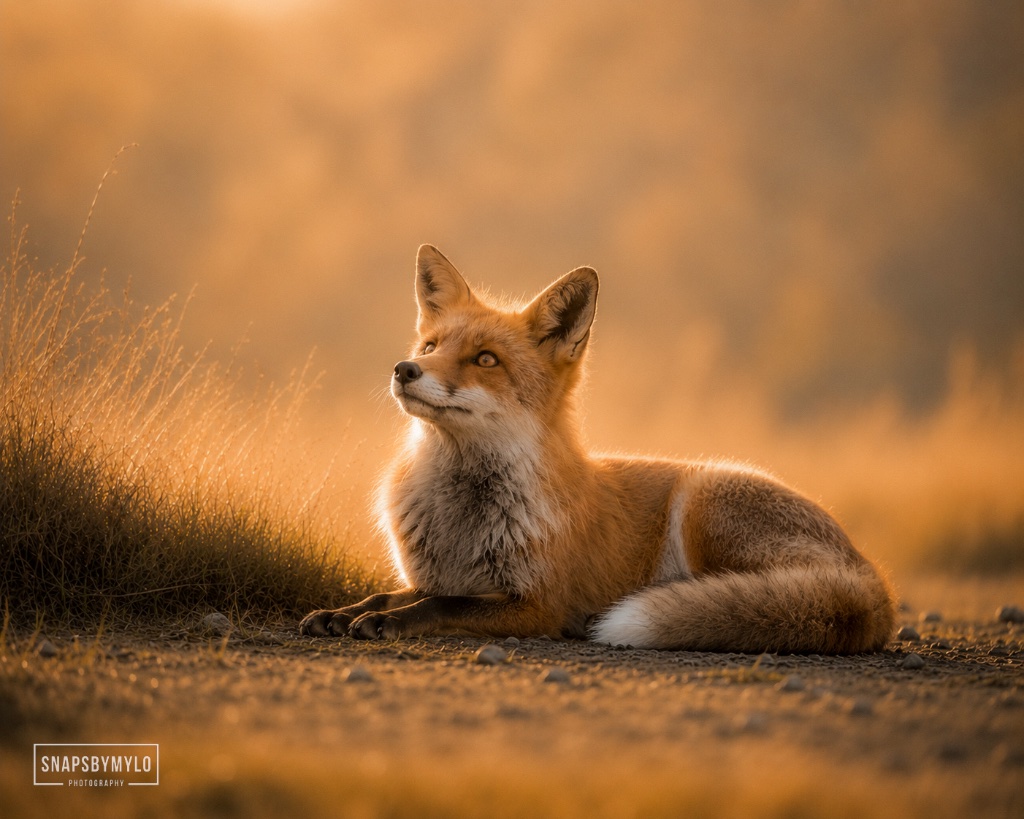
Before you raise anything to your eye, stop. Spend the first ten minutes of any encounter doing nothing but watching. This is not wasted time — it is the most productive thing you can do. Read the scene before the animal does. What is the light doing? In golden hour backlight, as with a fox resting on pale gravel, the entire tonal language changes. That rust-orange coat catches and holds warm light in a way that separates the subject completely from the background. The gravel path reflects just enough ambient light to keep shadow detail without flattening the image. None of that requires you to move — it requires you to notice. Background control is everything. A fox photographed against a cluttered treeline reads very differently from the same fox set against open shadow or soft, out-of-focus foliage. Before you position yourself, ask what is directly behind the animal. Get low if you need to — even a small drop in your own height can shift a busy background into clean, open sky or shaded grass. Position yourself with the light, not against it. With backlit subjects, a slight angle off the direct line can produce rim lighting that traces the fox's fur with a fine line of gold — one of the defining qualities of a strong backlit fox image. That positioning is intentional. You look for it before the fox moves. Patience is not passive. While you wait, track changes: the fox shifting position, a shadow moving across the scene, another animal appearing at the edge of frame. The gravel path in this instance adds texture and environmental context — it tells a story about where this animal lives. Blank, sterile surroundings produce blank images. Let the environment into the frame deliberately. Once you've read all of this, then you're ready.
Composition Ideas
Rim Light and the Fur Edge
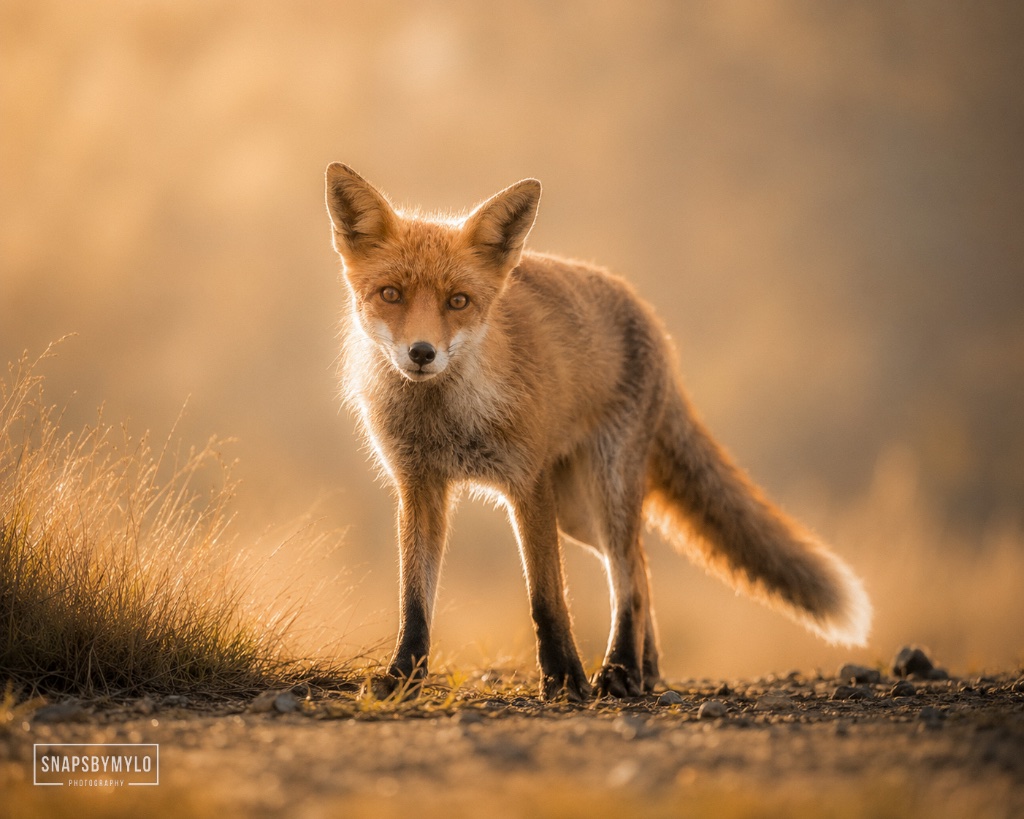
Look for: Position yourself so the low sun sits behind or just to the side of the fox. Look for the moment when the outline of the fox's ears, head, and brush catch the light and separate from the background with a thin golden line.
Why it works: Backlit fox fur behaves unlike almost any other animal coat — the fine guard hairs glow individually. This rim light creates instant depth and separates the subject from its environment with a naturalness that front-lit images can't achieve.
The Grounded Rest
Look for: A fox lying down or settled low on a textured surface — gravel, leaf litter, grass. Get to the animal's eye level entirely. The horizon should be low, the background should fall into clean, defocused tones behind the subject.
Why it works: Low-angle resting shots strip out environmental clutter and force the viewer into the fox's world. The texture of the ground surface anchors the subject and provides environmental storytelling without overwhelming the frame.
The Alert Triangle
Look for: A fox in the moment of stopping — head up, ears forward, one front paw slightly raised. The body forms a natural triangle of tension. Frame tightly enough that the negative space in front of the animal's gaze gives the image room to breathe.
Why it works: This is peak body language. The shape is inherently dynamic even in stillness. The raised paw creates movement tension — the viewer senses what might happen next. Leave space in the direction the fox is looking.
Pre-Pounce Weight Shift
Look for: As the fox prepares to hunt, watch the hindquarters lower and load. The brush rises. The nose drops. Frame wide enough to capture the full body curve — this is about the arc of the spine, not just the face.
Why it works: The pre-pounce position is one of the most recognisable and specific fox behaviours. It communicates hunting instinct, precision, and wild behaviour in a single frame. The arc of the spine against open ground is visually powerful.
Eye Contact in the Open
Look for: The moment a fox looks directly at you — not startled, not fleeing, but considering. This is a brief, earned window. It requires you to have been still long enough for the animal to assess and partially accept your presence.
Why it works: Direct eye contact with a predator carries a quality that no other moment replicates. With foxes, the amber-gold iris against rust fur is a colour pairing that photographs with extraordinary richness. The gaze holds the viewer.
Fox in Context — The Environmental Frame
Look for: Pull back from the close portrait. Include the path, the hedgerow, the field margin, the urban edge. Let the fox occupy one third of the frame with its environment telling the rest of the story.
Why it works: Foxes are animals of edges — woodland margins, park boundaries, suburban gardens. Including that edge environment in frame communicates something true about the animal's life. Context deepens a photograph.
The Yawn or Stretch
Look for: As a resting fox transitions to movement, watch for the full-body stretch — front legs extended, back arched, mouth open in a wide yawn. It lasts only two or three seconds. Anticipate it rather than react to it.
Why it works: The stretch is one of the most expressive and visually satisfying movements in a fox's repertoire. Open mouth, bared teeth, extended posture — it's the opposite of a composed portrait and more honest for it.
The Brush as Compositional Weight
Look for: Frame the fox so the brush — especially when full and winter-thick — sweeps into the lower or side portion of the composition. In a sitting or curled fox, the brush wraps around and acts as a framing element within the image itself.
Why it works: The tail is the fox's most distinctive physical feature. Treating it as a compositional element rather than an afterthought adds visual richness and emphasises what makes this animal visually unique.
Two Foxes, One Story
Look for: Where two foxes share a space — siblings, a mated pair — watch for the moment their body language mirrors or responds to each other. One looking away while the other looks toward. Physical contact or deliberate distance. Frame both without splitting the composition equally.
Why it works: Interaction immediately introduces narrative. A single fox is a portrait; two foxes in a frame become a story. The space between them is as important as the animals themselves.
Into the Light — The Silhouette Exit
Look for: A fox moving away from you into strong backlight, particularly at dawn or dusk when it walks a ridgeline, path edge, or field margin. Let the exposure lift the background and drop the fox toward silhouette.
Why it works: The fox's outline — particularly with brush extended — is immediately recognisable in silhouette. This approach trades detail for atmosphere and produces images that feel both cinematic and elemental. Resist the urge to stop it from happening.
Moments Worth Waiting For
- —The full-body stretch transitioning out of rest — spine arched, front legs extended, tail raised
- —Direct eye contact at close range when the fox has settled enough to look back without alarm
- —The mid-hunt pause — nose to ground, weight loaded, complete stillness before the pounce
- —A genuine yawn — wide mouth, visible teeth, ears flattened briefly, entirely unselfconscious
- —Two foxes grooming each other or making physical contact, particularly in late winter
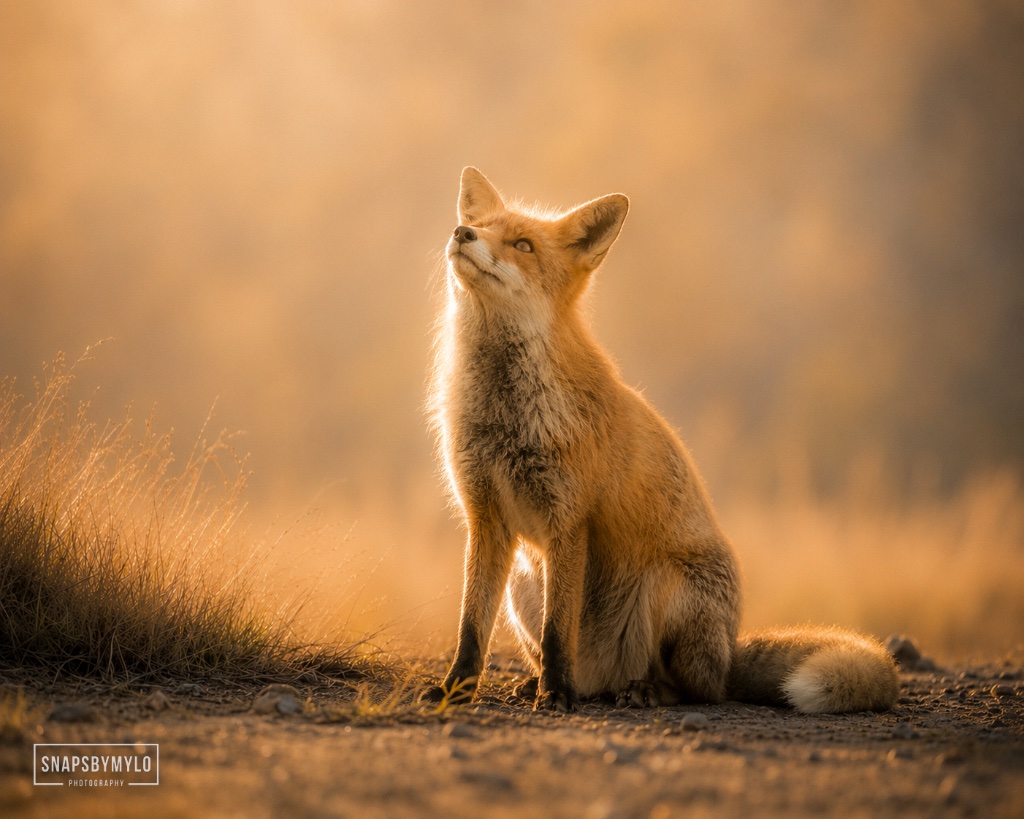
- —A fox sitting upright in profile, ears independently tracking two different sounds simultaneously
- —The exact moment a fox lifts its head from rest and scans the environment before moving
- —Backlit fur catching rim light at the precise angle where individual guard hairs separate and glow
- —A fox moving along a defined path or edge in flat, directional evening light casting a long shadow
- —Juvenile foxes at a den entrance in late spring — uncertain, curious, interacting clumsily with each other
- —A fox pausing mid-step with one paw raised, caught between motion and stillness
Field Notes
What I noticed
The fox had been on the gravel path for nearly eight minutes before I even considered framing. It wasn't moving. That's the kind of stillness that makes you want to act too early. What I noticed first was the quality of the light hitting the back of its ears — the fur there is finer, and in backlight it goes almost translucent at the edges. The gravel was doing something useful too: reflecting just enough warm light back up into the shadow side of the face to keep it readable. The background — out-of-focus mid-tones — wasn't accidental. I'd moved slowly to my left over about four minutes to clear a wooden post that was sitting directly behind the animal's head.
What I waited for
I waited for the fox to lift its head. It had been resting with its chin low, eyes half-closed, processing the environment through its ears. I knew that at some point it would raise its head fully and scan — foxes do this on a rhythm even at rest. When it did, the ears came fully forward, the chin came up, and for about four seconds it was exactly as I'd hoped. The backlight caught the full length of the brush, the face was in three-quarter view, and both eyes were open and sharp. That was the frame.
What I ignored
I ignored two foxes that broke from the hedgerow further down the path approximately twelve minutes into the session. Any other day I might have moved toward them. But this fox was already in good light, in a clean position, and I'd spent real time letting it settle. Abandoning that for the unknown felt like poor decision-making, not good instinct. I also ignored a flight of birds that crossed the background briefly — I didn't want the distraction of reframing and losing the window I'd built.
What created the strongest image
Patience and low angle. The two are inseparable here. The image only works because I was already at ground level and because I hadn't moved in a way that pushed the fox off the path. The warmth of the light is something you can't manufacture — you either put yourself in the right place at the right time or you don't. But being low meant that the gravel became a textured foreground leading directly to the animal, the background fell away completely, and the rim light defined the entire silhouette edge. None of that was lucky. All of it was waited for.
Conservation Insight
Red foxes are classified as Least Concern globally, but that status masks real pressures at a local level — illegal persecution, habitat fragmentation, and vehicle strikes remain significant. Urban fox populations face growing human conflict and increasingly fragmented green corridors. Photographing foxes with care — maintaining genuine distance, never baiting with food, never habituating animals to close human presence — matters. An image taken ethically costs nothing and demonstrates that wildlife has value beyond utility. The fox in the frame is an ambassador for every fox that will never be photographed.
Instagram Feed Cover
Photographs of Red Fox
Fine art prints available in limited and open editions.