Photographing Squirrel Monkey
Introduction
Squirrel monkeys are relentless. They don't pause for you, they don't pose, and they rarely offer the kind of stillness that photographers usually chase. What they offer instead is something richer — personality, chaos, and the occasional, fleeting moment of absolute quiet that stops you cold. Their faces hold something almost human: wide-eyed curiosity framed by masks of pale fur, golden bodies catching forest light like copper. Photographing them well has nothing to do with speed and everything to do with learning how they think. Once you understand their rhythms, the forest starts to tell you what's coming next.
Understand the Animal
Squirrel monkeys move in troops, and that troop structure is your greatest navigational tool as a photographer. They rarely travel alone. When one appears at the edge of a canopy gap, assume there are twenty more behind it. The troop moves with a loose, rolling momentum — they don't all pause at the same time, but they do share environmental responses. When feeding activity slows and the group begins to cluster and groom, that's your window. That's when individuals settle, when faces turn to the light, when hands rest on bark and eyes go soft. Learn to read the ears and posture. A squirrel monkey with its body low and angled toward a branch is foraging — scanning for insects or fruit, head tilting, fingers probing bark and leaf. This is high-energy and unpredictable movement, but it produces authentic expressions. A monkey sitting upright with weight settled evenly across both feet is resting or observing. This is your frame. This is the stillness worth waiting for. Tail use is a reliable behavioural signal. Squirrel monkeys use their tails for balance, not gripping — so when the tail is relaxed and draped, the animal is comfortable. When it's raised and active, the animal is alert, potentially about to move. Watch the tail before you watch the face. Social interactions are brief and electric. Two individuals meeting on a branch will often hold eye contact for a moment before one defers — that micro-moment of social negotiation is worth anticipating. Juveniles, in particular, are extraordinarily expressive. They shadow adults, they play-wrestle near resting spots, and they occasionally freeze in a posture of wide-eyed stillness that reads beautifully in a frame. Feeding behaviour varies by resource. When foraging for insects, movement is jittery and exploratory. When fruit is available and plentiful, the animal settles. It holds. It eats slowly. That metabolic pause is your strongest behavioural cue — position yourself before it ends. In Amazonian and Central American forests, look for activity peaks in the early morning and mid-to-late afternoon. The middle of the day is often flat, social, and slow. Slower is better for you.
Look Before You Shoot
Before you raise anything to your eye, spend time simply watching. This sounds obvious. It isn't. The instinct when you see a squirrel monkey is to react immediately — and that reaction almost always produces a mediocre frame. The animal is half-obscured, the background is chaotic, the light is behind it. Reacting to the first appearance almost never gives you the strongest image. Instead, identify the scene before the subject enters it. In forest environments, look for patches of directional light — shafts breaking through canopy, warm pools on mossy trunks, brighter gaps where the canopy opens. These are your stages. Position yourself relative to a scene you've already assessed, then wait for the animal to arrive. Background discipline is everything. Squirrel monkeys live in cluttered, visually complex environments. A clean frame requires you to find a sight line where the foreground and background separate — where a dark shadow or a depth of foliage creates negative space behind your subject. Get low, or move laterally, until the background simplifies. Even a small shift in your position can pull a monkey cleanly off a chaotic tangle of leaves. Light direction matters enormously in forest photography. Flat, even light produces flat, even images. Directional side-light — the kind that rims a cheekbone, catches the texture of fur, and pools in the hollow of a large eye — creates depth and warmth. Squirrel monkey fur is deeply saturated orange-gold. Directional light activates that colour. Flat light kills it. Patience in this context doesn't mean waiting passively. It means watching actively — tracking troop movement, predicting where individuals will settle, reading the sequence of behaviour. You are reading a story in real time. The photograph is not the first chapter.
Composition Ideas
The Anchored Perch
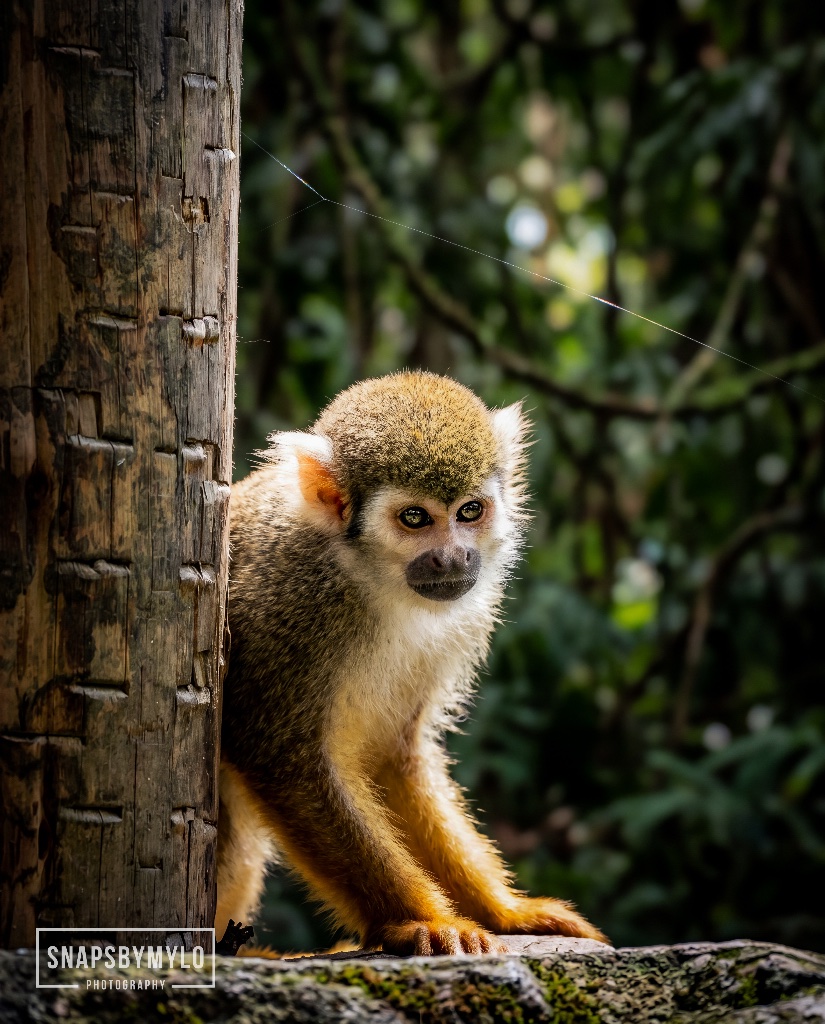
Look for: An individual settled on a horizontal branch or mossy trunk, body weight evenly distributed, hands resting rather than gripping
Why it works: The physical stillness creates visual stability. The texture of aged bark against golden fur gives the frame contrast in both tone and material. This is the posture where faces open up and eyes become the subject.
The Face in the Frame
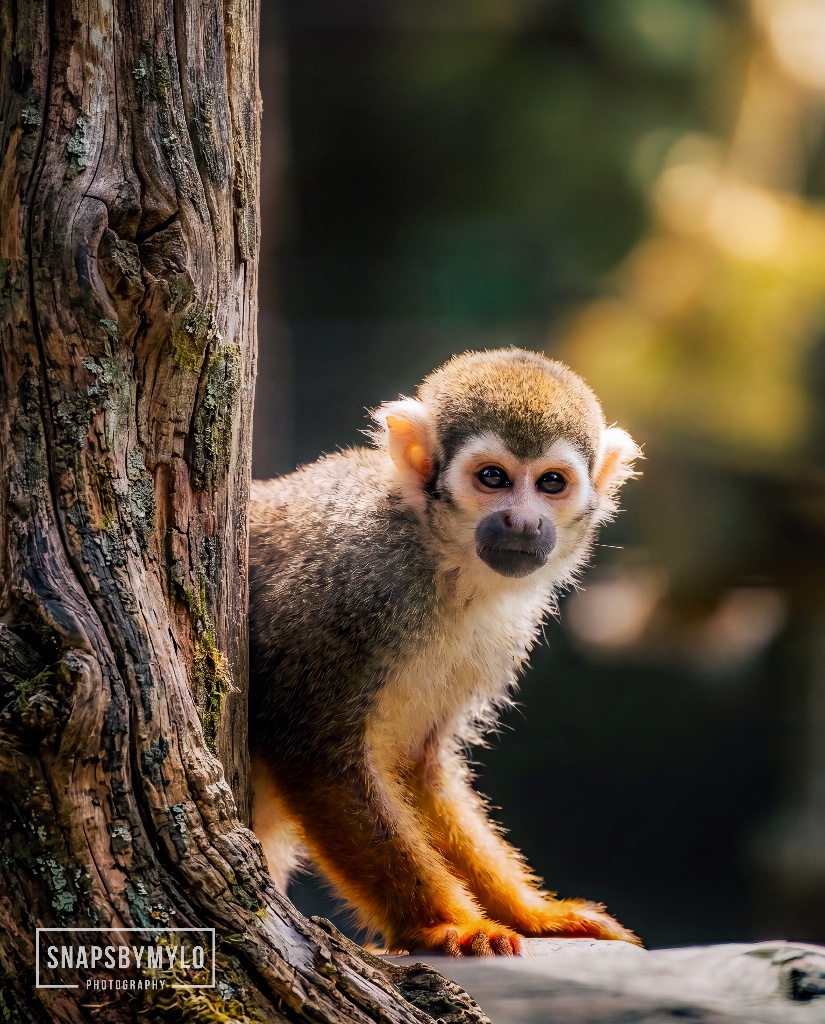
Look for: Moments where the monkey's face turns toward open light — particularly the white facial mask and large dark eyes catching directional warmth
Why it works: The squirrel monkey's face is graphically striking — pale mask, dark eye-ring, amber iris. When lit from the side, the face reads as portraiture. The contrast between the bright mask and dark surrounding fur draws the eye immediately.
Hands on Texture
Look for: Slender fingers resting on or exploring weathered wood, bark, or moss — particularly when the hand is open rather than clenched
Why it works: Squirrel monkey hands are surprisingly human in proportion and movement. An open hand on textured surface creates an intimate detail frame that communicates something tactile and personal. It's a quiet image in a loud subject.
The Canopy Silhouette
Look for: An individual paused against a bright canopy gap or open sky, ideally with the tail draping downward and head in profile
Why it works: Silhouette removes colour and detail and forces the viewer to read shape and posture. Squirrel monkeys have a distinctive compact body and long, expressive tail that reads clearly in profile. The contrast between subject and bright sky is inherently dramatic.
Social Geometry
Look for: Two or more individuals sharing a branch — looking in different directions or engaged in grooming — with their bodies creating a natural triangular or diagonal composition
Why it works: The relationship between individuals carries narrative weight. Multiple subjects give the eye a path to travel through the frame. Look for moments where their eye-lines diverge — it implies a wider, unseen world.
Environmental Context
Look for: A single individual small within a larger scene — framed by a cathedral of roots, vines, or canopy — rather than filling the entire frame
Why it works: Pulling back to show habitat communicates scale and belonging. The monkey becomes part of the forest rather than isolated from it. This is the frame that tells people where the animal lives.
The Direct Gaze
Look for: Eye contact — brief, direct, curious — where the monkey has registered your presence but chosen stillness over flight
Why it works: Eye contact between subject and viewer creates a connection that no other frame can replicate. With squirrel monkeys, this moment is rare and short. But their eyes — large, round, expressive — hold extraordinary weight when they face the lens.
Motion Against Stillness
Look for: One individual moving through frame while another remains stationary — particularly useful at forest edges where light and shadow divide the scene
Why it works: The contrast between motion and stillness within a single frame creates energy and storytelling. The static subject anchors the eye while the moving subject implies life, activity, and a broader world in motion.
The Juvenile and the Elder
Look for: A juvenile shadowing or touching an adult — particularly during rest periods when size contrast is most visible
Why it works: Scale difference communicates biology and relationship without a word. Juveniles carry an innate visual appeal, but pairing them with an adult creates context and hierarchy. This is a frame about family, which is what squirrel monkey troops fundamentally are.
Rim Light on Fur
Look for: Directional backlight or side-backlight catching the edge of the fur along the spine, crown, or tail — creating a luminous outline against a shadowed background
Why it works: The orange-gold fur of a squirrel monkey becomes almost incandescent when backlit. A dark background amplifies this effect dramatically. The animal appears to glow. This is a purely photographic phenomenon — something the eye alone doesn't experience — and it elevates the frame from document to image.
Moments Worth Waiting For
- —The pause mid-forage — when a monkey freezes, head tilted, listening or watching, before resuming movement
- —Direct eye contact held for more than two seconds — rare, significant, and almost always the strongest frame of the session
- —A juvenile landing clumsily on a branch beside an adult and steadying itself against the older animal's body
- —A monkey raising both hands to its mouth to eat, the face framed symmetrically between its own forearms
- —The full-body stretch — arms extended overhead on a branch, belly exposed, face turned upward in what reads as pure physical ease
- —Grooming between two adults, one still and receiving, one focused and methodical — the intimacy of contact in a tight frame
- —A troop moving through a canopy gap in sequence, each individual briefly silhouetted against open sky before disappearing into cover
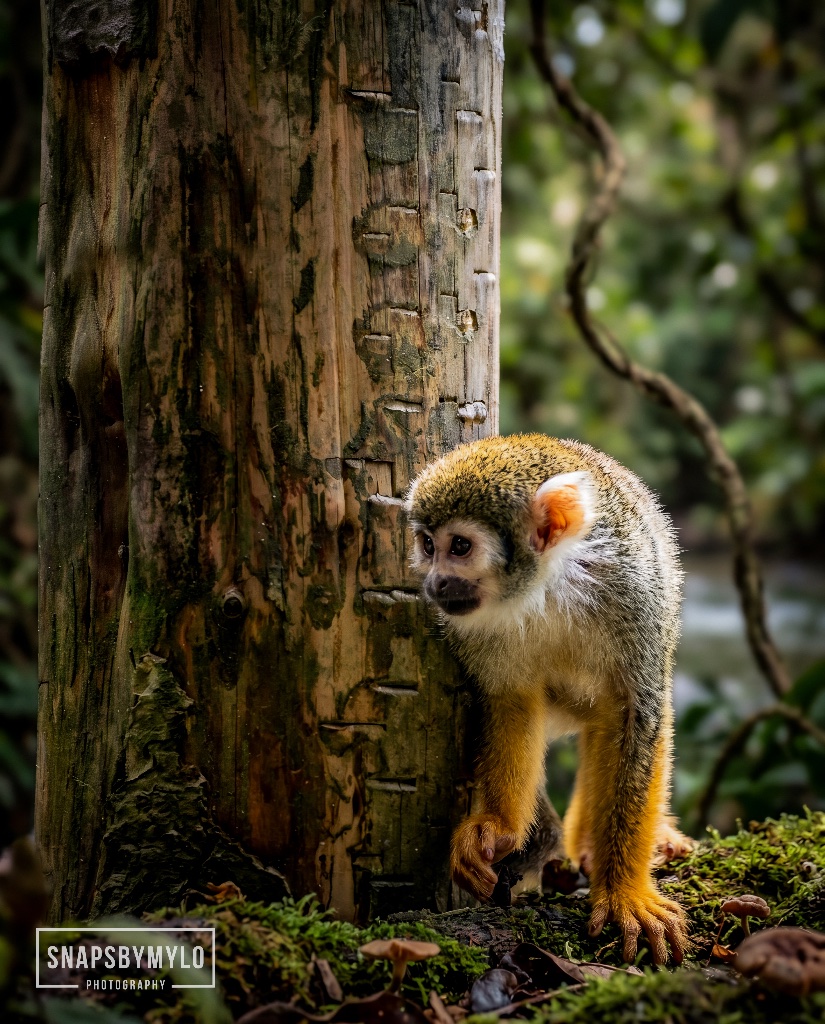
- —The investigative lean — a monkey bending forward from a branch, one hand extended for balance, examining something below with intense, narrowed focus
- —A moment of alarm response — the body low, every individual frozen, all eyes oriented in the same direction, before the troop decides to move
- —Warm afternoon light pooling across a single individual settled alone on an exposed branch, fur glowing, eyes half-closed in rest
Field Notes
What I noticed
The light only mattered when it came from the side. Every frame I made in flat overhead light looked like a record shot — accurate, but lifeless. When the afternoon light broke through at an angle and caught this individual from the left, the orange fur activated completely. The face came forward. The moss on the trunk went almost emerald. The image stopped being documentation and became something I actually wanted to look at.
What I waited for
I waited for the hands to rest. This monkey had been fidgeting — adjusting its grip, glancing around, picking at the bark. I held still. Eventually it settled. The fingers opened. The weight dropped through the legs. The eyes went to the middle distance. That was the frame. The moment the body stopped performing and just existed.
What I ignored
I ignored at least a dozen moments of action — leaping, scrambling, branch-to-branch movement. In the moment, action always looks like the obvious photograph. But the images that hold up are almost never the action frames. They're the frames where the animal is simply present. I've learned to let the movement pass.
What created the strongest image
The combination of textural contrast and directional light. Golden fur against grey-green weathered bark. Warm light on a cool surface. The large eye catching just enough light to show the iris. Nothing in the background competing for attention — just depth and shadow. I didn't manufacture any of it. I found a scene, read the light, and waited for the animal to enter it.
Conservation Insight
Several squirrel monkey species are under genuine pressure — habitat loss through Amazonian and Central American deforestation fragments troops and isolates populations. The Central American squirrel monkey is listed as Vulnerable. They are also historically affected by capture for the exotic pet trade and biomedical research. Photographing them well means photographing them with dignity — as complex, social animals embedded in ecosystems that are disappearing. Every strong image is an argument for why the forest they live in is worth keeping.
Instagram Feed Cover
Photographs of Squirrel Monkey
Fine art prints available in limited and open editions.