Photographing White Stork
Introduction
White Stork rewards the patient observer in ways that few birds can. They are large enough to read from a distance, predictable enough to position yourself ahead of, and expressive enough to give you genuine moments — not just records. Their relationship with open wetlands, agricultural edges, and traditional villages creates a layered context that elevates almost any photograph. The combination of clean white plumage, jet-black flight feathers, and that vivid red bill gives you contrast built by nature. But the real reward comes from learning to read what they are about to do. Anticipation is everything with White Stork. The bird always gives you a signal. The job is to already be watching when it does.
Understand the Animal
White Stork moves through its environment with deliberate intention. Unlike nervous waders that flush at the slightest pressure, stork hold their ground — but only if you understand how to approach them. They are not bold; they are habituated in some locations and genuinely wild in others. Learn to read which one you are dealing with before you move a single step closer. Feeding behaviour is your first lesson. A foraging stork walks slowly through shallow water or short grass with its bill angled slightly downward, scanning. The pace is rhythmic, almost methodical. When that pace stops — when the bird freezes mid-stride with one foot raised — something has been detected. This is a high-tension moment. The neck will compress, then extend fast. Strike. That explosive downward lunge happens faster than you expect. You cannot react to it. You anticipate it. Watch the neck. It tells you everything. A relaxed stork carries its neck in a soft S-curve. When the neck begins to straighten and the head draws back, a strike is coming. When the neck extends fully upward and the bird swallows, the moment has already passed. Learn to read the pre-strike compression — that brief moment of coiling energy — and you are already ahead. In social situations, stork are deeply communicative through posture. Bill clattering is the signature behaviour — head thrown back, bill snapped open and closed in rapid percussive bursts. This happens at the nest during pair bonding, during territorial display, and during greeting rituals between partners. It is theatrical, dramatic, and gives you extraordinary frame-filling moments if you are already positioned and watching the interaction build. Take-off is rarely spontaneous. Before a stork launches, it almost always crouches slightly, shifts its weight forward, and opens its wings a fraction — a half-second of pre-flight intent that you can learn to read. Use it. By the time those wings are fully spread, you need to have already reacted. The bird that is standing at the water's edge facing into a light breeze with its bill slightly raised is thinking about leaving. Watch it. At dawn, stork that have roosted communally will stand still for long periods before the day's activity begins — preening, stretching wings, engaging in short bill-clattering exchanges. This stillness is not wasted time. These are the conditions that create the strongest images. Warm, directional light. A bird not yet distracted by feeding. A moment of pure presence.
Look Before You Shoot
Before you raise anything to your eye, spend time simply watching. This is not a warm-up exercise — it is the most important thing you will do. Walk the location first. Identify where the light will fall and at what hour. Note what is behind the bird, not just in front of it. A White Stork with a clean sky or open water behind it is a fundamentally different photograph from the same bird in front of a tangled reed bed or a parked vehicle. Background control is not a technical decision — it is a positional one. Move your feet. Water-edge locations reward low positioning. Getting down to water level transforms the background from earth and vegetation into sky and reflected light. The stork does not change. The image transforms completely. Low and wide against open sky is one of the defining looks for wetland birds, and stork give it to you if you earn the ground position. Learn the bird's comfort distance at that specific location on that specific day. Approach on a diagonal — never head-on, never in a straight line toward the bird. Move during moments when the bird's head is down and feeding. Freeze when it looks up. This is not dramatic fieldcraft; it is simply how you arrive at close distances without changing the bird's behaviour. Light direction matters more than light intensity. Golden backlight at dawn — as in the image that inspired this guide — does something structural to a White Stork's plumage that flat overcast light never can. The black flight feathers transmit light differently than the white body feathers. Backlight separates those tones, creates rim lighting along the wing edge, and turns early morning haze into depth. Arrive before you think you need to. The best light is always the light you almost missed. Wait with a purpose. Know what moment you are waiting for before it arrives.
Composition Ideas
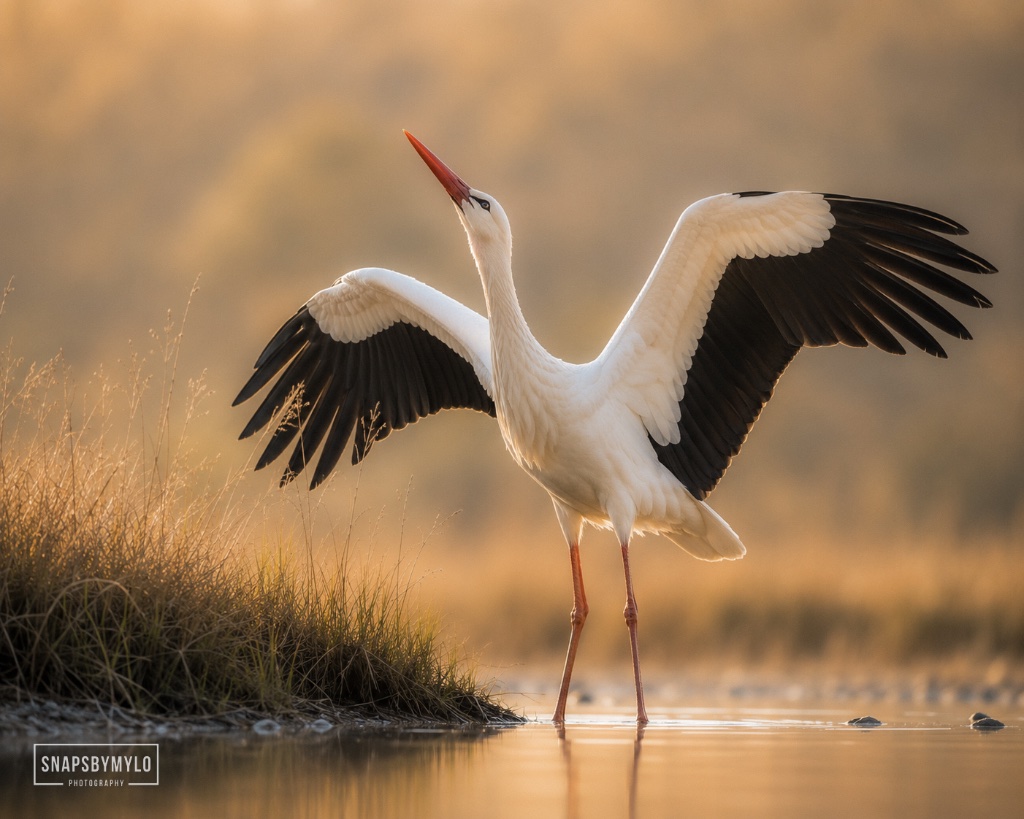
Backlit Wing Spread
Look for: A stork stretching or opening its wings fully at dawn or dusk with the light source behind the bird. Look for the moment when both wings are fully extended and the black flight feathers are illuminated from behind.
Why it works: Backlight separates the black and white tones that define the species. The wing spread creates an enormous, graphic shape that fills the frame with structure. Golden haze adds environmental atmosphere. This is the moment the photograph becomes about more than the bird.
The Pre-Strike Freeze
Look for: A foraging stork that has stopped mid-stride with its neck compressed and head drawn back. The bird is coiled. One foot may be raised. The water or grass around it should be calm.
Why it works: Tension without movement is one of the hardest things to photograph and one of the most rewarding when you get it. The still image carries the energy of what is about to happen. The viewer feels the anticipation.
Bill Clatter Portrait
Look for: At the nest or during pair greeting, position yourself level with the bird and wait for the head-back, bill-open posture of a full clatter display. Frame tight enough that the red bill and thrown-back neck fill significant space.
Why it works: The red bill against white neck is a graphic colour contrast. The open bill and extended neck create strong diagonal lines. It reads instantly as behaviour, not just a bird standing there.
Reflection and Still Water
Look for: Early morning before any wind disturbs the surface. A stork standing or wading in shallow water with a clean reflection forming below it. Look for symmetry — the real bird and its mirror image creating one unified shape.
Why it works: Reflection doubles the visual weight of the bird and anchors it to its environment. Still water light has a softness that works with the white plumage without blowing out detail.
Flight Against Dawn Sky
Look for: A stork in full flight silhouetted or semi-silhouetted against early morning sky. The wing position matters — look for the full downstroke where the wing creates its widest, most dramatic arc.
Why it works: Stork in flight create an immediately recognisable shape. The long neck extended forward and legs trailing behind create a horizontal line of pure movement. Against a tonal sky, the form alone carries the image.
Environmental Scale
Look for: Pull back and place the stork small within a large landscape — a flooded meadow, an open estuary, a traditional village with a rooftop nest. The bird becomes a detail within a story.
Why it works: White Stork are inextricably linked to their landscape. Showing that relationship contextualises the animal and creates images that communicate something beyond biology. The white of the bird still holds as a focal point even at small scale.
Low Angle Water-Level Frame
Look for: Get to water level and frame a wading stork with the horizon extremely low. The bird should be placed against open sky rather than vegetation. Look for the legs to be partially submerged, giving depth layers to the composition.
Why it works: Low angle shooting creates an intimate, immersive perspective that elevates the subject. The compressed background becomes tonal — sky above, water plane below — and the stork stands alone within it.
The Swallow
Look for: Immediately after a successful strike, the stork raises its head and tilts its bill upward to swallow. There is a brief moment where the prey is visible at the tip of the bill before it disappears. The neck distends slightly during the swallow.
Why it works: This is pure behavioural storytelling. It confirms the story — the hunt, the catch, the result. It is a complete narrative in a single frame. The eye is naturally drawn to the bill tip first, then moves through the frame.
Nest Life and Human Context
Look for: In traditional nesting villages across their European and African range, stork nest visibly on rooftops, chimney stacks, and telegraph poles. Frame the nest to include architectural context — terracotta tiles, old stone, weathered timber.
Why it works: The stork-and-village relationship is centuries old and carries cultural resonance that a wetland-only photograph cannot. These images tell a story about coexistence and build an emotional connection with viewers who may never visit a wetland.
Wing Preening in Stillness
Look for: A stationary stork drawing its bill along individual flight feathers, or extending one wing low and to the side in a long slow stretch. Often happens in morning warmth before flight activity begins.
Why it works: Preening creates angles and shapes the resting bird does not offer. The extended wing gives you geometry. The focused, contained quality of the behaviour creates an intimacy that active flight shots do not have.
Moments Worth Waiting For
- —The full wing-spread backlit against dawn sky — both wings simultaneously extended, black flight feathers glowing with transmitted light
- —Bill clattering between a bonded pair at the nest — head thrown back, rapid percussive display, necks crossing
- —The freeze before the strike — neck compressed, one foot raised, complete stillness before the explosive lunge
- —A clean swallow with prey visible at the tip of the bill, neck tilted skyward
- —First flight of the morning from a communal roost — multiple birds launching in sequence through low mist
- —Direct eye contact at close range with a bird that has become comfortable with your presence — that orange-red eye ring holds in a photograph
- —A stork landing on its nest with wings fully braked, legs forward, tail fanned — the full landing posture
- —Two birds in parallel flight, wingbeats synchronised, long necks and trailing legs creating matching horizontal lines
- —A stork standing completely still at the water's edge in heavy morning mist, the landscape dissolving behind it
- —A juvenile stork — bill not yet fully red, plumage slightly dishevelled — being fed at the nest by a parent
Field Notes
What I noticed
The first thing that stopped me was how the light was behaving on the water behind the bird — it was ahead of anything the bird itself was doing. The stork was standing still at the edge, just existing. But the backlight was already building that warm haze across the frame. I noticed the way the black wingtips caught the gold differently from the white body, and I understood immediately that if this bird opened its wings even partially, the tonal separation would be extraordinary. I watched that bird for close to forty minutes without the wing spread coming. It preened. It waded a few steps. It struck twice at something in the shallows. I stayed low and stayed still.
What I waited for
I was waiting for the wing spread — specifically a full spread, not a half stretch. I had seen the bird extend one wing twice in partial preening movements, which told me the behaviour was in the repertoire for this morning. I positioned myself so the light source was behind and slightly to the right of the bird. When the spread finally came, both wings extended simultaneously during what I believe was a thermoregulating stretch rather than a pre-flight behaviour. The timing — dawn light, open water background, full bilateral extension — was the convergence of everything I had been watching for.
What I ignored
I ignored every bird that was moving quickly, feeding actively, or positioned against a complex background. There were other stork in the scene — four or five working the far shallows — and at various points the activity over there was more obviously dramatic. I chose to stay with the single bird in the backlit position rather than chase the more active feeding behaviour in flat light. I also ignored the pair of stork on the nest structure to my left. The light on the nest was already high and harsh by the time I arrived. There was nothing to make there that morning.
What created the strongest image
The convergence of three things that had nothing to do with luck: position, patience, and pre-existing understanding of the behaviour. I was already low. I was already facing into the light. I already knew the wing spread was a possibility because I had watched this bird and understood what precedes it. The backlight did the structural work — separating those black flight feathers from the white body and burning a rim of gold along the leading wing edge. The haze added depth behind the bird that a clear sky never would have given me. The image works because the light, the background, and the moment all arrived together. That only happens if you are already in position waiting for it.
Conservation Insight
White Stork populations crashed dramatically through the twentieth century — a direct result of wetland drainage, agricultural intensification, and power line collisions. Western European populations have recovered partially through dedicated reintroduction programmes, nest platform projects, and electrification of dangerous power infrastructure. But across their African wintering grounds, habitat loss and pesticide use remain serious pressures. They are an indicator species — where stork thrive, functioning wetlands and low-intensity farmland still exist. Photographing them with care and intention contributes to a body of imagery that makes conservation arguments visual and emotional. Photographs change minds. Field time builds advocates.
Instagram Feed Cover