Photographing Tiger
Introduction
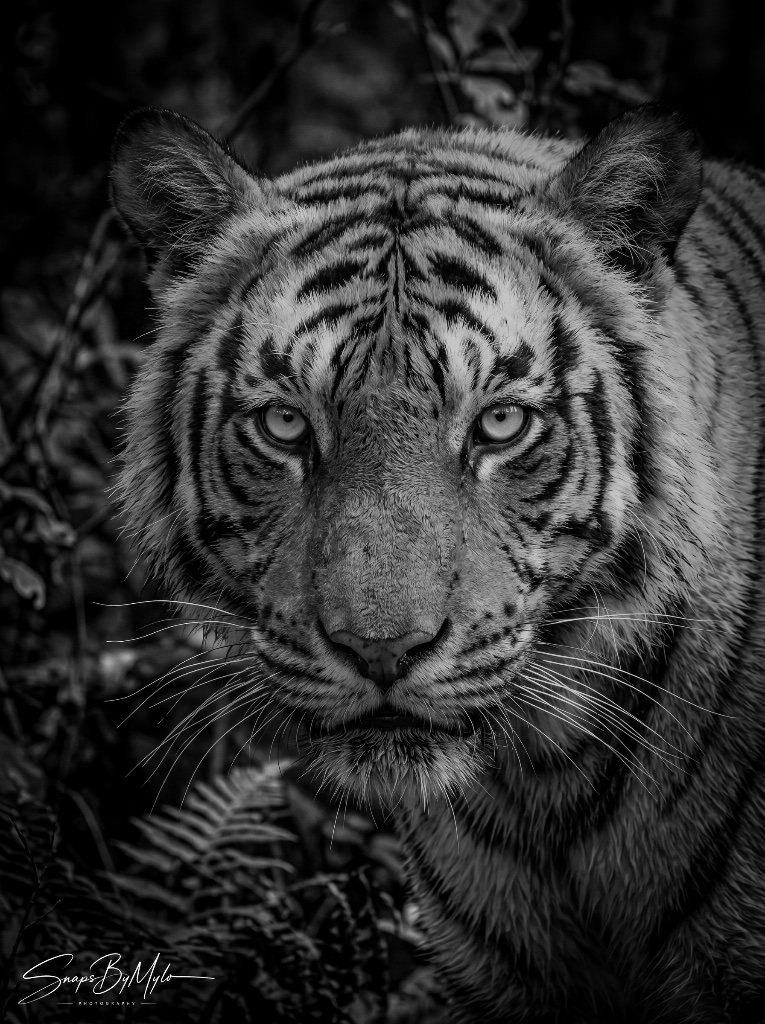
There is nothing casual about photographing a tiger. Every session demands full attention — not because the animal is dangerous, but because it is deliberate. Tigers move with intention, rest with awareness, and hold stillness in a way that makes every frame feel weighted. What makes them genuinely rewarding to photograph is contrast: between power and repose, between the fire of those amber eyes and the silence of a forest floor. They reward the patient. They punish the rushed. Spend enough time watching one and you stop thinking about photographs altogether — and that is exactly when the best ones happen.
Understand the Animal
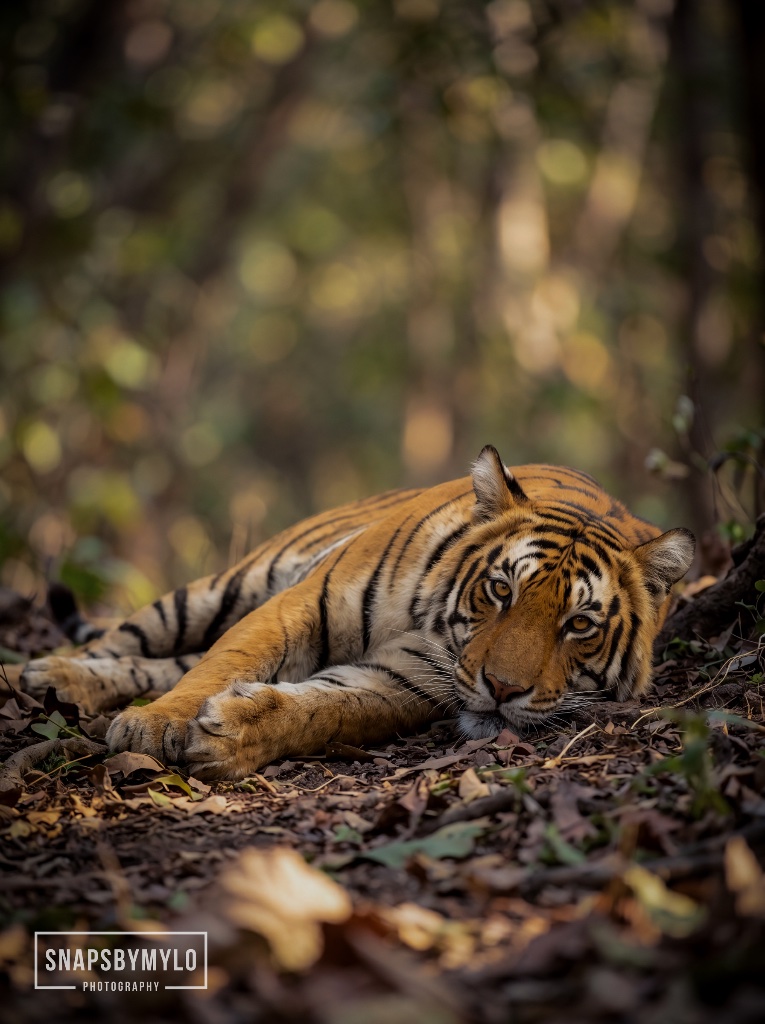
A tiger's day is largely structured around conserving energy. They are crepuscular hunters — most active at dawn and dusk — and during the middle hours, they rest. But resting does not mean switched off. A tiger lying in dry leaf litter is still reading every sound, every shift of wind, every movement at the edge of its sightline. Watch the ears. They rotate independently, like small radar dishes, before the head moves at all. That ear flick is your first signal that something has changed in the animal's awareness. The eyes will follow. Body language tells you the tier of interest. Flat relaxation looks like a heavy body pressed into the ground, jaw loose, paws splayed outward. Mild curiosity shifts the weight forward onto the elbows, head raised, eyes narrowing slightly. Active alertness brings the whole spine into a different geometry — the hindquarters tuck, the tail begins a slow, deliberate sweep low to the ground. That tail movement is critical. A slow, rhythmic tail sweep means focus. A faster, flicking tail signals agitation or heightened arousal. Learn to read this before the body commits to movement. Tigers are solitary and territorial, so most encounters are with lone individuals. Males hold vast ranges and patrol their boundaries with scent marking — you will often see a tiger pause at a particular tree or rock, raise its tail, and spray. This is a moment of stillness with purpose, and the body posture during it — upright, tail raised, face forward — is worth anticipating. Females with cubs move differently: lower, more deliberate, with frequent pauses to check surroundings before cubs are allowed to follow. Water is a behavioural magnet. Tigers are exceptional swimmers and actively seek waterholes during heat. At water, they lower their guard marginally — drinking requires the head down, the neck extended — and transitions between drinking, lifting the head, and scanning the bank create a rhythm you can learn to predict. Approach through woodland and pause at the treeline. Give the animal time to settle before you move into position. Finally, watch for yawning. It sounds minor, but a tiger's yawn — jaws fully extended, tongue curling, canines on full display — often signals a transition: from rest into movement, from sleep into wakefulness. It is a short window, but it is predictable if you have been watching long enough to recognise the build-up.
Look Before You Shoot
Before you raise anything, sit down with the scene. Literally. Lower yourself to the animal's eye level and look at what is behind it. The forest behind a resting tiger is rarely clean — there are branches cutting through the frame, bright sky gaps blowing out, competing colours fragmenting the background. Walk ten steps left or right and the entire backdrop can change. This is the work that happens before the photograph. Light direction matters enormously with tigers. The stripe pattern on a tiger's coat already creates its own internal visual complexity. Front-lit tigers flatten into graphic pattern. Side light — especially low morning or late afternoon sun raking across the body at an angle — separates the fur texture, defines the musculature, and makes the amber eyes glow from within rather than reflect. Position yourself with the light source behind your shoulder, not behind the animal. Background control is arguably the single most important compositional decision you will make. A tiger against a wall of uniform green or warm shadow becomes the only subject. A tiger against broken, cluttered forest becomes one element among many. Identify the sightlines where the background falls cleanly — open shade, distant treeline, the soft blur of dry grasses. Then wait for the animal to move into that space, or wait within it for the animal to arrive. Patience here is not passive. It is active observation. While you wait, you are noting the direction the animal's head turns most frequently, which part of the scene it scans, where it is likely to stand if something disturbs it. You are building a mental map of what the next thirty seconds might look like so that when it happens, you are already there.
Composition Ideas
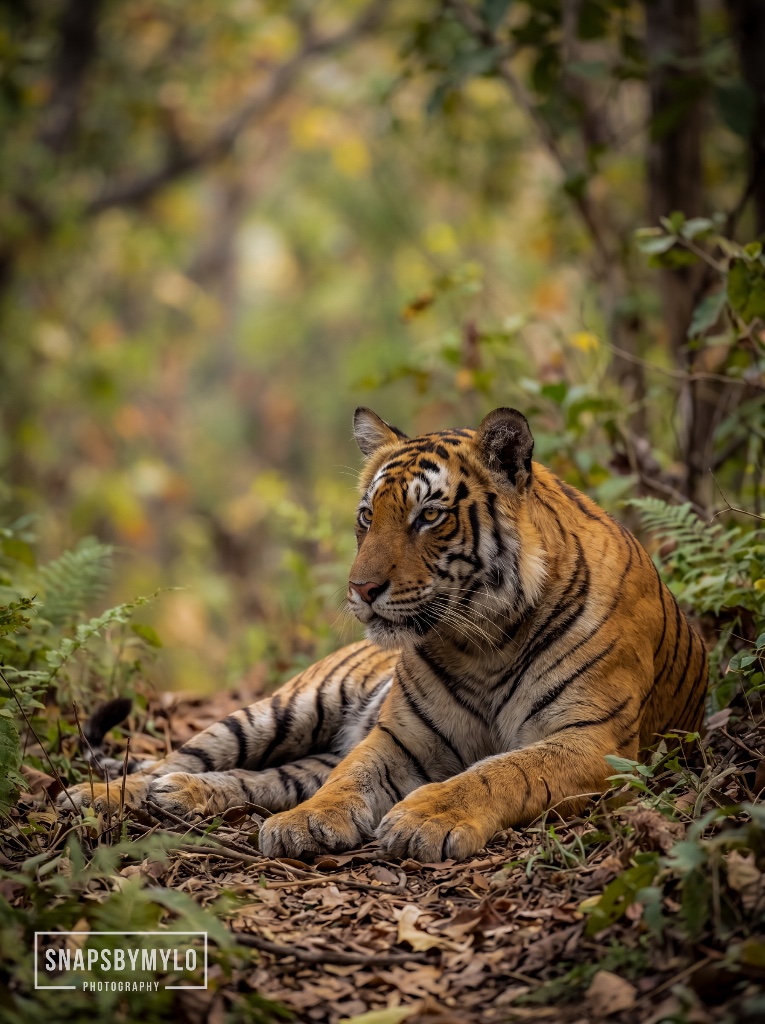
The Profile Lock
Look for: The head turned precisely side-on, with one full amber eye visible and the ear angled forward. Dry leaf litter or forest floor as the base layer.
Why it works: The tiger's profile reveals the full architecture of its face — the jaw line, the brow ridge, the depth of the eye socket. A single eye in profile carries more tension than a full face. The viewer is looking at the animal the way prey does — from the side, uninvited.
Eyes in the Grass
Look for: The animal's body low or partially obscured by tall dry grasses or undergrowth, with just the eyes and top of the skull visible above the line.
Why it works: Concealment is central to how a tiger exists. Showing only what the forest reveals — a slice of face, two watching eyes — puts the viewer inside the animal's world rather than outside it. The hidden half of the frame does more work than the visible half.
The Stripe and Shadow Geometry
Look for: Hard directional light falling across the body at an angle, making the black stripes cast micro-shadows on the orange fur. Best seen on the flank, shoulder, or haunches.
Why it works: The tiger's coat is already a compression of light and dark. When real light mirrors that pattern, the coat becomes three-dimensional — you can almost feel the weight of the animal.
Water Surface Reflection
Look for: The tiger drinking or wading at a waterhole or stream, the rippled reflection breaking up the lower frame.
Why it works: Reflection doubles the visual information and softens the boundary between the animal and its environment. Water also puts the tiger in a moment of need — head down, guard lowered — which reads as intimate rather than commanding.
Forest Frame
Look for: Two tree trunks or a natural gap in the treeline that frames the tiger within it as it moves along a path or sits in a clearing.
Why it works: Natural framing creates context and depth simultaneously. It tells the viewer: you are in a forest, and this animal belongs here. The frame within a frame also draws the eye directly to the subject with no ambiguity.
The Tail Arc
Look for: The slow sweep of the tail during a moment of alert focus — captured at the arc's furthest point, the tail curving away from the body against a clear background.
Why it works: The tail is a signal that most viewers do not consciously read but physically respond to. A tail mid-sweep communicates coiled intent. It transforms a still image into a moment just before something.
Compressed Foreground
Look for: Shooting through or just above dry leaves, low grasses, or forest floor debris, so the textured foreground occupies the bottom third of the frame with the tiger sharp in the middle distance.
Why it works: Ground-level framing places the viewer in the forest with the animal rather than above it. The foreground layer adds depth and environment, rooting the tiger in a specific place and time.
The Walk Away
Look for: The tiger moving away from your position, shot from behind or three-quarter rear, the stripes on the haunches and the slight sway of the walk filling the frame.
Why it works: Departure is an under-photographed moment. The tiger moving away creates unresolved tension — the question of where it is going, what it knows, what it has decided. The best departures feel like the animal has absorbed the scene and chosen to leave it.
Scent Mark Stillness
Look for: The tiger paused at a territory marker — tree, rock, or fallen log — body upright, tail raised, face forward or slightly turned. A moment of deliberate, full-body stillness.
Why it works: This posture conveys ownership without aggression. The animal is fully upright, fully present, and completely indifferent to your presence. That indifference reads as raw confidence in a frame.
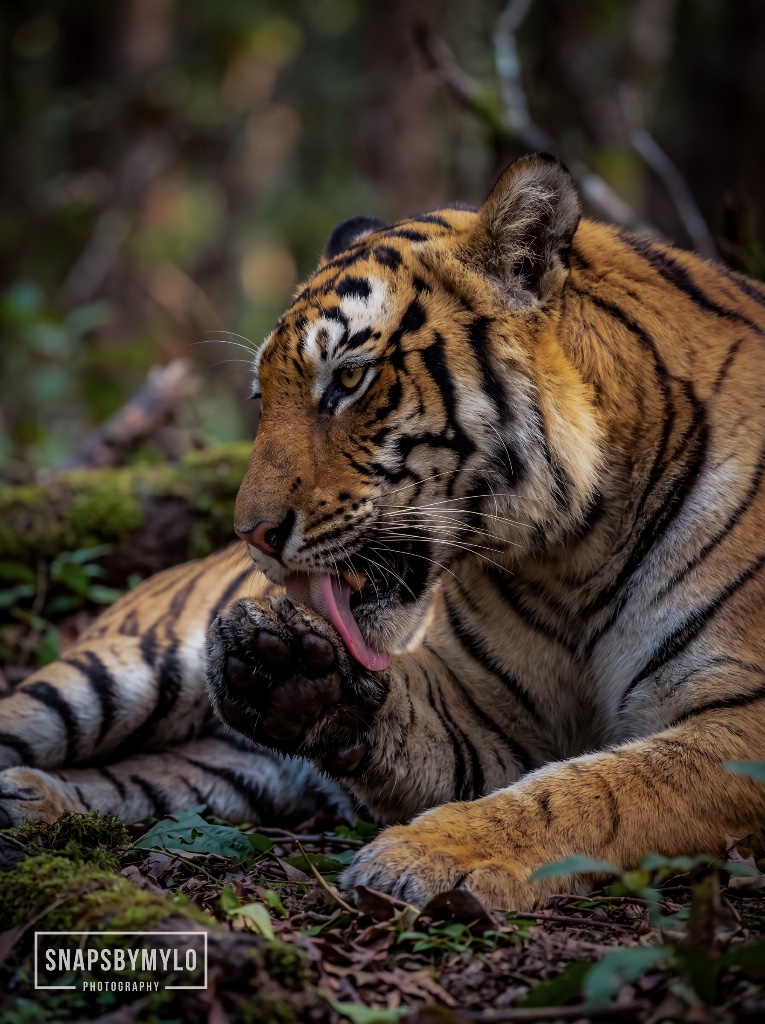
The Yawn Transition
Look for: Jaws at full extension, tongue curled, canines exposed. Frame tight enough that the interior of the mouth, the whisker pads, and the eye all register.
Why it works: Biologically familiar but visually extreme. A yawn at full stretch is both intimate and alarming — the viewer is simultaneously close to the animal's face and aware of exactly what those teeth are capable of. The contrast is what makes it land.
Moments Worth Waiting For
- —The head lift after a long rest — eyes opening, ears rotating, the first scan of the treeline — a moment of pure readjustment that lasts less than four seconds
- —Full eye contact held for more than a single glance — when the tiger decides to look directly at you and does not look away
- —The full yawn mid-transition from sleep to alertness, canines exposed, tongue curled to the roof of the mouth
- —A tiger entering water — the first step in, the hesitation, the body lowering as confidence builds
- —The scent mark pause at a territory boundary tree — tail raised, body still, face angled forward with total calm authority
- —A rear stretch after rising — front paws extended forward, back arched, face pressed toward the ground in a full spine extension
- —The slow tail sweep during an alert — when something at the edge of the frame has the animal's attention and the tail begins its deliberate arc
- —A cub-and-mother interaction — a cub attempting to engage a resting female, the female's ear pinning back before she shifts position
- —Rain-light on the coat — when cloud breaks and soft diffused light hits wet fur, the orange and black suddenly luminous against dark forest
- —The walk into open ground — the moment a tiger moves from treeline shadow into a clearing and the full body is briefly, completely visible
Field Notes
What I noticed
She had been lying in the dry leaves for close to forty minutes before the ear moved. Not a big movement — just a single rotation, the left ear tracking something behind me in the forest. The head stayed flat on the ground. The eyes stayed closed. But that ear told me she was entirely present. I stopped moving and waited. Within two minutes the head came up, turned to the left, and held there — profile perfectly lit by the low morning light coming through the sal trees. The amber of her eye caught it completely.
What I waited for
I wanted the head fully turned — not three-quarters, not slightly angled, but the complete profile with one eye fully visible and the ear angled forward. That specific geometry took another six minutes after the head first lifted. She looked left, looked forward, looked right, and then settled into the left profile again for about eight seconds. That was the window. I had pre-composed the frame for exactly that position while I was waiting.
What I ignored
There were two safari vehicles behind me that had arrived late and positioned badly — one was slightly in my sightline if I moved right, one had an engine running. I ignored both entirely. I had already found the background I wanted — a wall of warm-shadowed forest that fell clean behind her head — and I was not moving from that position regardless of what happened around me. Chasing a cleaner angle would have meant movement, and movement would have ended the moment.
What created the strongest image
The leaf litter. She was lying in deep, dry brown leaves that filled the entire lower frame — the same warm tones as her coat, so the boundary between tiger and forest floor was almost soft. It felt like she had grown from the ground. Combined with the profile turn and those alert eyes, the image stopped being a photograph of an animal and became something closer to a portrait of a place that still has apex predators in it.
Conservation Insight
Fewer than 4,000 tigers remain across all range states combined. Habitat fragmentation, prey depletion, and retaliatory killing remain the primary pressures — not poaching alone. The forest corridors that allow tigers to move between protected areas are disappearing to agriculture and infrastructure. Photographing a tiger is not a neutral act. Every image carries potential weight as conservation evidence, as public empathy, as reason to fund protection. Photograph with that awareness. The forests that hold tigers hold everything else too.
Instagram Feed Cover
Photographs of Tiger
Fine art prints available in limited and open editions.