Photographing White Lion
Introduction
There is nothing ordinary about watching a White Lion hold its ground. The coat alone — that layered cream, almost ghostly against red earth or dry grass — stops you before you even think about composing a frame. But what makes them genuinely rewarding to photograph is not their colour. It is the contradiction they carry. Something ancient and unhurried in the way they move. Eyes that seem to register you before you register them. To photograph a White Lion well, you have to stop chasing the obvious and start reading the animal. The image in your head when you arrive will never be as good as the one the lion decides to give you.
Understand the Animal
White Lions are not a separate species. They are colour morphs of the African lion, carrying a rare recessive gene that suppresses eumelanin pigmentation. But in the field, what matters is not their genetics — it is their behaviour, and that behaviour is unmistakably lion. They are predominantly crepuscular, most active in the low-light hours around dawn and dusk. During peak heat, they rest for stretches that can last four to six hours. This is not dead time for a photographer. This is observation time. Watch how they rest. Note which direction the head is pointing. A lion resting with its chin on its paws, eyes half-closed, is settling in. A lion resting with its head raised, ears angled forward, is processing something. There is a difference, and you need to learn it. Body language is your early warning system. A tail that begins to flick with low, deliberate sweeps signals a shift in attention or mood — something has caught their focus. The ears are equally expressive. Ears rotated sideways and pressed slightly back often precede a territorial vocalisation or a direct challenge. Ears fully forward, with the gaze locked ahead, means the lion is tracking. That is your cue to prepare. In a pride dynamic, the White Lion's colouration creates a visible hierarchy of attention. Other pride members and prey alike seem to track the white individual more readily. Watch how the pride positions the white lion — often centrally during rest, sometimes forward during a stalk, depending on individual personality and pride structure. Feeding behaviour follows a clear sequence you can learn to read. Lions rarely charge without a period of low, flattened movement first. Watch for the body to drop, the shoulder blades to rise, and the pace to slow while the gaze locks. That compressed posture is the tell. If you are already watching for it, you will never miss the moment it breaks. Vocalisations matter too. A roar sequence often ends with a long, drawn exhale — almost a groan — and in that final breath, the head typically drops and the eyes close briefly. That is one of the most underestimated photographic moments on the savanna.
Look Before You Shoot
Before you raise anything to your eye, spend time simply looking. Not scanning for a frame. Looking at the scene in its entirety — what is behind the animal, what is between you and the animal, where the light is falling, and where it will fall in twenty minutes. With White Lions specifically, background matters enormously. The pale coat is generous — it contrasts well against dark earth after rain, against the amber tones of dry grass, and powerfully against deep shadow. But it disappears against pale sky, washed-out sand, or overexposed vegetation. Before you settle on a position, identify what is behind the animal and decide whether it is working for you or against you. Then move accordingly. Small lateral adjustments — a few metres left or right — can entirely change a background without disturbing the animal. Light direction shapes everything. Side-light rakes across the texture of the mane and separates the animal from its environment with depth and dimension. Flat front-on light flattens the coat and loses that sculpted quality. With White Lions, overcast light can be extraordinary — it reduces harsh shadows, saturates the blue in the eyes, and renders the cream coat with a luminous quality that direct sun can actually overpower. Positioning low emphasises scale and creates a connection between the lion and the ground it occupies. A high position looking down reduces the lion to a subject in a landscape. Neither is wrong — but they tell different stories. Decide which story you are in. Then wait. The single most disciplined act in wildlife photography is choosing not to react the moment something starts to happen. Let the moment develop before you commit to it. The lion that just stood up is probably going to stretch. The lion staring into mid-distance is probably about to vocalise or move. Give the moment room to become what it is trying to become.
Composition Ideas
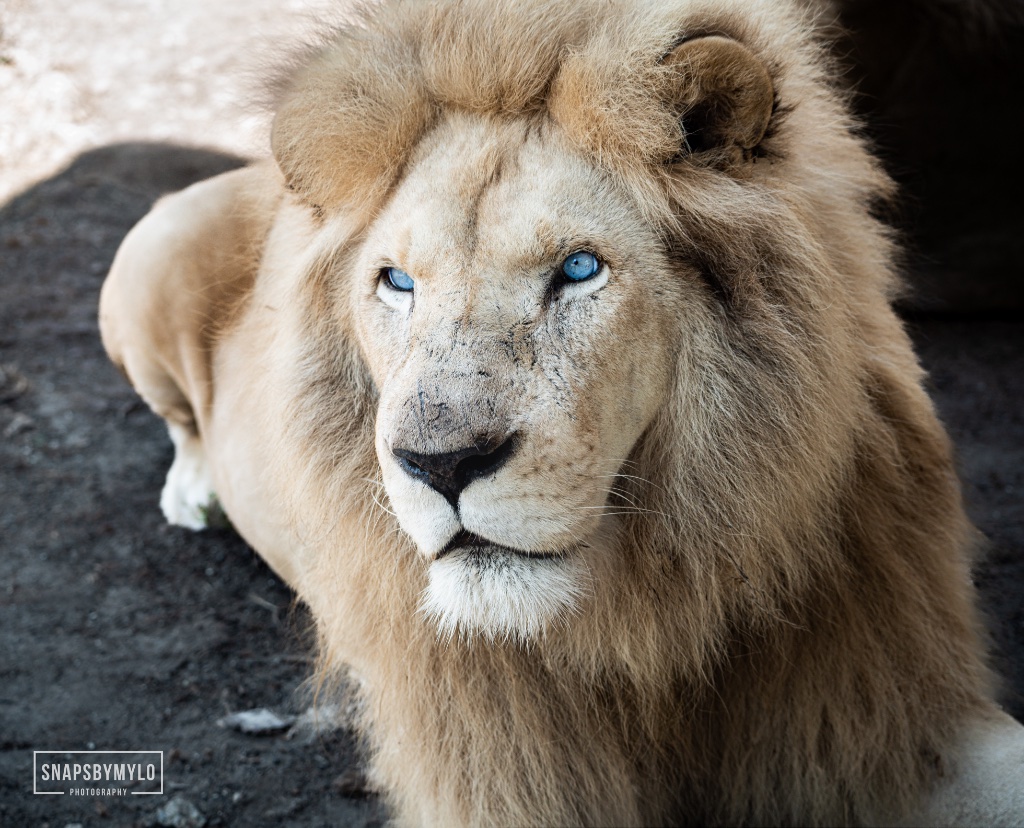
The Eyes Alone
Look for: A moment of full, direct eye contact with the lion's gaze locked at your level. Blue eyes against the pale face, ideally with a catch-light — a small specular reflection of open sky in the iris.
Why it works: The blue eyes of a White Lion are the visual anchor of any portrait. They are rare enough that the eye of the viewer goes there immediately. When that eye contact is direct and unblinking, it creates an intimacy that transcends distance. The catch-light transforms an eye from a flat surface into something alive.
Coat Against Dark Earth
Look for: The lion positioned against red-brown soil, dark clay after rain, or deep shadow. The cream-white coat should occupy a significant portion of the frame against the contrasting tone beneath or behind it.
Why it works: White Lions were not designed to disappear — and leaning into that contrast rather than fighting it produces images of genuine graphic power. The tonal opposition between the coat and earth is naturally striking and requires no embellishment.
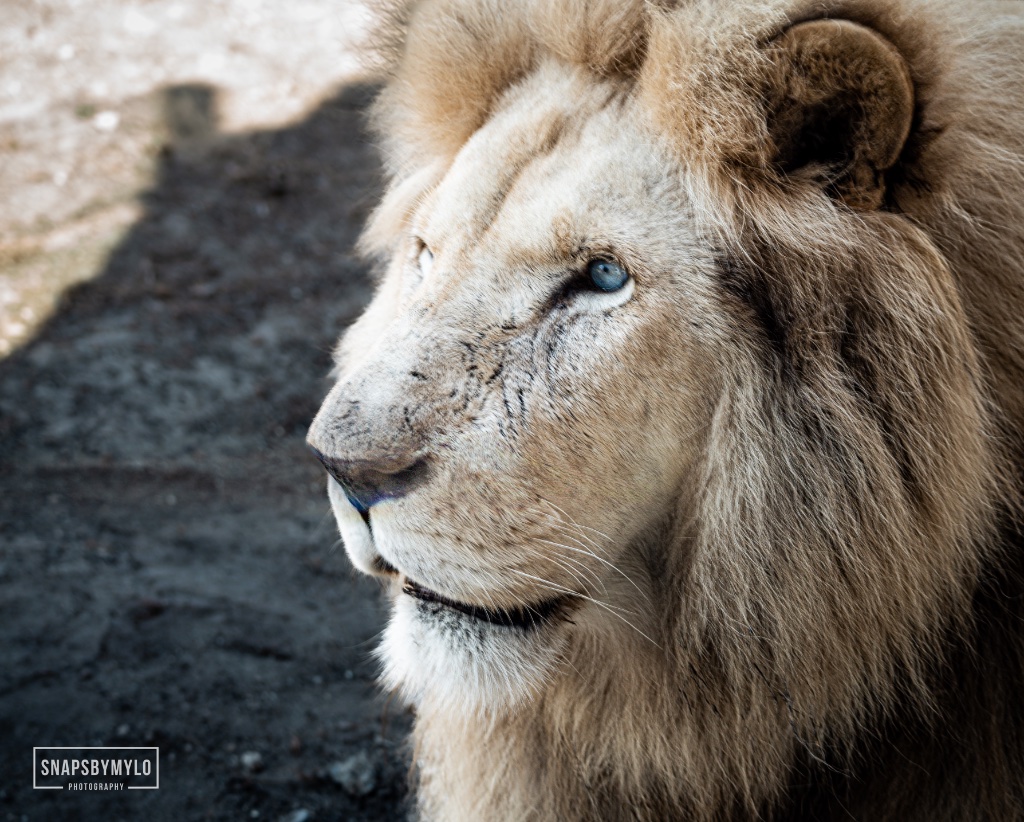
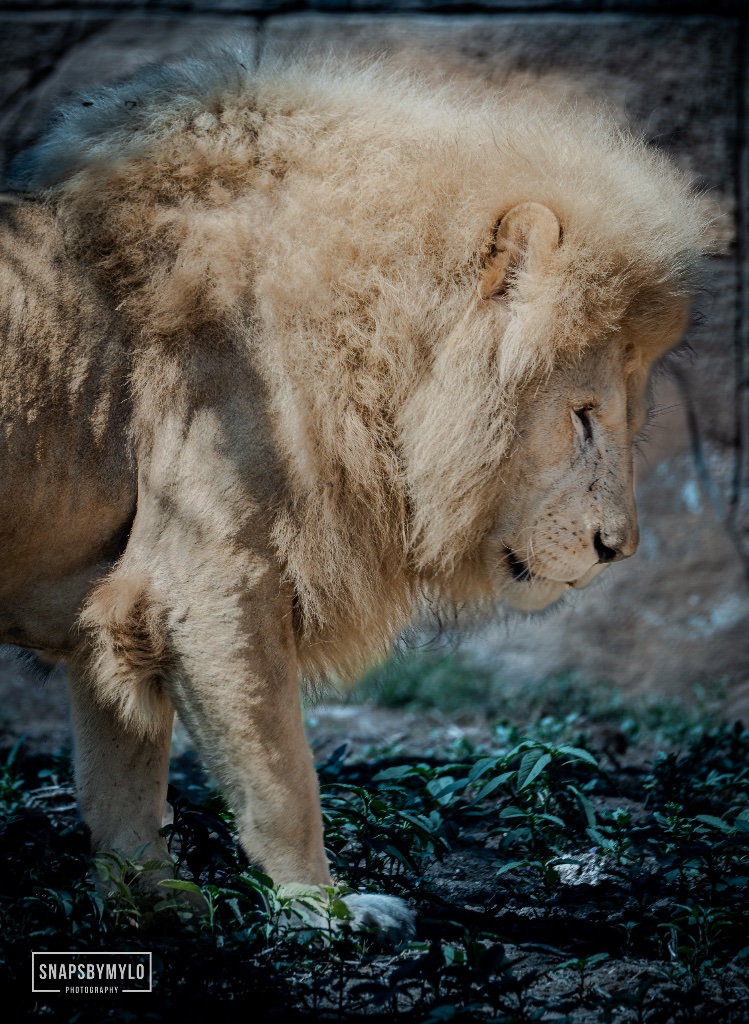
The Mane in Profile
Look for: A male turned in three-quarter or full profile, with side-light raking across the texture and layering of the mane. Look for individual hairs catching light separately.
Why it works: The White Lion's mane, particularly as it develops in younger males, transitions through cream, tawny, and amber tones. In profile with strong directional light, this texture and tonal range is fully revealed. A flat-on portrait compresses all of that into nothing.
Stillness and Space
Look for: The lion at rest — chin on paws, body low and settled — with deliberate negative space left in front of the animal's gaze. Let the emptiness of the frame hold weight.
Why it works: Empty space in the direction a lion is looking creates narrative tension. The viewer's eye follows the gaze into that space and wonders what the lion is watching. It transforms a resting shot into something contemplative and unresolved.
Pride Geometry
Look for: Multiple lions in frame, with the White Lion naturally distinguishable from the group. Look for overlapping bodies, repeated shapes, or a composition where the white coat anchors the frame while tawny forms surround it.
Why it works: The White Lion's colour mutation means it reads differently within its own pride. Used compositionally, this natural contrast becomes a story about belonging — the same but visibly distinct. It is a photograph that holds more questions than it answers.
The Environmental Portrait
Look for: The lion occupying a small portion of the frame — perhaps one-third or less — with the landscape it inhabits telling the wider story. Dry grass, open pan, termite mound, or treeline completing the scene.
Why it works: The White Lion does not need to fill a frame to dominate one. Pulling back and giving the animal context forces the viewer to understand what the animal is actually navigating — the scale of the environment becomes part of the subject.
Vocalisation Freeze
Look for: The open-mouthed, teeth-exposed freeze-frame during a roar, yawn, or growl. Look specifically for the moment the mouth is at maximum open and the eyes are still engaged rather than closed.
Why it works: Sound made visible. The anatomy of a roaring lion — the flared muzzle, the exposed canines, the vibrating throat — is primal and visually arresting. The White Lion's pale face and teeth render this moment with particular graphic clarity against darker surroundings.
Low Light and Long Shadow
Look for: The lion moving or standing in the final fifteen minutes of evening light, when the shadow cast by the body stretches long across the ground and the coat picks up amber and gold tones it never holds in direct midday sun.
Why it works: White Lions carry colour in low light the way they carry none in high sun. The warm spectrum of dusk saturates the coat from clinical white into layered gold, and the long shadow anchors the animal to the earth with physical weight.
Grooming or Tenderness
Look for: A White Lion being groomed by, or grooming, another pride member. Head-rubbing, licking across the mane, or a cub pressed against the flank.
Why it works: Behavioural connection between animals is consistently more compelling than any single portrait. The White Lion in a moment of social tenderness dismantles every expectation the viewer carried into the image. It is familiar in an unfamiliar subject.
The Walk Toward
Look for: The lion walking directly toward your position — not charging, not stalking, but covering ground with unhurried intent. Frame loosely, keep space in front of the animal.
Why it works: A lion approaching your position at walking pace is one of the most compositionally alive moments available. The reduction of distance in real-time creates energy within the frame. The White Lion's gaze — those blue eyes fixed forward — becomes more intense with every step it closes.
Moments Worth Waiting For
- —Direct, unblinking eye contact at low angle — the moment the lion registers you and holds the gaze rather than dismissing it
- —The full stretch immediately after rising from a long rest — spine extended, chin dropped, shoulders rolled forward
- —The roar sequence reaching its final exhaled groan, with the head dropping and the mane settling forward over the chest
- —A cub or younger pride member approaching the White Lion and initiating contact — head-butt, muzzle touch, or nursing posture
- —The flattened pre-stalk compression — body lowering, shoulder blades rising, pace slowing to near silence before a movement break
- —The White Lion drinking at water, with the reflection of the coat visible in the surface below
- —A yawn mid-rest that fully exposes the dentition — ideally with a sideways glance rather than eyes fully closed
- —Rain on the coat — the way water beads and tracks through the mane changes the texture and tone of the animal entirely
- —Two lions in a head-rub greeting, manes pressing together, one of which is the white individual — the tonal contrast in a single frame
- —The lion scent-marking — low walk along a boundary, pausing at a point, tail raised — a rare behavioural sequence that most visitors overlook entirely
Field Notes
What I noticed
The eyes hold the most information before the body moves. Every significant shift — standing, vocalising, alerting — was telegraphed first in the eyes. The pupils would sharpen, the gaze would fix, and the body would follow two to four seconds later. Once I stopped watching the body and started watching the eyes, I stopped being late.
What I waited for
I wanted the eye contact. Specifically, a moment where the blue of the iris was lit without the rest of the face being blown out — that balance only existed in a narrow window of overcast or angled light. I sat with that animal for nearly ninety minutes waiting for it to turn and hold its gaze at my level. When it happened, it lasted perhaps four seconds.
What I ignored
The midday hours entirely. When the light went flat and the animals went horizontal, I used that time to reposition and study the background options available to me. I chose not to photograph at all between roughly ten and three. Nothing I would have taken in that window would have been worth the compromise.
What created the strongest image
The contrast between the cream coat and the dark earth it was resting against, combined with that direct eye contact. But more than the visual elements — it was the stillness. The lion was not performing anything. It was simply occupying the earth with complete certainty. That quality of presence cannot be manufactured. You have to wait for the animal to produce it on its own terms.
Conservation Insight
White Lions exist today in critically low numbers outside managed environments. Their range is effectively restricted to the Greater Timbavati region of South Africa, where the recessive gene has persisted in isolated populations. Trophy hunting, habitat fragmentation, and illegal capture for captive breeding programs continue to threaten the gene pool. They are not separately listed as endangered because they are classified within Panthera leo — but their genetic uniqueness, and their cultural significance to indigenous Sepedi and Tsonga communities, demands specific attention. Photographing them responsibly means supporting the reserves and organisations actively working to protect both the animal and its wild range.
Instagram Feed Cover
Photographs of White Lion
Fine art prints available in limited and open editions.