Photographing White Pelican
Introduction
White Pelicans reward patience in a way few birds do. They move slowly, rest long, and when they do act — they do so with a kind of deliberate weight that gives you time to read what's coming. That quality is rare. Most birds don't offer you that window. These birds do. What makes them visually extraordinary isn't size alone — it's the contrast they carry with them: chalk-white plumage against dark water, the orange-gold of a bill catching low light, the architectural stillness of a bird in full preening mode. If you understand how they spend their time and what drives their behaviour, you stop chasing and start anticipating. That's where the real photographs live.
Understand the Animal
White Pelicans are deeply communal birds, and that social structure is your first and most important tool as an observer. They rarely do anything alone. When one bird begins preening, watch the birds around it — grooming behaviour often ripples through a resting group within minutes. When one lifts its head sharply, scan the water. Something triggered it, and the rest of the group will follow that cue within seconds. At rest, White Pelicans cycle through a predictable rhythm: alert scanning, head-tucking, preening, and then brief periods of almost total stillness where the bill drops to the chest and the eyes half-close. This tucked-bill posture — exactly what you see in a preening bird against its own chest — is one of the most graphically strong moments they offer, because it compresses the bird's form into a dense, sculptural shape that reads beautifully against a simple background. Feeding behaviour is something else entirely. White Pelicans don't dive like Brown Pelicans — they herd. On open water, a cooperative feeding group will form a loose crescent or line, driving fish toward shallower zones before scooping in unison. Watch for the head-lowering signal: when birds begin dipping their bills rhythmically at the surface, cooperative feeding is imminent. Position yourself before it starts. Bill movement tells you a great deal. A bird rapidly snapping its pouch — the gular flutter — is thermoregulating, not feeding. It signals the bird is hot and sedentary, which usually means it won't move for a while. That's your window for tight compositional work. Conversely, a bird that begins rolling its shoulders, extending its neck long and low, or lifting its wings slightly off its body is about to move — either to launch into flight or shift position on a log or rock. Wing stretching deserves special attention. White Pelicans stretch one wing at a time with a deliberate, slow extension that holds for two to four seconds. If you've seen a bird shift its weight to one side and begin to lower its opposite shoulder, you have roughly three seconds before that wing opens. Be ready. The moment is brief but the graphic it creates — one massive white wing fanned against sky or water — is among the strongest frames this bird offers.
Look Before You Shoot
Before you raise anything to your eye, spend time just watching. Sit with the scene. White Pelicans on a log or rocky outcrop create a layered social tableau, and the temptation is to shoot immediately. Resist it. The first frame is almost never the best frame. Start by reading the light. Golden-hour backlight on white plumage does something unusual — it warms the creamy tones, lifts the texture of individual feathers along the back and wing edges, and turns what would be a flat white bird into something with real depth and dimension. That quality changes fast. Know where the light is falling before you even approach the scene. Background is everything with a white bird. Dark water behind a white pelican is a gift — it creates instant tonal separation and pulls the subject clean from its environment. A bright or cluttered background collapses that separation and costs you the image. Move laterally, not forward. Your angle of approach matters far more than your distance. A slower, wider arc around a resting group will show you which backgrounds open up as you shift position — without disturbing the birds. Think about what you're including, not just what you're pointing at. A single bird on a clean dark log with still water beneath it is a fundamentally different photograph from that same bird surrounded by a dozen others. Both are valid. But decide which story you're telling before you commit to a position. Wait for the light to find the eye. A bird in full preening pose with its bill buried in chest feathers is graphically strong, but the moment it lifts its head and the amber eye catches the warm light — that's the frame. Learn to watch for the head-lift, and be ready before it happens.
Composition Ideas
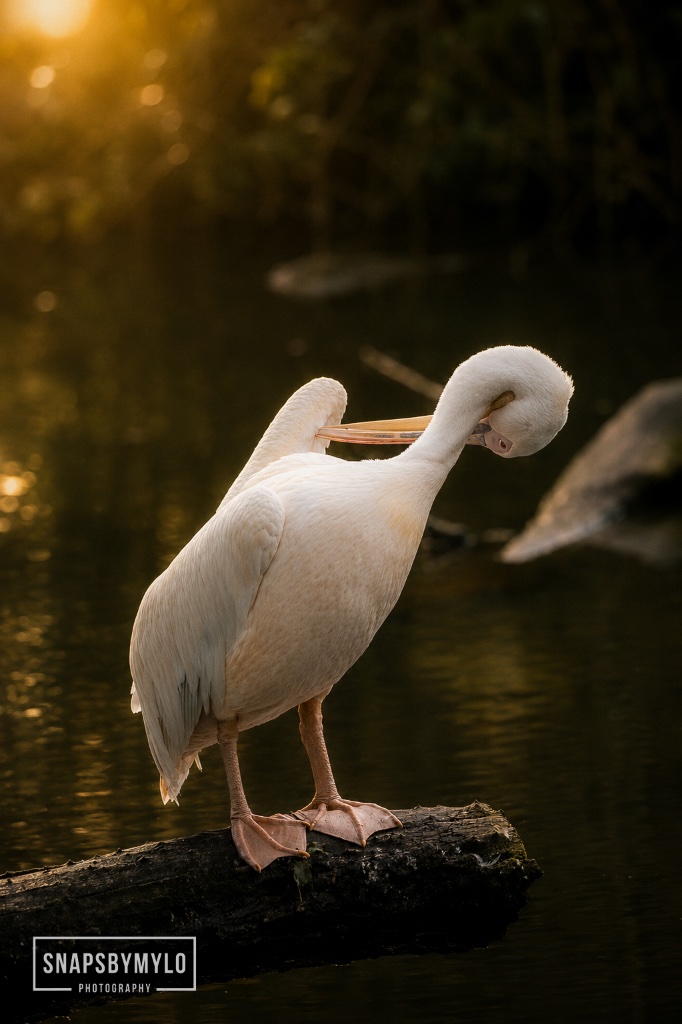
Bill-to-Chest Preening Form
Look for: A bird with its bill tucked fully against its chest, body rounded, neck compressed. Look for even, consistent background — ideally dark water or shadow.
Why it works: The bird becomes an almost abstract shape: a dense white oval with an orange-tipped suggestion of bill. The compressed form reads as pure graphic weight against a simple background. Negative space does the rest.
The Single Wing Stretch
Look for: A bird beginning to shift its weight to one side and lower one shoulder. Watch for this cue and anticipate the extension before it opens.
Why it works: One fully extended white wing against dark water or open sky creates a diagonal that breaks the otherwise static quality of a resting bird. It's momentary and therefore earned.
Reflections on Still Water
Look for: Birds resting at water's edge, preferably with undisturbed water directly below. Early morning, before wind picks up, offers the cleanest mirror surface.
Why it works: The reflection doubles the bird's graphic presence and introduces symmetry. Combined with the white-on-dark tonal contrast, a pelican and its reflection become a complete, self-contained composition.
Group Feeding Line
Look for: Multiple birds moving in a loose coordinated line across shallow water, bills angled toward the surface, necks beginning to dip in sequence.
Why it works: The repetition of form — identical postures, rhythmic spacing — creates a natural compositional rhythm. Leading lines formed by the birds' bodies draw the eye through the frame.
Backlit Plumage Texture
Look for: A bird positioned so that low-angle light rakes across its back and folded wings from behind. Individual feather edges will glow with a warm rim.
Why it works: Backlight reveals texture that flat light destroys. The creamy warmth of the feathers against the darker surrounding environment gives the image both luminosity and dimensionality.
The Eye in Profile
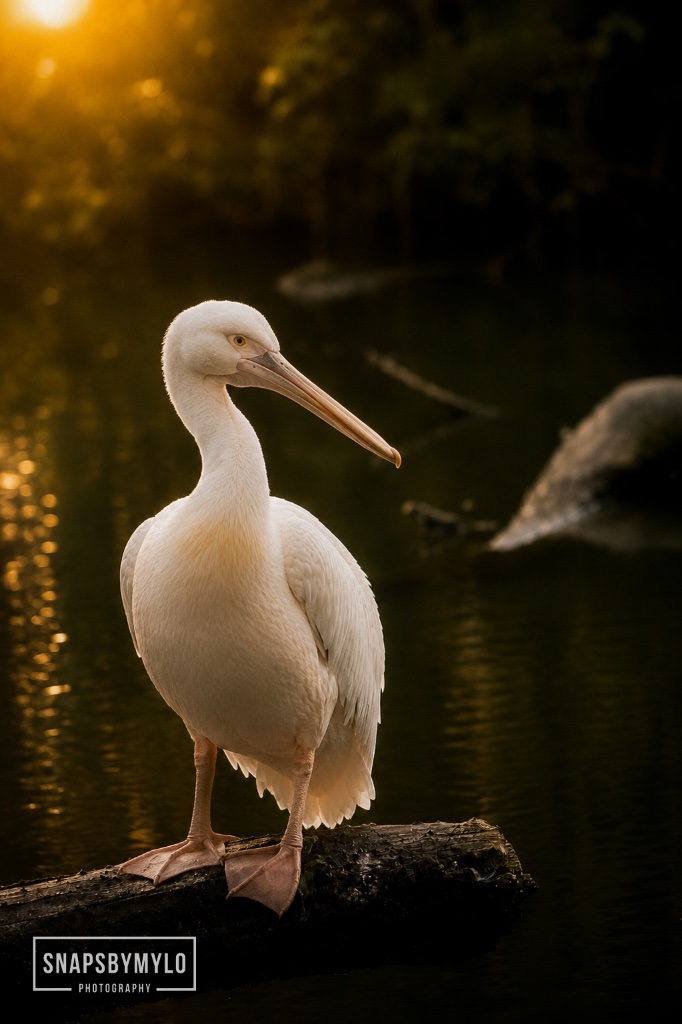
Look for: A bird in clean profile with its amber eye visible and illuminated. Wait for the head to lift after preening, when the eye often catches directional light.
Why it works: The amber iris against white feathering is a striking colour pairing. A lit eye in profile anchors the entire image and gives the viewer something to connect with — it's the single most humanising element the bird offers.
Isolation Within the Colony
Look for: One bird slightly separated from a resting group — on the end of a log, ahead of the pack on a sandbar — with cleaner negative space around it.
Why it works: Isolation within a social species creates tension. The viewer reads the bird as individual rather than anonymous. The surrounding group becomes context, not clutter.
Bill Pouch Detail
Look for: A bird with its gular pouch distended and visible — either in the process of a catch, during thermoregulation flutter, or at rest with the pouch relaxed and hanging.
Why it works: The orange and yellow tones of the pouch against white plumage are uncommon in nature. Filling the frame with this detail creates an intimate portrait that reveals something most viewers have never examined closely.
Landing Approach on Water
Look for: A bird in final approach — wings fully arched back, feet dropped, neck pulled in, water surface approaching beneath. Watch the sky for incoming birds above resting groups.
Why it works: The landing posture is angular, dynamic, and brief. The contrast between the tension of the wings and the calm of the approaching water creates visual drama without requiring anything other than the moment itself.
Wet Log and Shadow Anchoring
Look for: A bird perched on a dark, wet log or rock with the surface texture visible below the bird's feet. Shadow falling beneath the bird ties it to its perch.
Why it works: A bird that appears to float on a bright background lacks weight. Dark, wet surfaces ground the subject visually. The tonal contrast between white bird and dark wet wood is one of the cleanest natural pairings this species provides.
Moments Worth Waiting For
- —The full preening tuck — bill buried completely in chest feathers, body rounded into stillness — held for five or more seconds with directional light on the back
- —The head-lift after preening, when the amber eye first becomes visible and catches warm light
- —A single wing extended in full stretch, held against open sky or dark water
- —Two birds engaging in bill sparring or displacement behaviour on a shared log — brief, direct, and full of energy
- —Cooperative feeding formation: multiple birds moving as one, bills angling toward the surface in near-simultaneous rhythm
- —A bird in landing approach — wings back, feet forward, water surface approaching — caught in the final two seconds before touchdown
- —A long, slow yawn that opens the bill wide, showing the full interior of the pouch in warm light
- —The moment a bird on a wet log shakes water from its plumage — a quick, full-body shudder that briefly scrambles every feather before they resettle
- —A bird standing at the edge of a log, looking directly toward you, eye level, in clean profile against dark water
- —Two birds resting side by side, bills both tucked, reflected cleanly in still water below — the mirrored symmetry framing itself
Field Notes
What I noticed
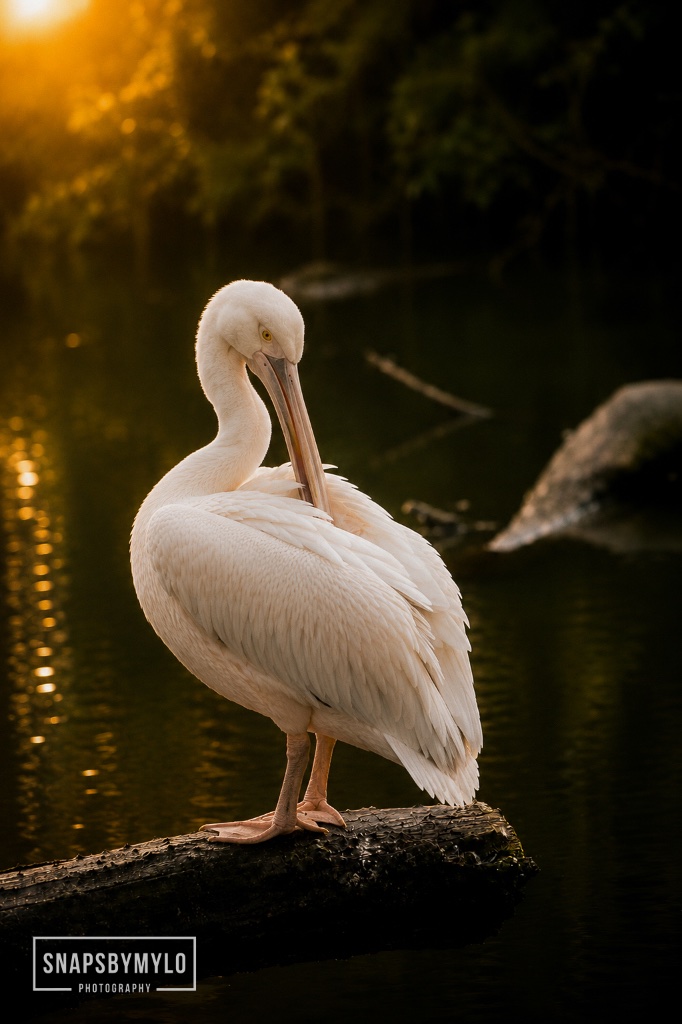
The light at golden hour didn't flatten this bird — it warmed it. The creamy undertones in the plumage came forward in a way they simply don't under midday light. The wet log was doing something important too: its dark, reflective surface was separating the bird from everything below it, creating a natural tonal border that no amount of repositioning could have manufactured. I also noticed how still the bird was. This wasn't a nervous animal. It had been on that log long enough to settle fully into preening, which told me I had a real window — not just a moment.
What I waited for
I waited for the bill-tuck. The bird had been active — grooming its wing, shifting its weight — and I could see it cycling toward a resting posture. When the bill finally came down against the chest and the neck shortened, I had the shape I came for. I also waited for the light to clear a thin band of cloud that had been softening the backlight. When it cleared, the rim light on the back feathers came alive. That was the frame.
What I ignored
I ignored two other birds that were more active on the far end of the log. They were doing more — moving, interacting — but the background behind them was broken and bright. The still bird on the near end had everything: form, light, and a clean dark background. Activity isn't always the story worth telling.
What created the strongest image
The combination of the compressed preening posture — which simplified the bird into a strong graphic shape — with the backlight creating warmth and feather texture, set against the dark wet wood and still dark water behind. None of those elements were arranged. They were found, read, and waited for. The photograph didn't happen because I moved closer. It happened because I stayed still long enough for the scene to complete itself.
Conservation Insight
White Pelicans are sensitive to human disturbance at nesting colonies, where even brief intrusions can cause nest abandonment at scale. Breeding populations face ongoing pressure from wetland drainage, water diversion, and fluctuating fish availability tied to drought and agricultural use. While North American populations have shown recovery in recent decades thanks to protections, colony sites remain vulnerable. Photographing these birds responsibly — from distance, without flushing or repositioning a subject — is not a courtesy. It's a commitment to the bird's welfare over the image. The strongest photographs are made by people who know when to stop approaching.
Instagram Feed Cover
Photographs of White Pelican
Fine art prints available in limited and open editions.